
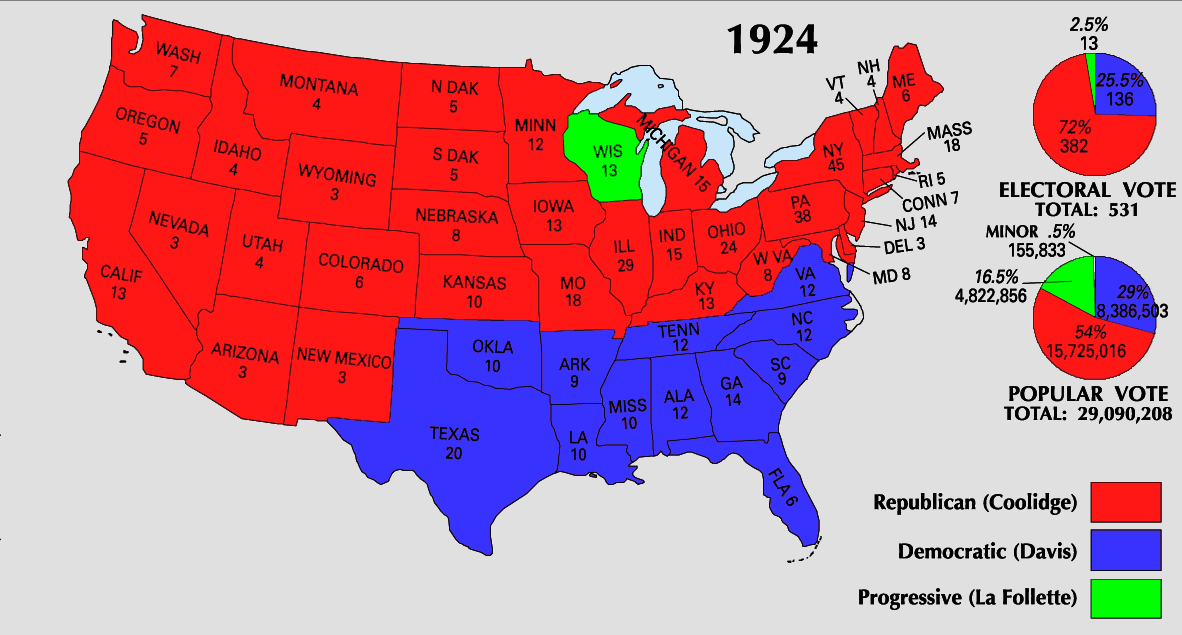
The map above shows the result of the 1924 US presidential election between Calvin Coolidge, John W. Davis and Robert M. La Follette. Turnout for the election was 48.90%.
Here are the key details:
| Winner: | Runner-Up: | |
|---|---|---|
| Name: | Calvin Coolidge | John W. Davis |
| Political Party: | Republican | Democratic |
| Home state: | Massachusetts | West Virginia |
| VP Name: | Charles G. Dawes | Charles W. Bryan |
| States: Won (Out of 48): | 35 | 12 |
| Electoral College Votes (out of 531): | 382 | 136 |
| Percentage of Popular Vote | 54.04% | 28.80% |
| Total Votes | 15,723,789 | 8,386,242 |
| Margin % | 25.22% | – |
| Margin (votes) | 7,337,547 | – |
| 3rd Place | 4th Place: | |
|---|---|---|
| Name: | Robert M. La Follette | Herman P. Faris |
| Political Party | Progressive-Socialist-Farmer–Labor | Prohibition |
| Electoral College Votes | 13 | 0 |
| Number of Votes: | 4,831,706 | 55,951 |
| Percentage of Popular Vote: | 16.60% | 0.19% |
Key Issues in the 1924 Election:
Here are the main issues and where each candidate stood on them:
1. Calvin Coolidge (Republican)
- Economic Policy: Coolidge was a strong advocate of laissez-faire economics. He supported limited government intervention in the economy, tax cuts, and reduced federal spending. Coolidge famously said, “The business of America is business.” He believed in fostering a pro-business environment, which included opposing high taxes and regulations.
- Labor and Agriculture: Coolidge was opposed to government intervention in the labor market and agriculture. He vetoed the McNary-Haugen Farm Relief Bill, which aimed to support struggling farmers by stabilizing agricultural prices. He also broke the 1919 Boston Police Strike when he was governor of Massachusetts, positioning himself as tough on labor unrest.
- Foreign Policy: Coolidge continued the isolationist stance typical of post-World War I America, with an emphasis on maintaining peace through diplomacy rather than involvement in European conflicts. His administration participated in the Washington Naval Conference, promoting naval disarmament to prevent future wars.
- Social Issues: Coolidge was generally conservative on social issues, supporting the status quo. His administration did not actively push for civil rights for African Americans or make moves to challenge segregation.
2. John W. Davis (Democrat)
- Economic Policy: Davis’ platform was quite similar to Coolidge’s in terms of support for limited government and conservative economic policies. He supported states’ rights and believed in a smaller federal role in business and economic affairs, making him somewhat indistinguishable from Coolidge on these issues.
- Labor and Agriculture: Davis did not support radical reforms for labor or farmers. He, like Coolidge, was opposed to the McNary-Haugen bill. His stance on labor unions was cautious, and he favored policies that did not strongly side with either labor or management.
- Foreign Policy: Davis was also generally isolationist but favored maintaining strong diplomatic ties, particularly in Latin America. He supported maintaining peace through international cooperation but without binding the U.S. to military alliances or foreign interventions.
- Social Issues: A native of West Virginia, Davis was more conservative on race and civil rights issues, reflecting the Democratic Party’s southern base at the time. He did not advocate for federal anti-lynching laws or aggressive civil rights reforms, positions that would have alienated southern Democrats.
3. Robert M. La Follette (Progressive)
- Economic Policy: La Follette championed progressive reforms and was a vocal critic of big business and monopolies. He advocated for stronger government regulation of industries like railroads and utilities and supported progressive taxation, including higher taxes on the wealthy and corporations.
- Labor and Agriculture: La Follette had the strongest support among labor unions and farmers. He called for labor rights, including collective bargaining and protections for workers, and supported government programs to help struggling farmers. His Progressive platform backed the McNary-Haugen bill and other forms of federal agricultural aid.
- Foreign Policy: La Follette opposed U.S. imperialism and military intervention abroad. He was a critic of World War I and was wary of postwar entanglements. While he supported international cooperation, he was more focused on domestic reforms and protecting American sovereignty.
- Social Issues: La Follette was more progressive on civil rights than either Coolidge or Davis. He opposed racial discrimination and was supported by some African American voters and civil rights activists. His platform included support for civil liberties and reforms to protect minorities from discrimination.
Why did Coolidge win?
Here’s a breakdown of why and how Coolidge won:
1. Popularity and Incumbency
Incumbent Advantage: As the sitting president, Coolidge had the advantage of incumbency. He had assumed the presidency in 1923 after the death of President Warren G. Harding and benefited from the “halo effect” of being seen as a steady, competent leader in the wake of scandals that had plagued the Harding administration (such as the Teapot Dome scandal).
“Silent Cal” Image: Coolidge’s calm, no-nonsense persona was appealing to many Americans. His nickname, “Silent Cal,” underscored his reputation for being a man of few words but strong principles. In a time of post-war uncertainty and economic recovery, this image of stability resonated with voters.
2. Strong Economy
Roaring Twenties Prosperity: The U.S. was experiencing an economic boom during the 1920s, commonly referred to as the Roaring Twenties. This period was characterized by strong industrial growth, rising consumerism, and technological advancements (like automobiles and radios).
Coolidge’s policies of low taxes and limited government intervention in the economy were popular with the business community and the growing middle class.
Business Confidence: Coolidge’s pro-business policies, which included tax cuts and a focus on reducing government debt, contributed to economic growth. Many voters associated his administration with the prosperity of the time, and the slogan “Keep Cool with Coolidge” effectively captured this sentiment.
3. Weak and Divided Opposition
Democratic Weakness: The Democratic Party was deeply divided in 1924, struggling to unite behind a candidate. It took 103 ballots at the Democratic National Convention before they finally nominated John W. Davis, a little-known conservative lawyer from West Virginia.
Davis was considered a compromise candidate, and his platform was not distinct enough from Coolidge’s to galvanize the electorate. This made it hard for Davis to build momentum.
Progressive Challenge: Robert M. La Follette ran as a third-party candidate under the Progressive Party banner, and while he attracted a significant number of votes (especially from labor unions and farmers), he split the opposition.
La Follette’s platform of government regulation, anti-monopoly policies, and support for labor reform resonated with the left, but the presence of a third major candidate hurt the Democrats more than the Republicans.
Regional Appeal: Davis primarily had support in the South, where the Democratic Party was traditionally strong, but he struggled to gain traction in other parts of the country. La Follette, meanwhile, was popular in the Midwest and some parts of the West, but his appeal was limited outside of those regions.
4. Campaign Strategy
Non-Campaign Approach: Coolidge largely adopted a “front porch” campaign style, similar to earlier Republican presidents like William McKinley. He did not actively campaign across the country, preferring to let his actions as president speak for themselves.
His political allies and surrogates carried the message for him. This low-key approach reinforced his image as a calm and dependable leader, contrasting with the sometimes chaotic campaigns of his opponents.
Republican Unity: The Republican Party was much more unified than the Democrats or Progressives in 1924. Coolidge’s policies were widely supported within the party, and there were no significant rifts that could weaken his base. The party also had strong organizational and financial resources, which they effectively deployed during the campaign.
5. Electoral Results
Electoral College: Coolidge won in a landslide victory, securing 382 electoral votes out of 531. He won most of the Northern and Western states, where the Republican Party had traditionally been strong.
Popular Vote: Coolidge received 54% of the popular vote, a decisive majority. Davis, the Democratic candidate, won about 29% of the vote, and La Follette, running on the Progressive ticket, won around 16%.
Fragmented Opposition: La Follette’s strong performance in some states, especially in the Midwest (he won his home state of Wisconsin), siphoned votes away from Davis, but not enough to seriously challenge Coolidge. The split opposition helped Coolidge secure a larger share of the vote, as neither Davis nor La Follette could consolidate enough support to pose a serious threat.
1924 Election Results Map By County

1924 Map From The National Atlas of the United States (now sadly permanently offline)
Other US Presidential Election Maps: