
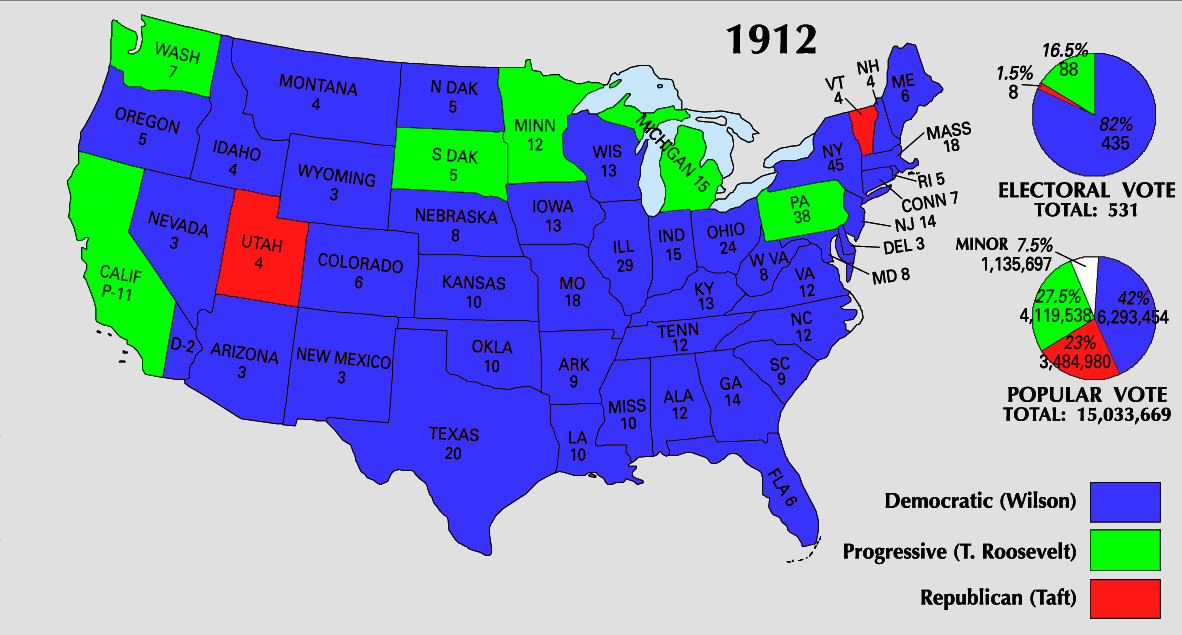
The map above shows the result of the 1912 US presidential election between Woodrow Wilson, Theodore Roosevelt and William Howard Taft. Turnout for the election was 59.00%.
Here are the key details:
| Winner: | Runner-Up: | |
|---|---|---|
| Name: | Woodrow Wilson | Theodore Roosevelt |
| Political Party: | Democratic | Progressive (Bull Moose Party) |
| Home state: | New Jersey | New York |
| VP Name: | Thomas R. Marshall | Hiram Johnson |
| States: Won (Out of 48): | 40 | 6 |
| Electoral College Votes (out of 531): | 435 | 88 |
| Percentage of Popular Vote | 41.84% | 27.40% |
| Total Votes | 6,296,284 | 4,122,721 |
| Margin % | 14.44% | – |
| Margin (votes) | 2,173,563 | – |
| 3rd Place | 4th Place: | |
|---|---|---|
| Name: | William Howard Taft | Eugene V. Debs |
| Political Party | Republican | Socialist |
| Electoral College Votes | 8 | 0 |
| Number of Votes: | 3,486,242 | 901,551 |
| Percentage of Popular Vote: | 23.20% | 6.00% |
Key issues in the 1912 Election:
Here’s where each of the candidates stood on key issues:
1. Big Business and Trusts
Woodrow Wilson: Advocated for reducing the influence of big businesses and monopolies through government regulation. He promoted his “New Freedom” platform, which aimed to dismantle large trusts to create more competition.
Theodore Roosevelt: Believed in regulating big businesses rather than breaking them up. His “New Nationalism” platform advocated for federal regulation of large corporations to prevent abuses of power but did not propose dismantling them.
William Howard Taft: Continued Roosevelt’s policy of trust-busting but was more conservative and favored a legalistic approach. He believed in enforcing existing laws like the Sherman Antitrust Act to curb monopolies.
2. Government Regulation and Economic Reform
Woodrow Wilson: Supported small businesses and aimed to reduce the size and power of both government and big business. He favored limited government intervention in the economy, wanting to break up monopolies and allow competition to flourish.
Theodore Roosevelt: Supported a more active government role in regulating the economy. His “New Nationalism” called for a strong federal government to regulate industries and ensure social justice, including minimum wage laws, social insurance, and labor rights.
William Howard Taft: Favored limited government intervention and opposed Roosevelt’s expansive view of executive power. While he was not opposed to some reforms, he preferred a more cautious and conservative approach.
3. Labor and Social Welfare
Woodrow Wilson: Promoted labor reforms such as reducing tariffs, regulating working hours, and improving conditions for workers. However, his stance was more moderate compared to Roosevelt.
Theodore Roosevelt: Strongly supported progressive labor reforms, including minimum wage laws, child labor laws, and workers’ compensation. His platform focused on government intervention to protect workers and promote social justice.
William Howard Taft: Was more conservative on labor issues and did not advocate for sweeping labor reforms. He believed labor issues should be handled at the state level, rather than through federal legislation.
4. Tariff Reform
Woodrow Wilson: Strongly supported lowering tariffs, which he saw as a way to reduce prices for consumers and stimulate competition. His administration later succeeded in passing the Underwood Tariff Act, which reduced tariffs.
Theodore Roosevelt: Roosevelt was less focused on tariff reform and more interested in government regulation of business. He did not push for major changes to tariffs but supported some adjustments to benefit the working class.
William Howard Taft: Defended the Payne-Aldrich Tariff, which kept tariffs relatively high. This position was unpopular with many progressives, who believed that lower tariffs would benefit consumers and small businesses.
5. Women’s Suffrage
Woodrow Wilson: Initially lukewarm on the issue of women’s suffrage, but later in his presidency, he came to support it, especially after the contributions of women during World War I.
Theodore Roosevelt: Actively supported women’s suffrage and included it as part of his Progressive Party platform.
William Howard Taft: Did not actively support women’s suffrage during the campaign, and his position was considered more conservative compared to Roosevelt’s.
6. Conservation and the Environment
Woodrow Wilson: Believed in some conservation measures but was not as strong on the issue as Roosevelt. His focus was more on economic reform than environmental conservation.
Theodore Roosevelt: A staunch advocate of conservation, Roosevelt made it a central part of his platform. He pushed for federal policies to manage natural resources, establish national parks, and conserve land and wildlife.
William Howard Taft: Continued some of Roosevelt’s conservation policies but did not emphasize it as much during his presidency or campaign. His approach was more bureaucratic and less visionary than Roosevelt’s.
7. Civil Rights and Racial Issues
Woodrow Wilson: Had a mixed and controversial record on civil rights. Although he was seen as a progressive on many issues, he supported racial segregation in federal offices and was not an advocate for racial equality.
Theodore Roosevelt: Had a more progressive stance on racial issues compared to Wilson, but his commitment was inconsistent. Roosevelt had invited Booker T. Washington to the White House, which was a bold move at the time, but he later downplayed racial issues to avoid political controversy.
William Howard Taft: Did not take a strong stance on civil rights and did little to address racial issues during his presidency.
Overall Platforms:
Woodrow Wilson’s “New Freedom”: Focused on promoting competition by dismantling monopolies, lowering tariffs, and reducing the size of government intervention in the economy.
Theodore Roosevelt’s “New Nationalism”: Advocated for a strong, centralized government to regulate big business, provide social welfare, and ensure labor rights. Roosevelt sought a more active role for the federal government in addressing social and economic problems.
William Howard Taft’s Conservative Platform: Stood for a restrained, cautious approach to governance, emphasizing law and order, limited government intervention, and continued economic stability through conservative policies.
This ideological split within the Republican Party between Roosevelt and Taft allowed Wilson to win the election, as the progressive vote was divided between the two former allies.
Why did Wilson win?
Here are the key reasons:
1. Republican Party Split
Division between Roosevelt and Taft: The Republican Party was deeply divided between two of its former leaders—Theodore Roosevelt and William Howard Taft. Roosevelt, dissatisfied with Taft’s conservative policies, formed the Progressive Party (also known as the “Bull Moose Party”) and ran for president.
This split the Republican vote. Roosevelt took most of the progressive and reform-minded Republicans, while Taft retained the support of the conservative wing of the party. This division allowed Wilson to consolidate the Democratic vote and win with a plurality.
Electoral Map Impact: Roosevelt and Taft together garnered about 50% of the popular vote, but because they were splitting Republican votes in many key states, Wilson was able to win the electoral votes in those states. Wilson won a commanding 435 electoral votes, while Roosevelt won only 88, and Taft won a mere 8.
2. The Appeal of Wilson’s Progressive Policies
“New Freedom” Platform: Wilson’s platform, known as the “New Freedom,” resonated with voters who were skeptical of big business and monopolies. He argued that monopolies needed to be broken up, not just regulated, and that the government should foster free-market competition rather than allow trusts and big corporations to dominate the economy. This appealed to a large segment of the electorate, especially those concerned with economic inequality and the power of large corporations.
Less Radical than Roosevelt: While both Wilson and Roosevelt were seen as progressives, Wilson’s policies were more moderate than Roosevelt’s “New Nationalism,” which proposed extensive government regulation of the economy and social welfare programs.
Wilson’s moderate progressivism was less alarming to more conservative voters, making him a more palatable choice for those who wanted reform but were wary of Roosevelt’s more aggressive approach.
3. Roosevelt and Taft’s Focus on Each Other
In-fighting among Republicans: Much of the campaign energy was spent on the bitter rivalry between Roosevelt and Taft, who had once been political allies. Roosevelt fiercely attacked Taft’s presidency, accusing him of abandoning progressive ideals, while Taft countered by accusing Roosevelt of being a radical and power-hungry.
This intense focus on their conflict allowed Wilson to run a relatively clean campaign, remaining above the fray and appealing to voters tired of the Republican in-fighting.
Roosevelt’s Third-Party Candidacy: Roosevelt’s decision to run as a third-party candidate was a significant factor. Although he was popular and won a significant portion of the vote (27.4%), third-party candidates historically face structural disadvantages in U.S. elections. The split in the Republican vote meant that neither Roosevelt nor Taft could defeat Wilson, even though together they garnered more popular votes than he did.
4. Public Desire for Change
Discontent with Taft’s Presidency: Many voters were disillusioned with Taft’s presidency. Progressives felt he had not done enough to continue Roosevelt’s reforms, while conservatives found him too indecisive. This dissatisfaction with the sitting Republican president helped Wilson, who appeared fresh and more focused on reform.
Progressive Mood of the Country: By 1912, there was a strong progressive current in American politics. Many voters were seeking reforms to address economic inequality, corporate power, labor rights, and government corruption.
Both Roosevelt and Wilson capitalized on this, but Wilson’s message of returning to more competitive markets without heavy government regulation was seen as a compromise between the extremes of Roosevelt’s “New Nationalism” and Taft’s conservatism.
5. Effective Campaign Strategy
Wilson’s Focus on the Middle Ground: Wilson positioned himself as the candidate of moderation between Roosevelt’s more radical progressivism and Taft’s conservatism. He attracted voters who wanted change but were wary of Roosevelt’s strong government intervention approach. This strategy helped Wilson capture swing voters.
Support from Southern and Western States: Wilson, as a Democrat, had solid support in the South, which was still a Democratic stronghold at the time. Additionally, his progressive platform appealed to voters in the West, who were often more reform-minded. These regions played a key role in giving him a strong electoral base.
6. Support from the Democratic Base
United Democratic Party: Unlike the divided Republicans, the Democrats were unified behind Wilson. This unity, combined with the fact that the Democrats had not won the presidency since 1892, motivated Democratic voters and gave Wilson a significant advantage.
Broad Coalition: Wilson was able to build a coalition of voters that included southern Democrats, progressive reformers, and independents who were dissatisfied with the Republican in-fighting.
1912 Election Results Map By County

1912 Map From The National Atlas of the United States (now sadly permanently offline)
Other US Presidential Election Maps: