
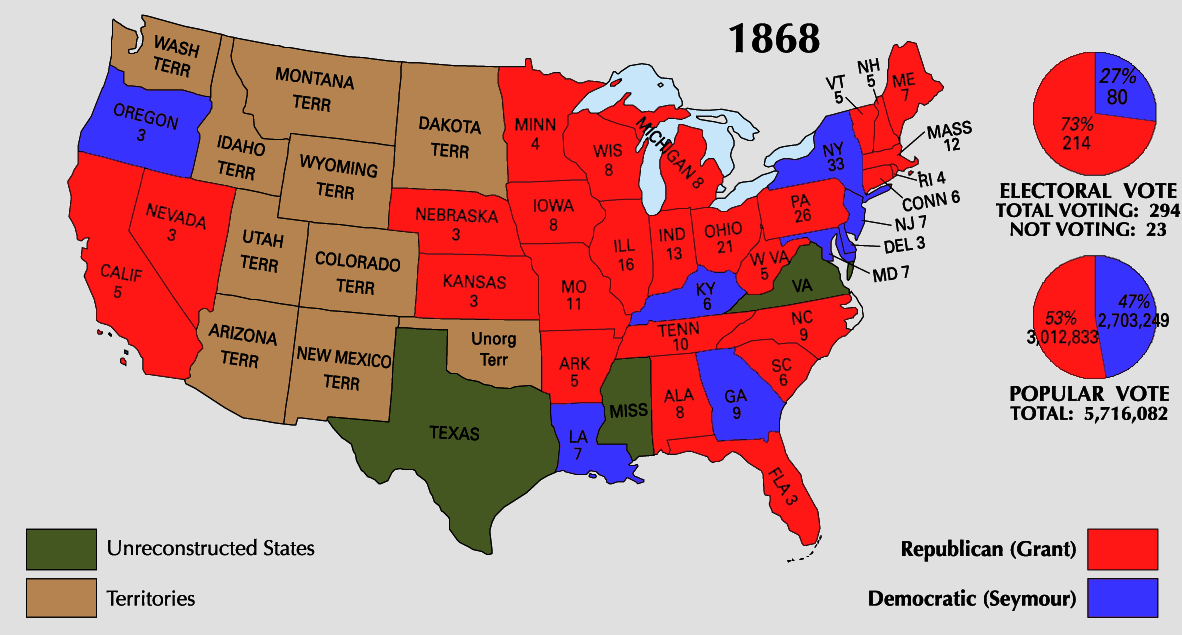
The map above shows the result of the 1868 US presidential election between Ulysses S. Grant and Horatio Seymour. Turnout for the election was 80.90%.
Here are the key details:
| Winner: | Runner-Up: | |
|---|---|---|
| Name: | Ulysses S. Grant | Horatio Seymour |
| Political Party: | Republican | Democratic |
| Home state: | Illinois | New York |
| VP Name: | Schuyler Colfax | Francis Preston Blair Jr. |
| States: Won (Out of 34): | 26 | 8 |
| Electoral College Votes (out of 294): | 214 | 80 |
| Percentage of Popular Vote | 52.66% | 47.30% |
| Total Votes | 3,013,790 | 2,708,744 |
| Margin % | 5.32% | – |
| Margin (votes) | 304,810 | – |
What were the key issues in the 1868 election?
The 1868 U.S. presidential election was the first held after the Civil War and was heavily influenced by issues related to Reconstruction, civil rights, and the reunification of the country. Here are the key issues that shaped the election:
1. Reconstruction and Civil Rights for Freed Slaves
The country was deeply divided over how to handle the Reconstruction of the South. Republicans, led by Ulysses S. Grant, supported policies that protected the rights of newly freed Black Americans.
They backed the Reconstruction Acts and the 14th Amendment, which granted citizenship and equal protection under the law.
Democrats, led by Horatio Seymour, opposed many of these Reconstruction policies. They argued for state sovereignty and were often aligned with Southern interests that wanted to limit rights for Black Americans and quickly restore power to the pre-war white ruling class.
2. Racial Violence and the Ku Klux Klan
The rise of white supremacist groups like the Ku Klux Klan, which targeted Black citizens and Republicans in the South, was a significant issue.
Voters were concerned about the violence and intimidation occurring in Southern states, with Republicans arguing for federal intervention to protect Black citizens and enforce Reconstruction laws.
3. Economic Recovery Post-Civil War
The Civil War had devastated the Southern economy, and there were significant debates about how to fund Reconstruction. Inflation, war debts, and the need for infrastructure rebuilding in the South put economic policy at the forefront.
Republicans generally favored policies that encouraged economic stability, including maintaining a strong federal government. Democrats, meanwhile, were often critical of high spending and national debt.
4. “Waving the Bloody Shirt”
The memory of the Civil War was fresh, and Republicans often used “waving the bloody shirt” as a campaign tactic to remind voters that Democrats were the party of secession and rebellion.
By associating the Democratic Party with the Confederacy and the horrors of the Civil War, Republicans sought to attract Northern voters who wanted to punish the South and ensure loyal governance.
5. Voter Intimidation and Suppression
Voting rights and suppression were significant issues, particularly concerning the participation of newly enfranchised Black men. Republicans advocated for expanded voting rights, while Democrats in many Southern states tried to use intimidation tactics to prevent Black Americans from voting.
6. The Legacy of Andrew Johnson’s Presidency
President Andrew Johnson, who had taken over after Lincoln’s assassination, was highly unpopular with Republicans due to his lenient approach to Southern Reconstruction and frequent clashes with Congress.
His impeachment in 1868 created significant tension, and the election became an opportunity to redefine the direction of the presidency and distance the office from Johnson’s policies.
Why did Grant win?
Ulysses S. Grant won the 1868 election due to a combination of factors including his popularity as a war hero, the Republican Party’s support for Reconstruction and civil rights, and effective campaign strategies.
The “unreconstructed” Southern states, those that had not been fully reintegrated into the Union and thus did not participate in the election, also influenced the outcome.
Here’s how these factors played out:
Reasons for Grant’s Victory
- Grant’s Popularity as a War Hero
- Ulysses S. Grant was immensely popular as the general who led the Union Army to victory in the Civil War. His reputation as a strong and steady leader gave him a natural appeal to voters, particularly in the North, who saw him as someone who could maintain order and uphold the Union’s values. This popularity overshadowed the political experience of his opponent, Horatio Seymour, the Democratic nominee.
- Republican Support for Reconstruction and Civil Rights
- The Republican Party platform was strongly pro-Reconstruction, advocating for civil rights and protection for freed slaves. Many Northern voters, especially African Americans in states where they had been granted the right to vote, supported Grant and the Republicans because of their commitment to ensuring civil rights for Black Americans. The passage of the 14th Amendment, which granted citizenship and equal protection under the law, was a key part of this platform.
- “Waving the Bloody Shirt” Campaign Tactic
- Republicans effectively used the memory of the Civil War to remind voters that Democrats were the party of the Confederacy. By “waving the bloody shirt,” Republicans tapped into the Northern public’s resentment toward the South and positioned Democrats as traitors and enemies of the Union. This strategy particularly resonated with Union veterans and voters who had suffered during the war.
- Violence and Intimidation in the South
- In the South, white supremacist groups like the Ku Klux Klan were using violence to intimidate Black voters and Republicans. Reports of this violence motivated many Northern voters to support Grant and the Republicans, who advocated for federal intervention to protect Black citizens. Grant’s platform promised to bring peace and order, which appealed to voters disturbed by the unrest in the South.
- Weaknesses of the Democratic Platform
- The Democrats, led by Horatio Seymour, opposed Reconstruction policies and instead favored a rapid reintegration of the South with minimal conditions. Their platform often appeared sympathetic to Southern interests, which alienated many Northern voters. Additionally, Seymour’s running mate, Francis P. Blair, was outspokenly racist and made inflammatory statements against Reconstruction, which further damaged their appeal, especially among moderate voters.
Impact of Unreconstructed States
Reduced Democratic Voting Power
Several Southern states were not allowed to participate fully in the 1868 election because they had not met the requirements for readmission to the Union. These unreconstructed states (Texas, Mississippi, and Virginia) could not contribute electoral votes, which weakened the overall Democratic base, as these states would likely have supported Seymour.
Greater Weight for Northern and Reconstructed Southern States
The absence of unreconstructed states meant that Northern states and a few reconstructed Southern states (where Black men were voting) had a greater influence on the election’s outcome.
Black voters, newly enfranchised in reconstructed Southern states, voted overwhelmingly for Grant, further boosting his support in areas where he might have been less competitive otherwise.
A Shift in the Balance of Power
The absence of several Southern states from the electoral count helped ensure a Republican victory and provided a mandate for the party to continue its Reconstruction policies.
If these states had participated and cast electoral votes for Seymour, the race might have been closer, though Grant was still popular enough to likely win.
1868 Election Results Map By County

1868 Map From The National Atlas of the United States (now sadly permanently offline)
Other US Presidential Election Maps: