
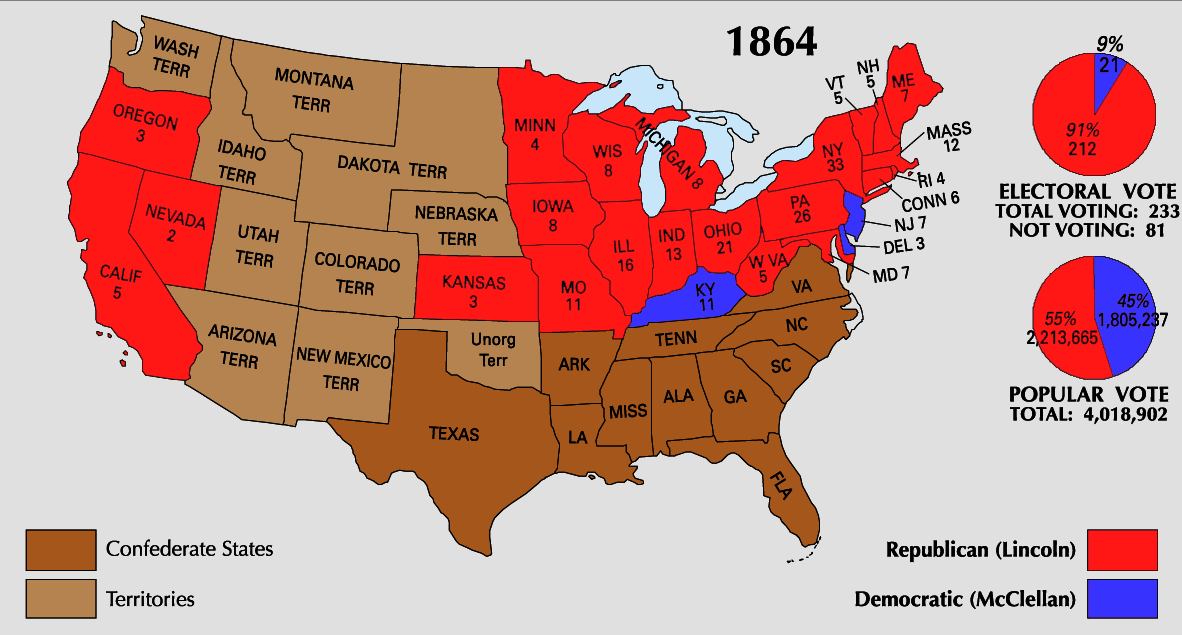
The map above shows the result of the 1864 US presidential election between Abraham Lincoln and George B. McClellan. Turnout for the election was 76.30%.
Here are the key details:
| Winner: | Runner-Up: | |
|---|---|---|
| Name: | Abraham Lincoln | George B. McClellan |
| Political Party: | National Union | Democratic |
| Home state: | Illinois | New Jersey |
| VP Name: | Andrew Johnson | George H. Pendleton |
| States: Won (Out of 27): | 22 (+2 invalidated*) | 3 |
| Electoral College Votes (out of 233): | 212 (+17 invalidated*) | 21 |
| Percentage of Popular Vote | 55.03% | 45.00% |
| Total Votes | 2,211,317 | 1,812,807 |
| Margin % | 10.08% | – |
| Margin (votes) | 405,090 | – |
* see below for Tennessee and Louisiana
What were the key issues of the 1864 election?
The 1864 U.S. presidential election took place during the American Civil War, making it one of the most significant and contentious elections in U.S. history.
The key issues centered on the Civil War, slavery, and the future of the Union. The two primary candidates were incumbent President Abraham Lincoln, representing the National Union Party (a coalition of Republicans and War Democrats), and George B. McClellan, the Democratic candidate.
Here’s a breakdown of the main issues and where each candidate stood:
1. Civil War Strategy and the Union
Abraham Lincoln: Lincoln’s platform was committed to continuing the war until the Confederacy was defeated and the Union preserved. His administration aimed to restore the Union with an unconditional surrender from the Confederate states.
Lincoln had recently appointed Ulysses S. Grant as general-in-chief, signaling his dedication to aggressive military strategies.
George McClellan: Although McClellan was a former Union general, his position was more complicated. While he personally supported the Union cause, the Democratic Party platform called for an immediate ceasefire and a negotiated settlement with the Confederacy, suggesting a potential compromise that could leave the Confederacy intact.
McClellan, however, disagreed with this peace platform publicly, arguing instead that he wanted to preserve the Union without undermining morale.
2. Slavery and Emancipation
Abraham Lincoln: By 1864, Lincoln had issued the Emancipation Proclamation, which declared freedom for enslaved people in Confederate-held territories.
His platform, therefore, leaned toward the abolition of slavery, aligning with the growing momentum to end slavery entirely. The Republican platform supported a constitutional amendment to abolish slavery (which later became the 13th Amendment).
George McClellan: McClellan’s position on slavery was less clear-cut. While he was not necessarily opposed to emancipation, he and the Democratic platform prioritized restoring the Union over addressing slavery.
The Democratic Party platform largely appealed to Northern war-weariness and tended to downplay emancipation, which led many abolitionists to distrust McClellan and the Democrats.
3. Reconstruction and Reconciliation
Abraham Lincoln: Lincoln’s approach to Reconstruction was already shaping up by 1864. He promoted a plan that would allow Southern states to rejoin the Union if 10% of voters swore loyalty and accepted emancipation. He aimed for a moderate approach to reconciliation while ensuring a transition away from slavery.
George McClellan: The Democratic Party’s platform emphasized restoring peace and reconciling with the South, with less emphasis on the conditions of reentry or on transforming Southern society.
Many Democrats advocated for a more lenient approach toward the Southern states, which appealed to those tired of the war but concerned Lincoln’s policies were too punitive.
4. Civil Liberties and Executive Power
Abraham Lincoln: Lincoln’s administration had suspended habeas corpus in certain areas and used executive authority to control dissent and limit Confederate support in the North. His critics argued that he had overstepped his powers, though he justified these actions as necessary in wartime.
George McClellan: McClellan criticized Lincoln for infringing on civil liberties, which resonated with Northern Democrats who felt Lincoln was acting like a dictator. He argued for more restraint in the exercise of executive power and a return to normal constitutional processes.
Why did Lincoln win?
Here’s an analysis of how and why he won:
1. Military Successes
Key Union Victories: Just months before the election, the Union achieved several significant military victories. General William Tecumseh Sherman captured Atlanta in September 1864, a major strategic win that boosted Northern morale. The fall of Atlanta was widely covered in the press and convinced many voters that the war was winnable under Lincoln’s leadership.
Renewed Confidence: Prior to these victories, there was considerable war fatigue in the North, and Lincoln’s prospects for re-election seemed dim. However, as Union forces continued to advance, public confidence in Lincoln’s strategy increased, making voters more inclined to support a candidate committed to seeing the war through to a Union victory.
2. The Emancipation Proclamation and Moral High Ground
Moral Clarity on Slavery: Lincoln’s Emancipation Proclamation in 1863 had transformed the Civil War from a struggle solely about preserving the Union into a fight against slavery. This moral shift galvanized support among abolitionists, African Americans, and many in the North who viewed slavery as incompatible with American values.
Support from Soldiers: Union soldiers, who overwhelmingly supported Lincoln, were given the opportunity to vote in the field, and many of them saw the war as a mission to end slavery as well as to preserve the Union. This strong support from the military was critical in securing Lincoln’s re-election.
3. Effective Political Strategy and Party Unity
Broadening His Coalition: Lincoln formed the National Union Party, a coalition that included both Republicans and War Democrats who were committed to the Union cause. By choosing Andrew Johnson, a Southern War Democrat from Tennessee, as his running mate, Lincoln broadened his appeal to pro-Union Democrats and presented himself as a unifier.
Unity vs. Division in the Opposition: The Democratic Party was divided. The peace wing of the party wanted an immediate ceasefire and compromise with the Confederacy, while McClellan, though personally committed to the Union, could not fully distance himself from this faction. This division weakened his campaign and made the Democrats appear disorganized and unsure of their goals.
4. Public Perception of Leadership and Resolve
Lincoln’s Commitment: Lincoln was perceived as steady, committed, and unwavering in his dedication to preserving the Union. His speeches and public letters, particularly his famous “With malice toward none” rhetoric, projected a vision for national healing after the war, which appealed to a population tired of conflict but hopeful for a future United States.
McClellan’s Inconsistent Message: McClellan’s campaign was hampered by the Democratic Party platform, which called for an immediate peace and negotiations with the Confederacy. McClellan himself disagreed with this platform and sought to distance himself from it, creating confusion about his stance. This inconsistency made him seem weak and indecisive compared to Lincoln’s firm commitment to a Union victory.
5. War-Weariness and Desire for a Decisive End
Desire to Finish the War: While there was considerable war-weariness, many Northern voters believed that a change in leadership would prolong the war or lead to a compromised peace. Lincoln’s campaign promised a clear endgame: complete Union victory and the abolition of slavery. This appealed to a public eager for a definitive conclusion.
Rejection of Compromise with the Confederacy: Voters were increasingly unwilling to accept a peace that might allow slavery to continue or divide the country permanently. Lincoln’s approach resonated with those who felt that the sacrifices made during the war should result in a fully restored Union, free of slavery.
Tennessee and Louisiana
Here’s how the participation of Tennessee and Louisiana played out:
Tennessee
Union Occupation and Loyal Government: Tennessee had a strong Unionist presence in parts of the state, especially in the eastern region, and was occupied by Union forces early in the war. By 1864, a loyalist government had been established, and Lincoln was keen to support its reintegration into the Union.
Electoral Votes: Tennessee held elections and selected presidential electors who cast their votes for Lincoln. However, Congress did not officially count Tennessee’s electoral votes because it was still technically under occupation and not fully restored as a state in the eyes of Congress.
Louisiana
Union-Controlled Areas and Loyal Government: Union forces had taken control of New Orleans and other parts of Louisiana relatively early in the war. Lincoln supported efforts to re-establish a loyal government there and even pushed for a new state constitution that would abolish slavery.
Electoral Votes: Like Tennessee, Louisiana held elections and appointed electors who voted for Lincoln. However, as with Tennessee, Congress declined to count Louisiana’s electoral votes due to questions over its status and the legitimacy of the elections in a partially occupied state.
Significance and Outcome
Political Statement: Even though Congress did not count the electoral votes from Tennessee and Louisiana, Lincoln encouraged these states’ participation as a symbolic step toward reintegration. He saw it as an important precedent for Reconstruction and a sign of hope that the Southern states could return to the Union.
No Impact on the Election Result: Lincoln’s margin of victory in the Electoral College was large enough that these votes were not essential to his win. The official electoral count excluded Tennessee and Louisiana, so Lincoln won 212 out of 233 counted electoral votes, easily defeating McClellan’s 21 votes.
In short, while Tennessee and Louisiana attempted to participate and cast electoral votes for Lincoln, Congress did not recognize these votes, and they did not officially impact the election outcome. However, their involvement was symbolically important for Lincoln’s vision of reunifying the country after the war.
1864 Election Results Map By County

1864 Map From The National Atlas of the United States (now sadly permanently offline)
Other US Presidential Election Maps: