
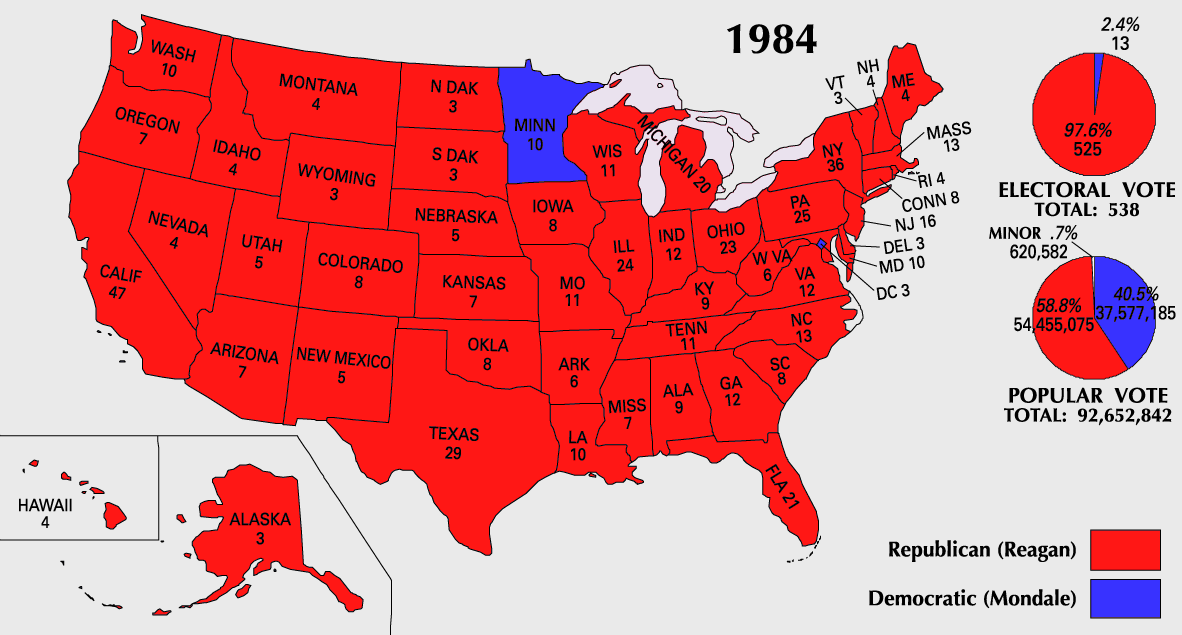
The map above shows the result of the 1984 US presidential election between Ronald Reagan and Walter Mondale. Turnout for the election was 55.20%.
Here are the key details:
| Winner: | Runner-Up: | |
|---|---|---|
| Name: | Ronald Reagan | Walter Mondale |
| Political Party: | Republican | Democratic |
| Home state: | California | Minnesota |
| VP Name: | George H. W. Bush | Geraldine Ferraro |
| States: Won (Out of 51): | 49 | 1 |
| Electoral College Votes (out of 538): | 525 | 13 |
| Percentage of Popular Vote | 58.77% | 40.60% |
| Total Votes | 54,455,472 | 37,577,352 |
| Margin % | 18.21% | – |
| Margin (votes) | 16,878,120 | – |
Other Parties
| 3rd Place | 4th Place: | |
|---|---|---|
| Name: | David Bergland | Lyndon LaRouche |
| Political Party | Libertarian | Independent |
| Electoral College Votes | 0 | 0 |
| Number of Votes: | 228,111 | 78,809 |
| Percentage of Popular Vote: | 0.25% | 0.09% |
Key Issues of The 1984 Election
The 1984 U.S. presidential election was a significant contest primarily between the incumbent Republican President Ronald Reagan and the Democratic challenger, former Vice President Walter Mondale.
The election took place during a time of economic recovery, shifting foreign policy concerns, and significant social debates.
Here’s how the key issues played out and how the candidates differed on them:
1. Economic Policy
- Ronald Reagan: Reagan campaigned on the success of his economic policies, often referred to as “Reaganomics.” This policy was centered on tax cuts, deregulation, and reducing government spending (with notable exceptions like defense). He argued that his policies had brought the U.S. out of a deep recession and led to economic growth. Reagan emphasized that continuing his policies would ensure ongoing prosperity.
- Walter Mondale: Mondale criticized Reagan’s economic policies, arguing that they disproportionately benefited the wealthy while increasing the federal deficit. Mondale advocated for tax increases, particularly on the wealthy, to reduce the deficit and fund social programs. During the campaign, Mondale made the controversial statement that he would raise taxes, a move intended to distinguish his approach from Reagan’s but which many believe hurt his campaign.
2. Social Issues
- Ronald Reagan: Reagan maintained a conservative stance on social issues, including opposition to abortion rights, support for traditional family values, and a strong stance against the Equal Rights Amendment (ERA). He appealed to the rising Christian Right, which became a significant part of the Republican base.
- Walter Mondale: Mondale supported progressive social policies. He was in favor of the ERA, supported abortion rights, and advocated for civil rights and social justice reforms. Mondale also emphasized the importance of protecting Social Security and other social welfare programs, which he argued were under threat from Reagan’s policies.
3. Foreign Policy
- Ronald Reagan: Reagan was a staunch anti-communist and his foreign policy was heavily focused on confronting the Soviet Union. His administration significantly increased defense spending and promoted the Strategic Defense Initiative (SDI), commonly known as “Star Wars,” which aimed to protect the U.S. from nuclear attacks. Reagan’s foreign policy was seen as aggressive, particularly with respect to his interventions in Central America and his rhetoric about the “Evil Empire.”
- Walter Mondale: Mondale criticized Reagan’s aggressive stance towards the Soviet Union, advocating instead for arms control and diplomacy. He was skeptical of SDI and other expensive defense programs. Mondale argued that Reagan’s foreign policy was dangerous and could lead to unnecessary conflicts, emphasizing the need for more balanced and peaceful international relations.
4. Gender and Representation
- Ronald Reagan: While Reagan did not focus specifically on issues of gender representation during his campaign, his administration was generally seen as less progressive on these issues compared to his opponent.
- Walter Mondale: Mondale made history by selecting Geraldine Ferraro as his running mate, making her the first woman to be nominated for vice president by a major American political party. This was a significant move in terms of gender representation and was intended to appeal to women voters and those who supported gender equality.
5. Government and Federalism
- Ronald Reagan: Reagan famously stated in his inaugural address that “government is not the solution to our problem, government is the problem.” His administration sought to reduce the size and role of the federal government, advocating for more power to be given to states and the private sector.
- Walter Mondale: Mondale believed in a more active federal government role in addressing social and economic issues. He supported federal programs and regulations designed to protect workers, the environment, and civil rights, arguing that the federal government had a responsibility to address these issues that states or the private sector could not adequately handle.
Why Did Reagan Win?
Ronald Reagan’s landslide victory in the 1984 presidential election was the result of several key factors that played to his strengths as a candidate and to the general political climate of the time. Here are the primary reasons why Reagan won so decisively:
1984 Election Results Map By County

1984 Map From The National Atlas of the United States (now sadly permanently offline)
Other US Presidential Election Maps: