
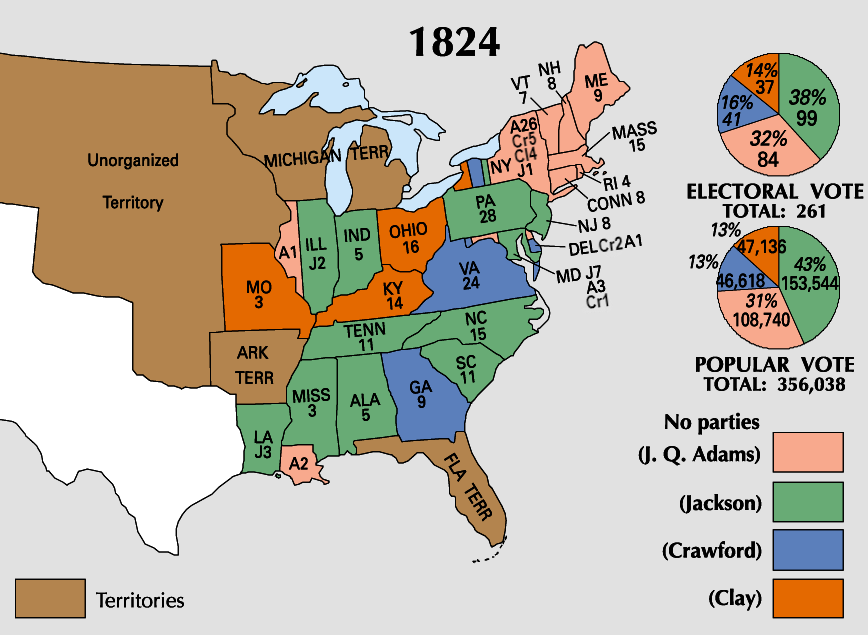
The map above shows the result of the 1824 US presidential election between John Quincy Adams, Andrew Jackson, William H. Crawford and Henry Clay. Turnout for the election was 26.90%.
Here are the key details:
| Winner: | Runner-Up: | |
|---|---|---|
| Name: | John Quincy Adams | Andrew Jackson |
| Political Party: | Democratic-Republican | Democratic-Republican |
| Home state: | Massachusetts | Tennessee |
| VP Name: | John C. Calhoun | John C. Calhoun |
| States: Won (Out of 24): | 7 | 11 |
| Electoral College Votes (out of 261): | 84 | 99 |
| Percentage of Popular Vote | 30.92% | 41.40% |
| Total Votes | 113,142 | 151,271 |
| Margin % | −10.44% | – |
| Margin (votes) | −38,221 | – |
| 3rd Place | 4th Place | |
|---|---|---|
| Name: | Henry Clay | William H. Crawford |
| Political Party | Democratic-Republican | Democratic-Republican |
| Electoral College Votes | 38 | 40 |
| Number of Votes: | 47,531 | 40,856 |
| Percentage of Popular Vote: | 13.00% | 11.20% |
5 Facts About the 1824 Election
Here are five interesting facts about the 1824 U.S. Presidential Election:
- The “Corrupt Bargain”: The 1824 election is most famously associated with the term “corrupt bargain.” None of the candidates—John Quincy Adams, Andrew Jackson, William H. Crawford, and Henry Clay—secured a majority of the Electoral College votes. The decision went to the House of Representatives, where Speaker of the House Henry Clay supported Adams, helping him win the presidency. In return, Adams appointed Clay as his Secretary of State. This led to accusations by Andrew Jackson and his supporters that a “corrupt bargain” had been struck.
- First Election Decided by the House of Representatives Since 1800: This election was the second in U.S. history to be decided by the House of Representatives. According to the 12th Amendment, if no candidate receives a majority of the electoral votes, the House selects the president from the top three candidates. In this case, Adams, Jackson, and Crawford were considered, with Adams ultimately winning the House vote.
- Andrew Jackson’s Popular Vote Victory: Although John Quincy Adams won the presidency, Andrew Jackson had won a plurality of both the popular and electoral votes. Jackson received 99 electoral votes and the most popular votes, while Adams received 84 electoral votes. However, Jackson did not have the majority needed to win outright, leading to the House’s decision.
- End of the Era of Good Feelings: The 1824 election marked the end of the “Era of Good Feelings” and the one-party dominance of the Democratic-Republican Party. The election revealed deep divisions within the party, which soon split into two factions: the National Republicans, led by Adams and Clay, and the Democratic Party, led by Jackson. This split laid the groundwork for the modern two-party system.
- Multiple Candidates from the Same Party: All four main candidates—John Quincy Adams, Andrew Jackson, William H. Crawford, and Henry Clay—were members of the Democratic-Republican Party. This unusual situation arose because the party was the only major political force at the time. The competition among its members showcased the significant ideological and regional differences within the party.
What were the key issues of the 1824 election?
The 1824 U.S. presidential election was unique because it was the only one in history where all the major candidates came from the same party: the Democratic-Republican Party.
This unusual situation stemmed from the collapse of the Federalist Party after the War of 1812, leaving the Democratic-Republicans as the dominant political force in the U.S.
However, deep divisions within the party meant that four distinct candidates with different visions for the nation emerged.
Key Issues of the Election
- Internal Improvements (Infrastructure)
- This issue concerned whether the federal government should fund improvements like roads, canals, and bridges to support the growing nation’s infrastructure.
- Tariffs and Economic Policy
- There was debate over whether to implement high tariffs (import taxes) to protect American manufacturing or low tariffs to support agricultural exports. This was particularly significant due to regional differences: the North tended to favor protective tariffs, while the South generally opposed them.
- States’ Rights vs. Federal Power
- Some candidates leaned toward a stronger central government to unify and improve the nation, while others favored states’ rights, supporting a more decentralized approach.
- Expansion and Indian Policy
- Expansionism was generally supported, but opinions varied on how to handle Indigenous populations in the path of westward movement.
The Candidates and Their Positions
- John Quincy Adams (Secretary of State)
- Position on Internal Improvements: Adams was a strong advocate for federal support for infrastructure, including the construction of roads, canals, and other public works. He believed this would unify the country and stimulate economic growth.
- Position on Tariffs: He supported a protective tariff to promote American manufacturing, aligning him with Northern interests.
- Position on Federal Power: Adams favored a strong central government to promote progress and development.
- Expansion and Indian Policy: While he supported westward expansion, Adams preferred more cautious policies regarding Indigenous peoples compared to other candidates.
- Andrew Jackson (Military Hero)
- Position on Internal Improvements: Jackson was generally supportive but preferred that states, rather than the federal government, manage these projects to some extent.
- Position on Tariffs: He was more ambivalent on tariffs, showing some support but largely favoring what was popular among his constituency at the time.
- Position on Federal Power: Jackson emphasized states’ rights but supported a strong executive branch, which would later be central to his presidency.
- Expansion and Indian Policy: He strongly supported westward expansion, including policies that displaced Indigenous populations to make room for settlers, foreshadowing the Indian Removal Act of his presidency.
- Henry Clay (Speaker of the House)
- Position on Internal Improvements: Clay was a strong proponent of the “American System,” which included federally funded infrastructure projects to connect the country and stimulate commerce.
- Position on Tariffs: Clay supported high tariffs to protect American industry, aligning him with Northern and Western manufacturers.
- Position on Federal Power: He believed in a balanced approach, supporting a strong federal government while also valuing state involvement in governance.
- Expansion and Indian Policy: Like Adams, Clay advocated for controlled expansion, sometimes supporting more conciliatory policies toward Indigenous peoples.
- William Crawford (Secretary of the Treasury)
- Position on Internal Improvements: Crawford was more conservative and opposed extensive federal spending on infrastructure, favoring states’ rights.
- Position on Tariffs: He opposed high tariffs, representing Southern agricultural interests that wanted free trade to keep export costs low.
- Position on Federal Power: He was a states’ rights advocate and believed in limiting federal government power.
- Expansion and Indian Policy: Crawford was more cautious about westward expansion, aligning somewhat with Southern interests wary of increased federal control.
Why Were They All from the Same Party?
The collapse of the Federalist Party after the War of 1812 led to what was called the “Era of Good Feelings,” a period in which the Democratic-Republicans held nearly unchallenged control.
However, internal divisions based on regional, economic, and philosophical differences split the party into factions.
By 1824, these factions crystallized into four different candidates, each representing varying interests within the party rather than separate parties altogether.
This election set the stage for the emergence of the Second Party System, with Jackson’s supporters eventually forming the Democratic Party and Adams and Clay’s supporters forming the National Republican Party, which would later evolve into the Whig Party.
How and Why did Adams win?
John Quincy Adams won the 1824 election in a controversial and complex outcome, primarily due to a lack of majority in the popular and electoral votes and the subsequent role of the House of Representatives.
Here’s a breakdown of the key factors that led to Adams’s victory:
1. The Split Electoral Vote and the “Corrupt Bargain”
- In the 1824 election, none of the four candidates won a majority of the Electoral College votes. Andrew Jackson received the most electoral votes (99) and also led in the popular vote, but he did not reach the required majority. John Quincy Adams came in second with 84 electoral votes, while William Crawford and Henry Clay trailed with 41 and 37, respectively.
- According to the Twelfth Amendment, when no candidate wins a majority in the Electoral College, the House of Representatives must choose the president from the top three candidates. This effectively eliminated Henry Clay, who finished fourth.
2. Henry Clay’s Influence and the “Corrupt Bargain” Allegation
- As Speaker of the House, Henry Clay wielded significant influence over the House’s decision. Although he was eliminated from the presidential race, he supported Adams, largely because he shared Adams’s vision for a strong federal government and infrastructure development (known as the “American System”). Clay deeply distrusted Andrew Jackson, whom he viewed as a populist with authoritarian tendencies.
- Clay used his influence to rally support for Adams among House members, and on February 9, 1825, the House elected Adams as president.
- Shortly after Adams took office, he appointed Clay as his Secretary of State, a powerful and prestigious position that had historically served as a stepping stone to the presidency. Jackson’s supporters, feeling betrayed, labeled this appointment a “Corrupt Bargain,” accusing Adams and Clay of striking a backroom deal for mutual benefit. Although no evidence of an explicit deal was ever proven, the accusation damaged Adams’s reputation and haunted his presidency.
3. Adams’s Appeal to Key Interests
- Adams’s support for federally funded infrastructure projects and high tariffs appealed to various regional interests, particularly in the North and West, where there was strong support for economic modernization and the “American System.”
- He was also seen as a highly capable and experienced diplomat and statesman, having served as Secretary of State and negotiated key treaties. His supporters argued that Adams had the experience to lead the country, especially in a time of growing sectional divides.
4. Opposition to Jackson’s Populism
- Many members of Congress feared Jackson’s populist, anti-establishment rhetoric and his military background, worried that he might use his popularity to consolidate power in a way that threatened the Republic. Adams’s supporters in Congress considered him a safer and more predictable choice.
Why Adams’s Victory Was So Contentious
Although Adams legally won under the Constitution, his presidency was overshadowed by the “Corrupt Bargain” controversy. Many Jackson supporters felt that Jackson had been unfairly denied the presidency, having won a plurality of both the popular and electoral votes.
This sense of betrayal fueled the formation of the Democratic Party and intensified the animosity between Adams and Jackson, culminating in Jackson’s decisive victory over Adams in the 1828 election.
Impact of the 1824 Election
The election exposed deep political rifts within the Democratic-Republican Party, eventually leading to the emergence of a two-party system. It also established a precedent for the House deciding the presidency when the Electoral College is deadlocked, though this situation has not recurred in the same way since.
The controversy surrounding Adams’s election and presidency marked the beginning of a new era in American politics, driven by partisanship, populism, and regional interests.
1824 Election Results Map By County
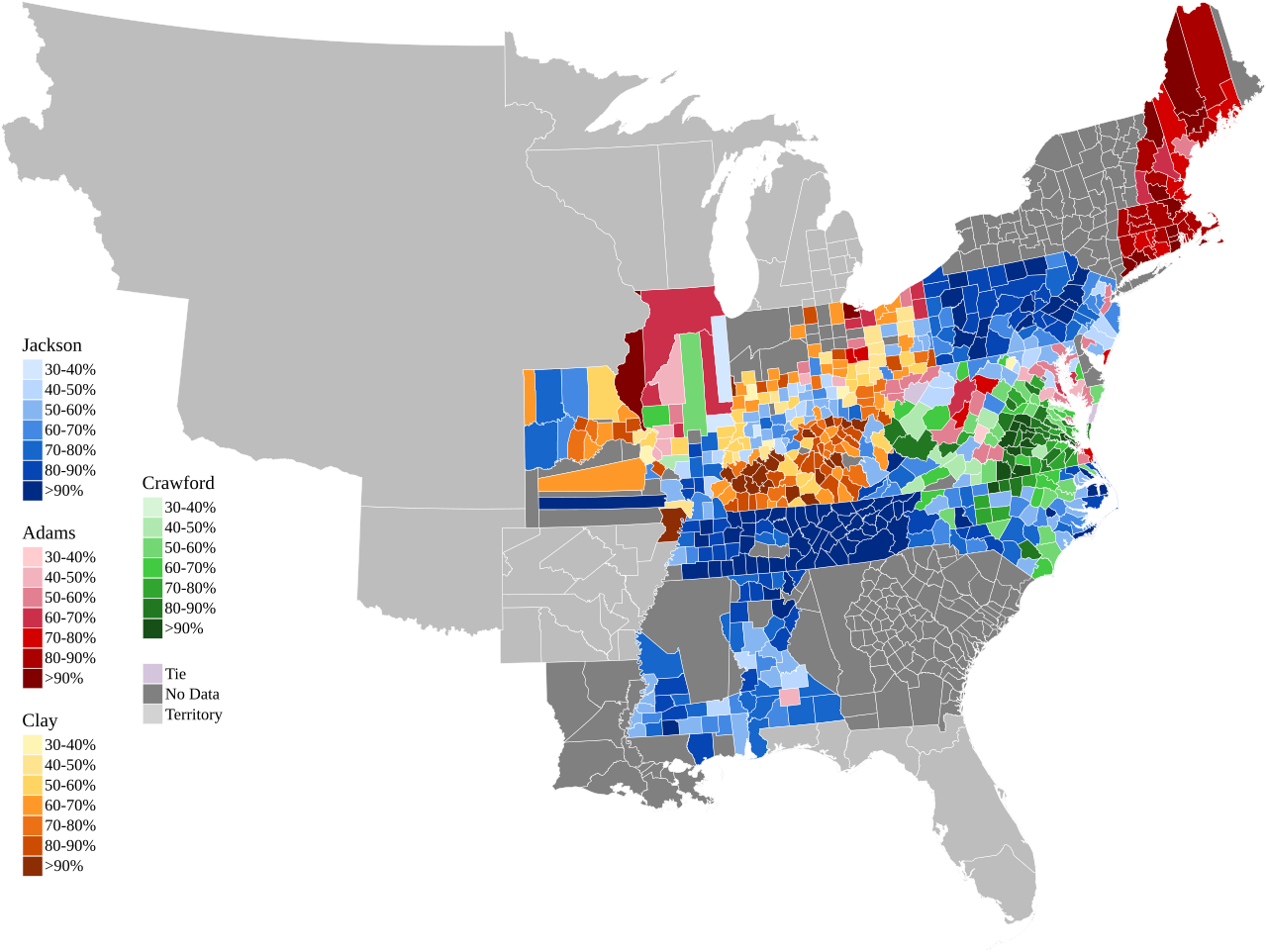
1824 Map From The National Atlas of the United States (now sadly permanently offline)
Other US Presidential Election Maps: