
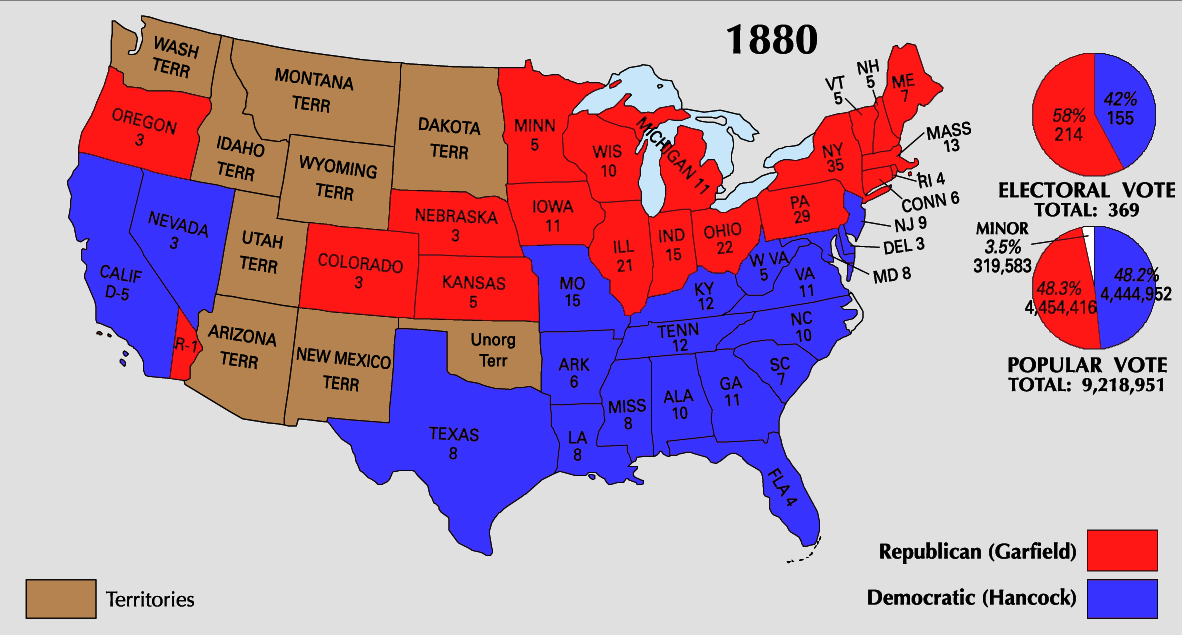
The map above shows the result of the 1880 US presidential election between James A. Garfield and Winfield Scott Hancock. Turnout for the election was 80.50%.
Here are the key details:
| Winner: | Runner-Up: | |
|---|---|---|
| Name: | James A. Garfield | Winfield Scott Hancock |
| Political Party: | Republican | Democratic |
| Home state: | Ohio | Pennsylvania |
| VP Name: | Chester A. Arthur | William H. English |
| States: Won (Out of 38): | 19 | 19 |
| Electoral College Votes (out of 369): | 214 | 155 |
| Percentage of Popular Vote | 48.31% | 48.30% |
| Total Votes | 4,453,337 | 4,444,260 |
| Margin % | 0.09% | – |
| Margin (votes) | 1,898 | – |
| 3rd Place | 4th Place | |
|---|---|---|
| Name: | James B. Weaver | Neal Dow |
| Political Party | Greenback | Prohibition |
| Electoral College Votes | 0 | 0 |
| Number of Votes: | 308,649 | 10,364 |
| Percentage of Popular Vote: | 3.35% | 0.11% |
What were the key issues in the 1880 election?
Here’s a breakdown of the primary issues and each candidate’s stance:
1. Civil Service Reform
Key Issue: The federal government was plagued by the spoils system, where government jobs were given based on loyalty and connections rather than merit, leading to inefficiency and corruption.
- Garfield (Republican): Garfield supported reforming the civil service, advocating for a system that would appoint federal workers based on merit rather than political connections. This appealed to reform-minded Republicans and those disillusioned by the corruption in government.
- Hancock (Democrat): Hancock’s stance on civil service reform was less clear-cut, and he didn’t emphasize it as much as Garfield. Democrats were generally more divided on this issue, with some supporting reform and others wanting to maintain the traditional patronage system.
2. Tariffs and Economic Policy
Key Issue: Tariffs were a central economic issue. Republicans generally favored higher tariffs to protect American industry, while Democrats preferred lower tariffs.
- Garfield (Republican): Garfield supported higher tariffs to protect American businesses and labor, a popular stance in Northern industrial states where manufacturing was growing.
- Hancock (Democrat): Hancock and the Democrats argued for a more moderate tariff policy, advocating that high tariffs disproportionately hurt farmers and consumers. However, Hancock avoided detailed positions on the tariff, aiming to keep Southern and Western voters united despite their economic differences.
3. Reconstruction and Southern Relations
Key Issue: Although Reconstruction had formally ended in 1877, tensions between the North and South continued, especially regarding voting rights and civil rights for African Americans in Southern states.
- Garfield (Republican): Garfield supported federal efforts to protect the rights of African Americans in the South and endorsed the continued enforcement of civil rights, aligning with the Republican Party’s historical stance on Reconstruction.
- Hancock (Democrat): Hancock and the Democrats appealed to white Southerners by advocating for “home rule,” which would allow Southern states more autonomy and reduce federal oversight. This was seen as tacit approval of the Democratic Party’s commitment to restoring white dominance in Southern politics.
4. Currency and Monetary Policy
Key Issue: There was debate over the gold standard versus “soft money” (using silver and paper currency), which had implications for inflation and economic growth.
- Garfield (Republican): Garfield favored the gold standard, a position that appealed to business interests and those who feared inflation. This stance aligned with the more conservative economic policies of the Republican Party at the time.
- Hancock (Democrat): Hancock largely avoided a strong stance on currency issues, as Democrats were divided between farmers and Westerners who favored “soft money” and Eastern Democrats who supported the gold standard.
Why did Garfield win?
Here’s a look at why and how Garfield won:
1. Regional Support and Party Loyalty
- The Republican Party had strong support in the Northern states, where industrialization was growing rapidly. The North had a larger population than the South, which gave Garfield an electoral advantage since states with more residents had more electoral votes.
- Republicans were viewed as the party of Union victory in the Civil War and were strongly associated with policies that promoted industrial growth and infrastructure. This history helped the party retain loyalty among Northern and Midwestern voters who saw Republicans as protectors of industry and stability.
- Garfield’s endorsement of high tariffs to protect American industries appealed to Northern factory owners and workers who benefited from protectionist policies.
2. Civil Service Reform Appeal
- Civil service reform was a growing issue, as many were disillusioned with the corrupt patronage practices of the federal government.
- Garfield’s support for civil service reform attracted independent voters and reform-minded Republicans who wanted to see an end to corruption in federal hiring practices.
- Though Garfield was somewhat cautious in his reform pledges, his message resonated better than Hancock’s, as Hancock largely avoided the topic, which hurt him among reformers.
3. Appealing to African American Voters
- The Republican Party, associated with abolition and post-war Reconstruction efforts, traditionally had support from African American voters, particularly in the North and some Southern states.
- Garfield’s stance on protecting civil rights for African Americans kept many in the African American community loyal to the Republican Party. This provided crucial support in some key states where African Americans could vote freely, adding to his popular vote margin.
4. Democratic Weakness and Hancock’s Limited Appeal
- Winfield Scott Hancock, a war hero, was popular, but he was seen primarily as a military figure without a clear political vision. His campaign largely focused on his record as a Union general, which didn’t effectively address the pressing issues of civil service reform, tariffs, and economic policy.
- Hancock’s ambiguous stance on major issues like the tariff and civil service reform limited his appeal among diverse Democratic factions, who wanted stronger policy commitments.
- The Democratic Party was also divided, with tensions between the Southern wing, which wanted to emphasize states’ rights, and other factions that wanted to appeal to Northern laborers and farmers.
5. Effective Republican Campaign Strategy
- The Republicans ran an organized campaign, focusing on high turnout in key Northern states, where they had traditionally strong support.
- Garfield was portrayed as an educated and principled leader, and the Republican campaign avoided controversial issues, keeping the focus on the idea that the Republican Party represented economic growth, stability, and moral leadership.
- Republicans also effectively painted Hancock as inexperienced in governance, given his military background, and portrayed him as an advocate of the South’s interests, which hurt his appeal in the North.
The Election Outcome
The result was extremely close: Garfield won the popular vote by less than 0.1% (fewer than 2,000 votes) but secured a clear victory in the Electoral College, with 214 electoral votes to Hancock’s 155.
His win hinged on narrow victories in pivotal states like New York, which was crucial in securing the electoral majority.
Garfield’s victory reflected a combination of the North’s loyalty to the Republican Party, his appeal to reform-minded voters, and weaknesses in Hancock’s campaign.
The close nature of the race also underscored ongoing national divisions, but Garfield’s victory gave the Republicans a continued mandate to shape post-Reconstruction America.
1880 Election Results Map By County

1880 Map From The National Atlas of the United States (now sadly permanently offline)
Other US Presidential Election Maps: