
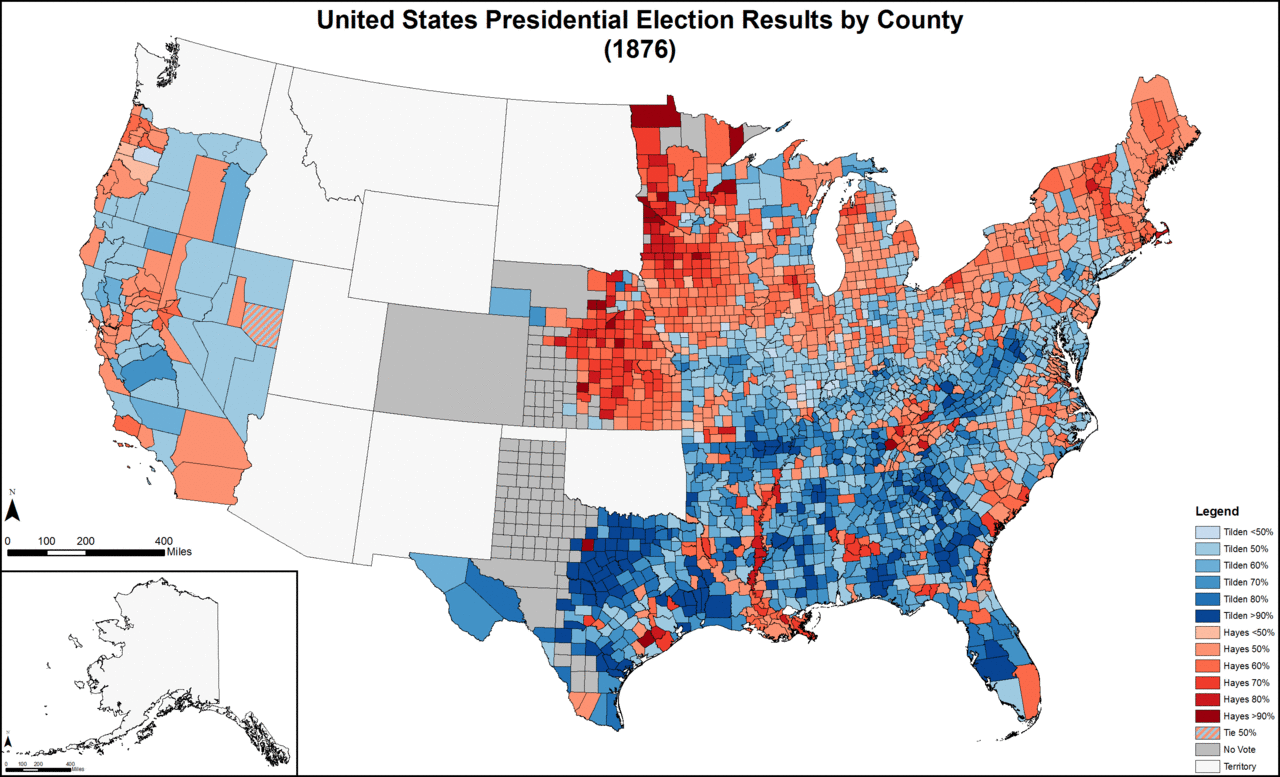
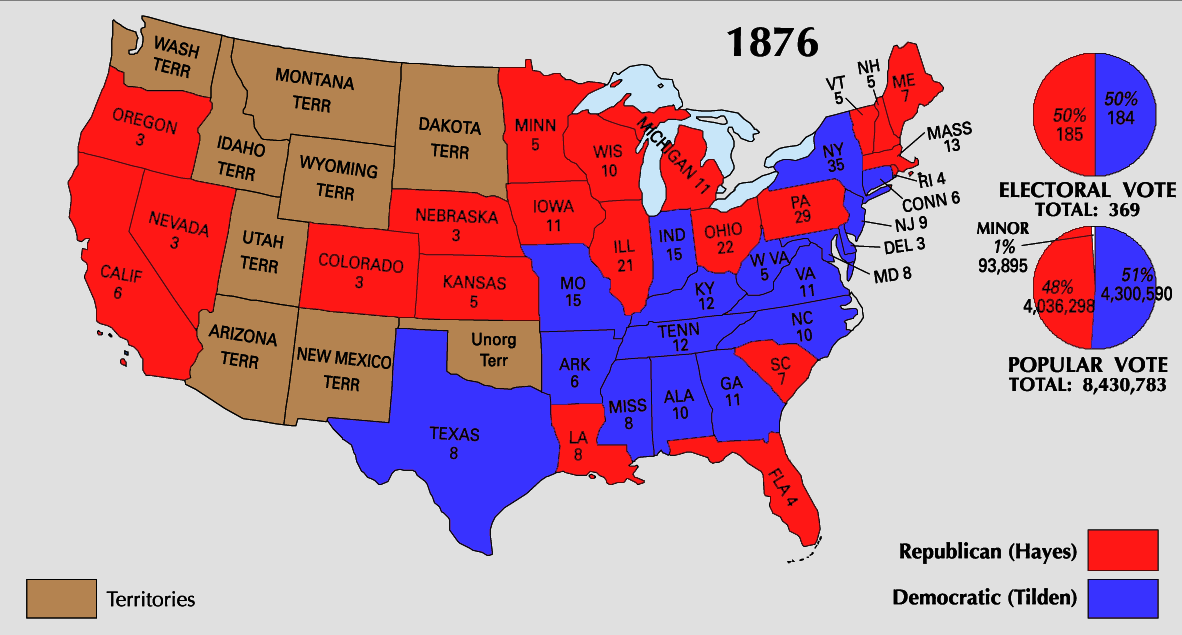
The map above shows the result of the 1876 US presidential election between Rutherford B. Hayes and Samuel J. Tilden. Turnout for the election was 82.60%.
Here are the key details:
| Winner | Runner-Up | |
|---|---|---|
| Name: | Rutherford B. Hayes | Samuel J. Tilden |
| Political Party: | Republican | Democratic |
| Home state: | Ohio | New York |
| VP Name: | William A. Wheeler | Thomas A. Hendricks |
| States: Won (Out of 38): | 21 | 17 |
| Electoral College Votes (out of 369): | 185 | 184 |
| Percentage of Popular Vote | 47.92% | 50.90% |
| Total Votes | 4,034,142 | 4,286,808 |
| Margin % | −3.00% | – |
| Margin (votes) | −252,666 | – |
| 3rd Place | 4th Place | |
|---|---|---|
| Name: | Peter Cooper | Green Clay Smith |
| Political Party | Greenback | Prohibition |
| Electoral College Votes | 0 | 0 |
| Number of Votes: | 83,726 | 6,945 |
| Percentage of Popular Vote: | 0.99% | 0.08% |
What were the key issues of the 1876 election?
The 1876 U.S. presidential election was one of the most contentious and controversial in American history.
The candidates, Republican Rutherford B. Hayes and Democrat Samuel J. Tilden, had distinct positions on these issues, though both generally aimed to appeal to voters who were weary of the Reconstruction policies and the corruption associated with the Grant administration.
1. Reconstruction and Civil Rights
Samuel J. Tilden (Democrat): Tilden was critical of Reconstruction, viewing it as an overly aggressive intervention in Southern states. He argued that it was time to end federal intervention in the South, effectively allowing Southern states more control over their own affairs, including their treatment of African Americans.
His position appealed to white Southern voters and Democrats who believed Reconstruction policies were a burden and that Southern states should be “redeemed” and returned to local control.
Rutherford B. Hayes (Republican): Hayes supported civil rights for African Americans and initially supported the continued federal presence in the South to enforce Reconstruction policies and protect African American rights.
However, he was also open to compromise and hinted that he might end Reconstruction policies if elected. His stance was somewhat moderate; he wanted to appeal to Northern voters who were tired of Reconstruction but still retain support from African Americans in the South.
2. Government Corruption
Tilden: As Governor of New York, Tilden had gained a reputation as a reformer by taking on the powerful and corrupt Tammany Hall political machine in New York City.
He campaigned on a platform of government reform and attacking corruption, focusing on cleaning up the alleged abuses of power within the federal government, particularly those associated with the administration of President Ulysses S. Grant.
Hayes: Hayes, also considered honest and reform-minded, pledged to restore integrity to the government, though he was less vocal about rooting out specific corruptions. He tried to distance himself from the Grant administration’s scandals without openly criticizing his party.
3. Economic Recovery
Tilden: He focused on reducing government spending and taxes to alleviate the economic strain caused by the Panic of 1873, which had led to a severe recession. He advocated for a return to the gold standard, which he argued would stabilize the economy and restore confidence in American currency.
Hayes: Hayes supported similar policies to stabilize the economy, though he was not as explicit as Tilden on specific economic policies. Like Tilden, he sought to reassure business interests and the public that the economy would improve under his leadership.
Why did Hayes win?
Rutherford B. Hayes won the 1876 election through a controversial process that involved the Compromise of 1877, an informal agreement between Democrats and Republicans to resolve disputed electoral votes.
This election and the resulting compromise had significant implications for the United States, especially for African Americans and Southern states.
1. The Electoral Dispute and Compromise of 1877
Disputed Electoral Votes: Hayes received 165 electoral votes, while Tilden received 184, one vote shy of the 185 needed to win. However, 20 electoral votes from four states (Florida, Louisiana, South Carolina, and Oregon) were in dispute due to allegations of fraud, voter intimidation, and competing state election boards.
Electoral Commission: To resolve the dispute, Congress created a bipartisan electoral commission composed of 15 members from the House, Senate, and Supreme Court. The commission had a slight Republican majority and ultimately awarded all 20 disputed votes to Hayes by a margin of 8-7, giving him a 185-184 electoral victory.
The Compromise of 1877: Behind the scenes, Southern Democrats and Republicans brokered a deal. Southern Democrats agreed to accept Hayes as president in exchange for several concessions:
- End of Reconstruction: Hayes agreed to withdraw federal troops from South Carolina and Louisiana, the last two states under Republican-controlled Reconstruction governments.
- Appointments of Southerners: Hayes promised to appoint at least one Southerner to his cabinet.
- Federal Support for Southern Infrastructure: Hayes also pledged to support Southern infrastructure projects, like railroads, to help the region recover economically.
The Result: With these promises in place, Democrats refrained from further contesting the results, allowing Hayes to become president peacefully.
2. Reasons for Hayes’s Victory
Political Willingness to Compromise: Both sides wanted to avoid further conflict after the intensely divisive Civil War and Reconstruction periods. The compromise allowed the nation to move forward without further inflaming tensions.
Fatigue with Reconstruction: Many Northern voters were weary of Reconstruction and were open to ending federal intervention in the South. Hayes’s openness to a more conciliatory approach appealed to moderates and Northern Democrats.
3. Impact of Hayes’s Victory and the Compromise
End of Reconstruction: The immediate effect of Hayes’s victory was the formal end of Reconstruction. With the withdrawal of federal troops, Southern states quickly came under the control of white Democrats who were opposed to Reconstruction and civil rights for African Americans. They began to enact “Jim Crow” laws, implementing widespread segregation and disenfranchising African American voters.
Civil Rights Reversal: African Americans lost many of the rights they had gained during Reconstruction. Violence and intimidation were used to suppress Black voting, and discriminatory laws were passed to marginalize them economically, politically, and socially.
Southern “Redemption” and “Solid South”: Southern Democrats, who took back control, often referred to this process as the “Redemption” of the South. It marked the beginning of the “Solid South,” where the Democratic Party would dominate Southern politics for nearly a century.
Legacy of Electoral Controversy: The election underscored the weaknesses in the U.S. electoral process and exposed how political compromises could undermine democratic principles. This legacy of mistrust and concerns over electoral legitimacy continued to influence future elections.
Hayes won due to a negotiated compromise that prioritized national unity over upholding the protections of Reconstruction. This decision had profound consequences, ending efforts to ensure African Americans’ civil rights in the South and leading to nearly a century of legalized segregation and disenfranchisement.
1876 Election Results Map By County
1876 Map From The National Atlas of the United States (now sadly permanently offline)
Other US Presidential Election Maps: