
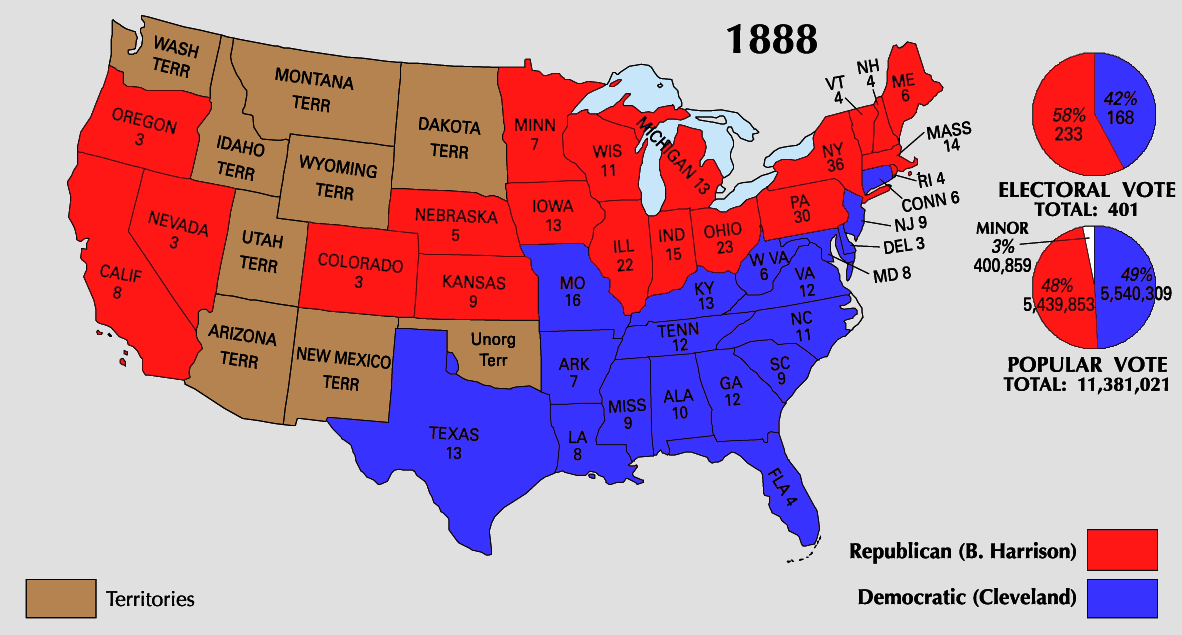
The map above shows the result of the 1888 US presidential election between Benjamin Harrison and Grover Cleveland. Turnout for the election was 80.50%.
Here are the key details:
| Winner: | Runner-Up: | |
|---|---|---|
| Name: | Benjamin Harrison | Grover Cleveland |
| Political Party: | Republican | Democratic |
| Home state: | Indiana | New York |
| VP Name: | Levi P. Morton | Allen G. Thurman |
| States: Won (Out of 38): | 20 | 18 |
| Electoral College Votes (out of 401): | 233 | 168 |
| Percentage of Popular Vote | 47.80% | 48.60% |
| Total Votes | 5,443,892 | 5,534,488 |
| Margin % | −0.83% | – |
| Margin (votes) | −90,596 | – |
| 3rd Place | 4th Place: | |
|---|---|---|
| Name: | Clinton B. Fisk | Alson Streeter |
| Political Party | Prohibition | Union Labor |
| Electoral College Votes | 0 | 0 |
| Number of Votes: | 249,819 | 146,602 |
| Percentage of Popular Vote: | 2.20% | 1.31% |
What were the key issues in the 1888 election?
Here’s a breakdown of the major issues and where each candidate stood:
1. Tariffs and Trade
Grover Cleveland (Democratic Party): Cleveland advocated for lowering tariffs, which he argued were too high and placed an unfair burden on consumers by increasing the cost of goods. In his view, high tariffs created excess revenue for the federal government, leading to a surplus that he believed was unnecessary and should be reduced.
Cleveland’s position was based on the belief that lowering tariffs would benefit consumers and reduce government waste.
Benjamin Harrison (Republican Party): Harrison, by contrast, supported high protective tariffs. Republicans argued that tariffs were necessary to protect American industries and workers from foreign competition.
They contended that high tariffs would encourage American manufacturing, ensure job stability, and lead to better wages. Harrison’s stance was popular in industrial areas where factories and manufacturing were central to the economy.
2. Veterans’ Pensions
Grover Cleveland: Cleveland took a conservative approach to veterans’ pensions, vetoing many pension bills he viewed as fraudulent or unjustified. He believed in granting pensions only to veterans with legitimate service-connected disabilities, not for unrelated issues or cases he considered spurious.
This position made him unpopular among Union veterans and the Grand Army of the Republic (GAR), a powerful lobbying group for veterans.
Benjamin Harrison: Harrison, a Union Army veteran himself, was more sympathetic to veterans’ issues and supported expanding pensions for Union veterans. He argued for broader pension policies to honor and support those who had served, appealing to voters who were Union veterans or supportive of veterans’ interests.
3. Civil Service Reform
Grover Cleveland: Cleveland supported civil service reform and sought to limit the “spoils system” where government jobs were given as rewards for political support. His administration aimed to reduce corruption by appointing qualified individuals rather than political loyalists.
Benjamin Harrison: While Republicans were generally supportive of civil service reform, they were more inclined than Cleveland to reward party supporters with government positions.
Harrison’s stance was less restrictive, and he was willing to allow some political appointments to reward party loyalty, although he didn’t fully oppose reform.
4. Economic Management and Government Surplus
Grover Cleveland: Cleveland’s tariff policy was also tied to his concern over the growing federal surplus, which he saw as economically inefficient and potentially corrupting.
He believed the surplus indicated that the government was overtaxing citizens, and he viewed tariff reduction as a way to reduce this surplus responsibly.
Benjamin Harrison: Harrison and the Republicans did not see the surplus as a major issue that required lowering tariffs. Instead, they argued it could be used for internal improvements or expanding pensions, especially for veterans, thus making use of the surplus without reducing tariffs.
Why did Harrison win?
Benjamin Harrison won the 1888 presidential election primarily due to the electoral advantages created by his strong support in key industrial states, which swung the electoral college in his favor, despite Grover Cleveland winning the popular vote.
Several factors explain Harrison’s victory:
1. The Tariff Issue and Support from Northern States
- High Tariffs and Industrial Support: Harrison’s stance on maintaining high protective tariffs appealed to voters in Northern industrial states, where manufacturing and jobs were closely tied to tariff protection from foreign competition. These tariffs were popular in states like Ohio, Indiana, Pennsylvania, and New York, which had significant manufacturing sectors and where high tariffs were seen as essential to economic stability.
- Economic Interests: Manufacturers and business owners were generally aligned with the Republican Party because the high tariffs protected American-made goods from cheaper foreign imports. Workers in these regions also supported tariffs, believing that they helped maintain high wages by limiting competition from cheaper labor markets abroad.
2. The Role of Veterans and the Grand Army of the Republic (GAR)
- Veterans’ Pensions: Harrison’s support for expanded veterans’ pensions resonated with Union veterans and their families, a sizable and politically active constituency, especially in the North. The Grand Army of the Republic (GAR), a powerful veterans’ organization, endorsed Harrison and mobilized support against Cleveland, who had vetoed several pension bills and was seen as unsympathetic to veterans’ causes.
- Personal Connection: Harrison was a Union Army veteran himself, which further strengthened his appeal among Northern veterans. This alignment with the GAR and veterans’ interests bolstered his support in the North, where GAR members and veterans turned out strongly for Harrison.
3. Political Strategy and Republican Party Organization
- Republican Party Machine: The Republican Party had a highly organized political machine, particularly in swing states, which allowed them to mobilize voters effectively. They used various methods, including door-to-door canvassing and rallying support in local communities, to ensure a strong turnout for Harrison.
- Targeted Electoral Focus: Recognizing that winning the electoral college was key, Republicans concentrated their efforts on pivotal swing states, particularly New York and Indiana (Harrison’s home state). By focusing resources on these states, they managed to secure narrow but crucial victories.
- “Blocks of Five” Tactics: There were also accusations that Republicans engaged in vote-buying, particularly in Indiana, through a tactic known as “blocks of five,” where party operatives allegedly bought votes in blocks of five voters to swing tight races. Although these allegations were never fully proven, they reflect the aggressive tactics used in key states.
4. Electoral College Dynamics
- Cleveland’s Popular Vote vs. Electoral College Loss: Although Cleveland won the popular vote by a slim margin, Harrison’s strategy focused on winning the electoral college, where the concentration of support in Northern swing states mattered more. In states with large populations, like New York and Indiana, Harrison’s margin of victory in the electoral vote was enough to secure the presidency even without a majority of the popular vote.
- Geographic Advantage: Harrison’s support in densely populated industrial states gave him the edge in electoral votes, despite Cleveland having strong support in the South and the popular vote majority. The electoral system’s weighting toward states with higher populations meant that Harrison’s victories in critical Northern states were more decisive.
5. Cleveland’s Vulnerabilities
- Vetoes of Popular Bills: Cleveland’s frequent use of the veto, especially on veterans’ pensions, alienated groups that might have supported him otherwise. Many voters saw his vetoes as overly harsh, making him vulnerable to charges that he was unsupportive of Union veterans and their families.
- Lack of a Strong Counter-Message on Tariffs: While Cleveland made the case for lowering tariffs to reduce the government surplus, this message did not resonate as strongly with voters who believed tariffs were necessary for job security and economic growth. The high tariff message from Republicans had a stronger appeal in the key Northern industrial states Cleveland needed to win.
1888 Election Results Map By County

1888 Map From The National Atlas of the United States (now sadly permanently offline)
Other US Presidential Election Maps: