
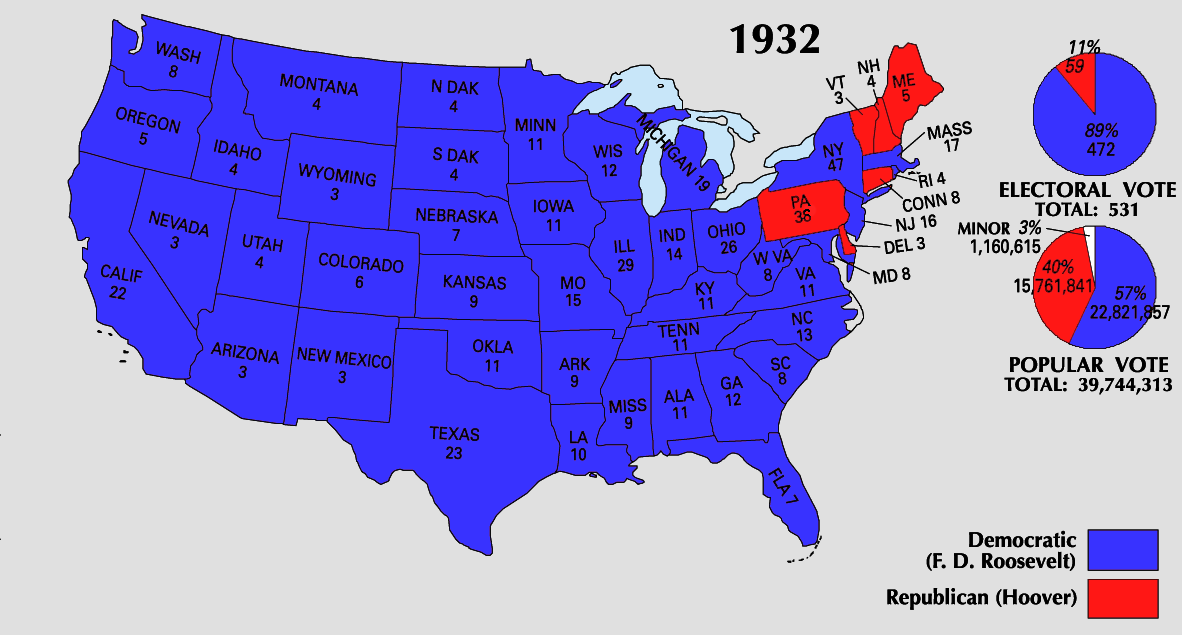
The map above shows the result of the 1932 US presidential election between Franklin D. Roosevelt and Herbert Hoover. Turnout for the election was 56.90%.
Here are the key details:
| Winner: | Runner-Up: | |
|---|---|---|
| Name: | Franklin D. Roosevelt | Herbert Hoover |
| Political Party: | Democratic | Republican |
| Home state: | New York | California |
| VP Name: | John Nance Garner | Charles Curtis |
| States: Won (Out of 48): | 42 | 6 |
| Electoral College Votes (out of 531): | 472 | 59 |
| Percentage of Popular Vote | 57.41% | 39.70% |
| Total Votes | 22,821,277 | 15,761,254 |
| Margin % | 17.76% | – |
| Margin (votes) | 7,060,023 | – |
| 3rd Place | 4th Place: | |
|---|---|---|
| Name: | Norman Thomas | William Z. Foster |
| Political Party | Socialist | Communist |
| Electoral College Votes | 0 | 0 |
| Number of Votes: | 884,885 | 103,307 |
| Percentage of Popular Vote: | 2.23% | 0.26% |
What were the key issues of the 1932 election?
The 1932 U.S. presidential election took place during the Great Depression, and the main issues revolved around how to address the severe economic crisis.
Here is an overview of where they stood on the main issues:
1. Economic Recovery and the Great Depression
Herbert Hoover: As the incumbent president, Hoover believed in limited government intervention. He argued that the economy would eventually recover on its own through private initiative and individual efforts.
While he had created some government programs like the Reconstruction Finance Corporation to help businesses and banks, he opposed direct relief or large-scale government involvement in the economy, fearing it would undermine individual responsibility and lead to socialism.
Franklin D. Roosevelt: Roosevelt advocated for much more active government intervention to address the crisis. His platform called for a “new deal for the American people” (what would later become known as the New Deal), which proposed government programs to provide jobs, relief for the poor, and regulations to prevent future economic disasters.
He believed the federal government should play a significant role in restoring economic stability.
2. Unemployment
Herbert Hoover: Hoover believed that voluntary cooperation between businesses and workers, supported by local governments and charities, would be sufficient to address the growing unemployment crisis. He was reluctant to increase federal spending for public works or direct assistance.
Franklin D. Roosevelt: Roosevelt called for direct government action to address unemployment, including the creation of public works programs to provide jobs and stimulate the economy. He emphasized that the federal government should help those in need through direct relief and job creation.
3. Agricultural Crisis
Herbert Hoover: Hoover supported measures like the Agricultural Marketing Act of 1929 to stabilize farm prices and provide credit to farmers. However, many believed his efforts were too little and ineffective in solving the deep-rooted problems of overproduction and falling prices in the agricultural sector.
Franklin D. Roosevelt: Roosevelt advocated for more aggressive action to help farmers, including price supports and policies that would reduce overproduction. This eventually led to programs like the Agricultural Adjustment Act (AAA) under his New Deal, which aimed to raise farm income by controlling production and supporting prices.
4. Government Spending and Balanced Budget
Herbert Hoover: Hoover was committed to balancing the federal budget. He believed that large deficits and government spending would worsen the economic situation. Even during the Depression, he increased taxes, such as with the Revenue Act of 1932, to reduce the deficit.
Franklin D. Roosevelt: While Roosevelt initially spoke of the need for a balanced budget, he was more willing to accept deficit spending as a necessary tool to stimulate the economy and provide relief. His policies during his presidency led to significant government spending to create jobs and provide economic support.
5. Banks and Financial Regulation
Herbert Hoover: Hoover supported the Reconstruction Finance Corporation, which provided loans to banks and large businesses. However, he did not advocate for comprehensive banking reforms or deposit insurance.
Franklin D. Roosevelt: Roosevelt believed in stricter regulation of the financial industry to prevent future collapses. His administration later introduced reforms such as the Glass-Steagall Act and the creation of the Federal Deposit Insurance Corporation (FDIC) to stabilize the banking system and protect depositors.
6. Prohibition
Herbert Hoover: Hoover supported maintaining Prohibition, which had been in effect since 1920. He believed it was a “noble experiment” aimed at improving American society, despite the growing unpopularity of the law and its role in fostering organized crime.
Franklin D. Roosevelt: Roosevelt favored the repeal of Prohibition, reflecting the changing public sentiment that the ban on alcohol was ineffective and harmful to the economy. He advocated for legalizing alcohol as a means of raising government revenue through taxation.
7. Public Opinion and Political Rhetoric
Herbert Hoover: Hoover’s approach during the campaign was to defend his administration’s actions and argue that the worst of the Depression had already passed. He continued to emphasize individualism and self-reliance.
Franklin D. Roosevelt: Roosevelt was optimistic and exuded a sense of hope and renewal. He promised a “New Deal” and took a more pragmatic approach, willing to experiment with new ideas and policies. His campaign focused on the idea that the federal government had a responsibility to act aggressively to help the people.
Why did Roosevelt win?
Here are the key reasons why Roosevelt won:
1. The Great Depression and Public Discontent
- The United States was in the midst of the Great Depression, which began with the stock market crash of 1929 and had worsened by 1932. Unemployment reached about 25%, banks were failing, businesses were collapsing, and millions of Americans were living in poverty.
- Herbert Hoover, as the incumbent president, was blamed for the worsening conditions. His reluctance to provide direct federal relief to individuals and his adherence to the idea of limited government intervention made him seem out of touch with the desperate needs of ordinary people. As a result, Hoover was deeply unpopular, and many voters wanted change.
2. Roosevelt’s Promise of the New Deal
- Roosevelt’s campaign focused on offering hope and solutions through his promise of a “New Deal” for the American people. Although he was not specific about all of his policies during the campaign, he clearly advocated for a more active role for the federal government in addressing the economic crisis.
- His vision of government intervention to create jobs, provide relief, and stabilize the economy resonated with millions of Americans who were suffering under the economic downturn. Roosevelt’s willingness to experiment with new ideas and his pragmatism made him seem like the leader who could turn the country around.
3. Hoover’s Unpopularity
- Hoover’s policies, which included efforts like the Reconstruction Finance Corporation to help businesses and banks, were perceived as too focused on aiding big business and not doing enough to help average Americans. His insistence on balancing the federal budget and raising taxes in the midst of a depression also hurt his reputation.
- Hoover’s handling of the Bonus Army protest in 1932 further damaged his image. When thousands of World War I veterans marched on Washington, D.C., demanding early payment of bonuses they had been promised, Hoover ordered the U.S. Army to forcibly remove them. This resulted in a violent confrontation, further alienating voters.
4. Roosevelt’s Charisma and Optimism
- Roosevelt had a charismatic personality and a remarkable ability to connect with voters. His optimistic and hopeful tone stood in stark contrast to Hoover’s more dour and defensive rhetoric. Roosevelt’s speeches, particularly his promise of a “new deal” and his emphasis on bold, persistent experimentation, inspired confidence.
- His personal story of overcoming polio added to his appeal, as he was seen as a fighter who had triumphed over adversity—something many Americans could relate to during the Great Depression.
5. The Democratic Party’s Appeal
- The Democratic Party had been out of power for most of the preceding decade, and Roosevelt’s campaign revitalized the party by bringing together a broad coalition of voters. His campaign reached out to urban workers, farmers, immigrants, African Americans, and other groups who had been hit hard by the Depression.
- Roosevelt’s campaign also targeted key swing states and regions, helping to build a new political coalition that would remain influential for years. The Democrats became the party of government intervention and economic relief, which won over many voters who had traditionally supported the Republicans.
6. Campaign Strategy and Media
- Roosevelt’s campaign utilized the radio effectively to communicate his message to the public, a new and powerful medium at the time. He spoke directly to the people with clarity and warmth, building trust and expanding his reach.
- His campaign was also well-organized and focused on mobilizing voters. Roosevelt’s Democratic Party capitalized on the growing dissatisfaction with Hoover and the Republicans, running a highly effective national campaign that worked to energize key voter bases.
7. The Call for Government Action
- Many Americans had come to believe that direct government action was necessary to solve the economic problems the country was facing. Roosevelt’s call for expanded federal programs, such as public works to create jobs and economic relief for the poor, appealed to this growing sentiment.
- In contrast, Hoover’s philosophy of “rugged individualism” and belief in limited government action seemed increasingly out of step with the realities of the Depression. Roosevelt’s vision of a more active government was seen as the more realistic and humane solution.
8. Voter Turnout and Realignment
- The election of 1932 marked the beginning of a major political realignment in the United States. Roosevelt’s victory helped to create a lasting Democratic majority that would dominate American politics for decades. His success in winning over urban voters, working-class Americans, and African Americans (who had previously largely supported Republicans) helped reshape the political landscape.
- Roosevelt won in a landslide, capturing 472 electoral votes to Hoover’s 59, and winning 57% of the popular vote. This overwhelming victory was a clear rejection of Hoover’s policies and a mandate for Roosevelt’s New Deal.
1932 Election Results Map By County

1932 Map From The National Atlas of the United States (now sadly permanently offline)
Other US Presidential Election Maps: