
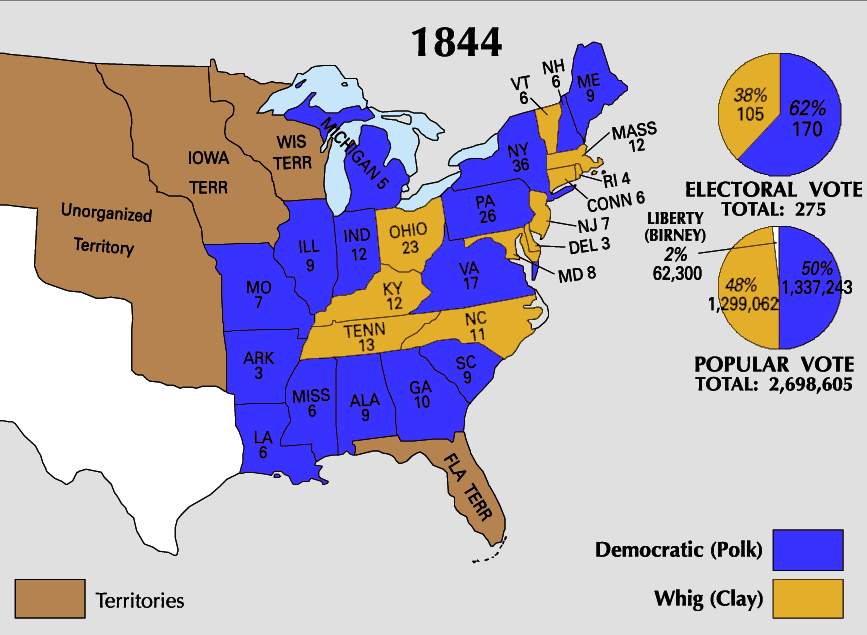
The map above shows the result of the 1844 US presidential election between James K. Polk and Henry Clay. Turnout for the election was 79.20%.
Here are the key details:
| Winner: | Runner-Up: | |
|---|---|---|
| Name: | James K. Polk | Henry Clay |
| Political Party: | Democratic | Whig |
| Home state: | Tennessee | Kentucky |
| VP Name: | George M. Dallas | Theodore Frelinghuysen |
| States: Won (Out of 26): | 15 | 11 |
| Electoral College Votes (out of 275): | 170 | 105 |
| Percentage of Popular Vote | 49.54% | 48.10% |
| Total Votes | 1,339,570 | 1,300,004 |
| Margin % | 1.45% | – |
| Margin (votes) | 39,413 | – |
| 3rd Place | 4th Place | |
|---|---|---|
| Name: | James G. Birney | NA |
| Political Party | Liberty | NA |
| Electoral College Votes | 0 | NA |
| Number of Votes: | 62,103 | NA |
| Percentage of Popular Vote: | 2.30% | NA |
What were the key issues in the 1844 election?
The 1844 U.S. presidential election was primarily defined by two key issues: the annexation of Texas and the expansion of slavery. The two main candidates, James K. Polk (Democratic Party) and Henry Clay (Whig Party), held opposing views on these issues, reflecting the intense regional tensions of the time. Here’s an overview of the main issues and each candidate’s stance:
1. Annexation of Texas and Manifest Destiny
- James K. Polk (Democrat): Polk strongly supported the annexation of Texas and embraced the idea of Manifest Destiny — the belief that the U.S. was destined to expand across North America. Polk’s campaign slogan, “Fifty-Four Forty or Fight,” captured his desire to acquire not only Texas but also the Oregon Territory up to latitude 54°40′ (though he later compromised). He argued that U.S. expansion was beneficial for the country’s economic growth and would spread democratic values.
- Henry Clay (Whig): Clay opposed the immediate annexation of Texas, fearing it would lead to war with Mexico and further divide the country over the issue of slavery. He believed the acquisition of Texas would disturb the balance between free and slave states, risking sectional conflict. Clay initially took a more ambiguous stance but later came out clearly against annexation due to growing Northern opposition.
2. Expansion of Slavery
- James K. Polk: While Polk himself was a slaveholder and was sympathetic to the South, he avoided taking a strong public stance on slavery during his campaign, instead focusing on territorial expansion. By advocating for the annexation of Texas, Polk implicitly supported the spread of slavery, as Texas would enter the Union as a slave state, increasing the South’s political power.
- Henry Clay: Clay tried to strike a balance by expressing opposition to the immediate annexation of Texas, partly because it would expand slave territory. However, he didn’t present himself as an abolitionist, recognizing the Whig Party’s base was split on the issue. His opposition to annexation was more about the risks of war with Mexico and disrupting the delicate North-South balance in Congress than a moral stance against slavery.
3. Oregon Territory Dispute
- James K. Polk: Polk supported acquiring the Oregon Territory from Great Britain and was willing to go to war over it, hence the slogan “Fifty-Four Forty or Fight.” Ultimately, though, he compromised with Britain to set the boundary at the 49th parallel.
- Henry Clay: Clay did not emphasize Oregon as much as Polk and focused on preserving peace with Britain, showing less enthusiasm for territorial expansion in this region. His more cautious approach on Oregon aligned with his broader desire to avoid conflict over new territories.
4. Tariffs and Economic Policy
- James K. Polk: Polk supported lower tariffs and was generally in favor of a more agrarian, Southern economy with limited government intervention.
- Henry Clay: Clay was a proponent of the American System, advocating for high tariffs to protect American industries, a strong banking system, and federal funding for internal improvements like roads and canals to support economic growth and connect the country’s regions.
Why did Polk win?
Here’s an analysis of why and how he achieved victory:
1. Clear Support for Manifest Destiny
Polk’s campaign capitalized on the widespread popular belief in Manifest Destiny, the notion that the U.S. was divinely ordained to expand across North America.
By championing the annexation of Texas and the acquisition of the Oregon Territory, Polk presented himself as the candidate who would fulfill this vision of westward expansion, appealing to voters who believed that more land would bring economic opportunity and national prosperity.
His slogan, “Fifty-Four Forty or Fight,” tapped into this expansionist enthusiasm, indicating his willingness to assert U.S. claims in Oregon. Although he eventually compromised on the Oregon boundary with Britain, his rhetoric resonated with expansion-minded Americans.
2. Clay’s Ambiguity on Texas Annexation
Henry Clay, the Whig candidate, took a more cautious and ambiguous stance on the issue of Texas annexation. He initially wavered on the subject, which hurt his credibility.
His eventual opposition to annexation was a calculated move to avoid antagonizing Northern voters who feared the spread of slavery, but it alienated Southern voters who supported annexation.
Polk’s straightforward, pro-annexation position drew a clear contrast to Clay’s, winning over voters who valued clarity and were eager for expansion. This decisive stance made Polk appear more committed to territorial growth than Clay, especially in the South and among expansionists.
3. Appeal to Both Northern and Southern Voters
Polk crafted his campaign to appeal to both Northerners and Southerners. By advocating for the expansion of both Texas (which would likely become a slave state) and Oregon (seen as potential free territory), Polk managed to appease Southern voters who wanted to expand slaveholding territory while simultaneously appealing to Northern voters who sought land where slavery would not be permitted.
His dual focus on Texas and Oregon created a broad coalition that crossed sectional lines, allowing him to win support from both pro-slavery Southerners and anti-slavery Northerners who still wanted to see the U.S. grow.
4. Third-Party Candidate: The Liberty Party
The presence of the Liberty Party, an abolitionist third party led by James G. Birney, split the Whig vote in New York. The Liberty Party drew anti-slavery voters who otherwise might have supported Clay, especially in Northern states like New York where anti-slavery sentiment was strong.
This division proved crucial, as New York’s electoral votes were pivotal to winning the presidency. Polk won New York by a narrow margin, and had the Liberty Party not drawn votes away from Clay, it’s likely Clay could have carried the state and won the election.
5. Democratic Unity and Polk as a “Dark Horse” Candidate
Polk was a “dark horse” candidate, meaning he was relatively unknown and initially not expected to win the Democratic nomination. The frontrunner, Martin Van Buren, opposed Texas annexation, which was unpopular in the South.
As a compromise, Democrats nominated Polk, who supported annexation and was a staunch Jacksonian Democrat.
The Democratic Party rallied around Polk with strong unity, contrasting with a more divided Whig Party. This cohesion helped Polk mobilize Democratic voters and maintain focus on his expansionist platform.
6. Political Strategy and Timing of Texas Annexation
The issue of Texas was controversial, but the Democratic Party played its cards well by emphasizing that the annexation of Texas would be a way to secure the region before any European powers, particularly Britain, could exert influence. This framing made annexation appear as a patriotic duty, winning additional support.
After Polk’s election, President John Tyler, an outgoing Whig sympathetic to Democratic expansionist ideals, helped push through Texas annexation in early 1845, framing Polk’s victory as a mandate for expansion and Manifest Destiny.
Also see: Map of President Polk’s Plans For The United States
1844 Election Results Map By County

1844 Map From The National Atlas of the United States (now sadly permanently offline)
Other US Presidential Election Maps: