
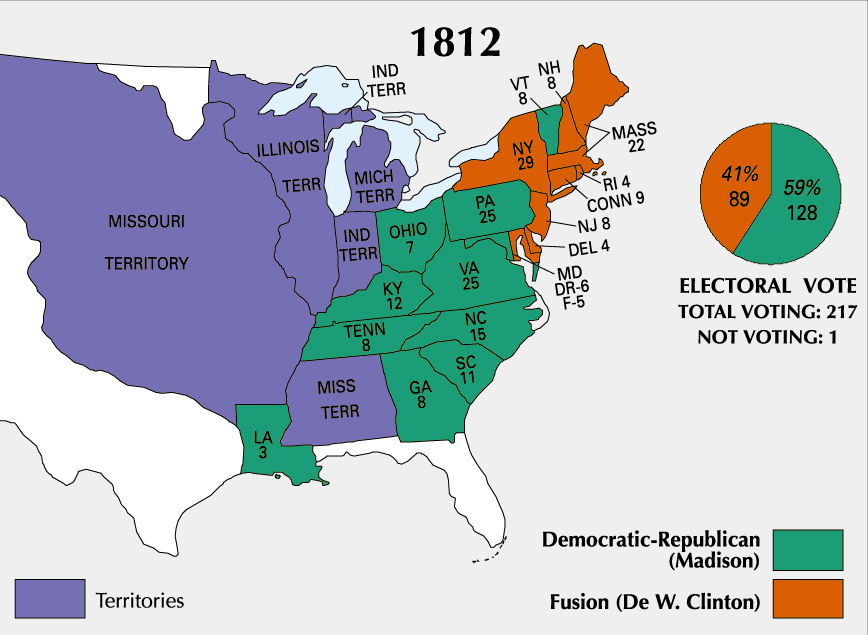
The map above shows the result of the 1812 US presidential election between James Madison and DeWitt Clinton. Turnout for the election was 40.40%.
Here are the key details:
| Winner: | Runner-Up: | |
|---|---|---|
| Name: | James Madison | DeWitt Clinton |
| Political Party: | Democratic-Republican | Democratic-Republican |
| Home state: | Virginia | New York |
| VP Name: | Elbridge Gerry | Jared Ingersoll |
| States: Won (Out of 18): | 11 | 7 |
| Electoral College Votes (out of 217): | 128 | 89 |
| Percentage of Popular Vote | 50.37% | 47.60% |
| Total Votes | 140,431 | 132,781 |
| Margin % | 2.74% | – |
| Margin (votes) | 7,650 | – |
5 Facts About the election:
Here are 5 interesting facts about the 1812 U.S. presidential election:
- First Wartime Presidential Election: The 1812 election was the first and only U.S. presidential election to take place during an active war until the Civil War in 1864. The election unfolded against the backdrop of the War of 1812, which created a highly charged and divided political atmosphere.
- Fusion Candidacy of DeWitt Clinton: DeWitt Clinton was a unique candidate because he was supported by both Federalists and disaffected Democratic-Republicans, forming an unusual coalition. This alliance was built on shared opposition to the war but lacked cohesion, which ultimately weakened his campaign.
- Narrow Popular Vote: While Madison won the Electoral College by a decisive margin (128 to 89), the popular vote was much closer. This reflects the deep division within the nation, with significant regional variation in support for Madison’s war policies.
- Impact of the War on Regional Voting Patterns: The war had a significant influence on voting patterns. Madison’s support was strongest in the South and the West, where anti-British sentiment and the desire for territorial expansion were high. Conversely, Clinton found more support in New England, where the war’s negative impact on trade led to widespread dissatisfaction.
- The Role of Native American Conflicts: One aspect that swayed many voters, especially in western regions, was the perception that the British were encouraging and supporting Native American resistance against American expansion. Madison’s strong stance on pushing back against British influence in these territories helped him maintain support from these key areas.
What were the key issues in the 1812 election?
The 1812 U.S. presidential election occurred against the backdrop of the War of 1812, a significant and divisive conflict between the United States and Great Britain.
Here are the key issues and where each candidate stood:
1. The War of 1812
- James Madison (Democratic-Republican Party): As the incumbent president, Madison was a strong supporter of the war. He believed it was necessary to defend American sovereignty and respond to British impressment of American sailors and interference with U.S. trade. Madison’s administration argued that Britain’s actions were a direct affront to U.S. independence and economic rights.
- DeWitt Clinton (Federalist-supported, but running as a fusion candidate): Clinton, a prominent New York politician, represented a coalition that included disaffected Democratic-Republicans and Federalists who opposed the war. He argued that the conflict was poorly managed and unnecessary, and he called for a negotiated peace to end hostilities. Many of his supporters viewed the war as harmful to American trade and regional economic interests, particularly in New England, which suffered the most due to disrupted maritime commerce.
2. National Defense and Military Preparedness
- Madison: Advocated for strengthening the military to protect American interests and continue the war effort. Madison’s administration focused on rallying public support and resources to fight Britain, despite initial setbacks in military campaigns.
- Clinton: Criticized the government’s lack of preparedness for war and its handling of military operations. His campaign suggested that better leadership and strategic planning were needed, emphasizing a shift toward more efficient defense and less aggressive posturing.
3. Economic Policy and Trade
- Madison: The war exacerbated existing tensions over economic policies. Madison and the Democratic-Republicans favored a more agrarian-based economy with limited government intervention, even as they sought temporary measures to address wartime disruptions. The administration’s support for trade restrictions, like the Embargo Act of 1807 and subsequent Non-Intercourse Acts, was part of the lead-up to the war.
- Clinton: He and his supporters, particularly in the Northeast, opposed trade restrictions and the economic impact of the war. They argued that the embargoes and economic isolation damaged American merchants and hurt economic growth. Clinton’s stance appealed to those who wanted a return to a more stable trade environment with Britain and other nations.
4. Regional and Partisan Divides
- Madison: His support base was strong in the South and the West, regions that were more agrarian and supportive of expanding American territory. These areas were more inclined to view British support of Native American resistance as a threat that justified war.
- Clinton: Had stronger support in New England and other areas tied to trade and commerce, where the Federalist influence was greater, and opposition to the war was more pronounced. These regions favored peace to resume their economic activities and reduce federal control over trade.
Why did Madison win?
James Madison won the 1812 presidential election due to a combination of factors related to political alignment, regional support, public perception of the war, and the fractured nature of opposition to his administration.
Here’s an overview of how and why he secured re-election:
1. Strong Support Among Democratic-Republicans
- Party Loyalty: Madison was the incumbent president and leader of the Democratic-Republican Party, which was the dominant political force at the time. The party had broad support in the South and West, regions that were more inclined to view British actions as affronts to American sovereignty.
- Congressional Backing: Madison benefited from the backing of a Congress controlled by Democratic-Republicans who supported his policies, including the war effort. This gave him a strong political machine that was able to mobilize voters effectively.
2. Popular Support for National Honor and Sovereignty
- War Sentiment: While the War of 1812 was divisive, many Americans, particularly in the West and South, saw it as a necessary response to British violations of American rights, such as the impressment of American sailors and interference with U.S. trade. Madison successfully appealed to nationalistic sentiments by framing the conflict as a defense of American honor and independence.
- Native American Conflict: The British were accused of supporting Native American tribes resisting American expansion in the western territories. This further rallied western and southern support for the war, reinforcing Madison’s position as a leader committed to securing American frontiers.
3. Fragmented Opposition
- DeWitt Clinton’s Coalition: Clinton ran as a fusion candidate supported by the Federalists and some discontented Democratic-Republicans. However, this coalition was not cohesive and had conflicting interests. While the Federalists opposed the war, many Democratic-Republicans in Clinton’s camp had more moderate views on the conflict.
- Regional Divide: Clinton’s strongest support came from New England, a region highly critical of the war due to its detrimental impact on trade and commerce. However, outside of New England, his appeal was limited. Madison was able to capitalize on broader national support across the South and West, which weakened Clinton’s ability to build a unified opposition.
4. Perception of Clinton as Inconsistent
- Mixed Messaging: Clinton’s attempt to build a coalition with different political factions led to a perception that he lacked a clear, consistent stance on major issues. While he criticized the war, he did not present a strong, unified alternative policy that could resonate nationwide.
- Federalist Stigma: The Federalists were unpopular in many parts of the country due to their perceived elitism and opposition to expansionist policies. Clinton’s association with the Federalists alienated some voters who might otherwise have been drawn to his anti-war stance.
5. Madison’s Incumbency Advantage
- Presidential Power: As the sitting president, Madison had the advantage of incumbency, including established political influence and access to national communication channels. His leadership during wartime, despite criticisms, conveyed stability to many voters.
- Framing of the War Effort: Madison and his supporters were able to frame the ongoing conflict as a patriotic struggle, emphasizing resilience against British aggression. This narrative appealed to a sense of unity and independence, themes that resonated deeply in the young nation.
Outcome
Madison secured 128 electoral votes to Clinton’s 89, demonstrating the enduring strength of the Democratic-Republican coalition. His victory affirmed support for continuing the war effort and solidified the party’s influence for years to come.
1812 Election Results Map By County

1812 Map From The National Atlas of the United States (now sadly permanently offline)
Other US Presidential Election Maps: