
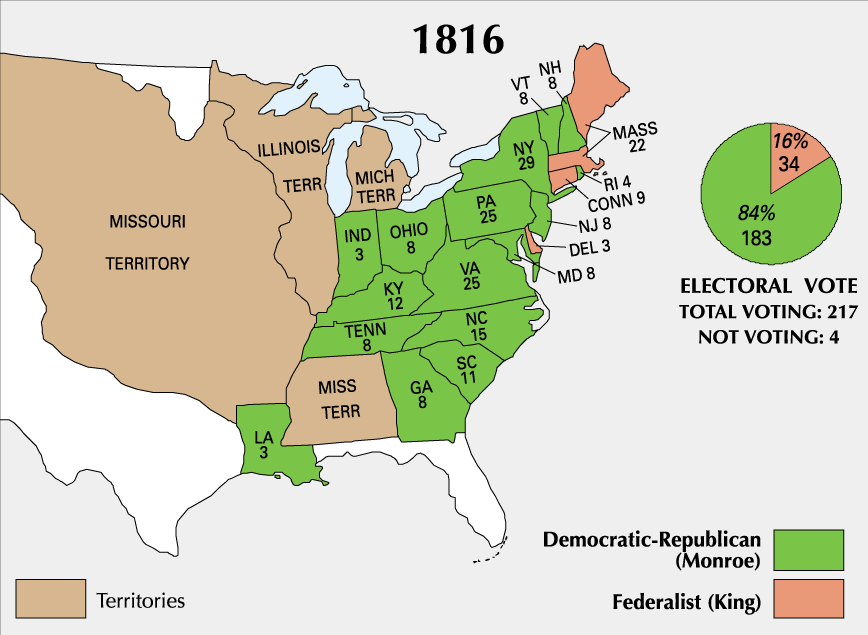
The map above shows the result of the 1816 US presidential election between James Monroe and Rufus King. Turnout for the election was 23.50%.
Here are the key details:
| Winner: | Runner-Up: | |
|---|---|---|
| Name: | James Monroe | Rufus King |
| Political Party: | Democratic-Republican | Federalist |
| Home state: | Virginia | New York |
| VP Name: | Daniel D. Tompkins | John E. Howard |
| States: Won (Out of 19): | 16 | 3 |
| Electoral College Votes (out of 217): | 183 | 34 |
| Percentage of Popular Vote | 68.16% | 30.90% |
| Total Votes | 76,592 | 34,740 |
| Margin % | 37.24% | – |
| Margin (votes) | 41,852 | – |
5 Facts About the 1816 Election
Here are five interesting facts about the 1816 U.S. Presidential Election:
- The Era of Good Feelings: The 1816 election marked the beginning of what is known as the “Era of Good Feelings,” a period in U.S. history characterized by a decline in partisan divisions and political unity under the Democratic-Republican Party. This was largely due to the collapse of the Federalist Party, leaving James Monroe and the Democratic-Republicans as the dominant political force.
- James Monroe’s Victory: James Monroe, the Democratic-Republican candidate and Secretary of State under President James Madison, won a decisive victory over his opponent, Rufus King. Monroe secured 183 electoral votes, while King, the last Federalist candidate to run for president, received only 34.
- Last Stand for the Federalists: The 1816 election was the last presidential election in which the Federalist Party fielded a candidate. Their decline was precipitated by the unpopularity of their stance during the War of 1812, including opposition to the war itself, which many Americans viewed as unpatriotic.
- Regional Divisions: The election highlighted regional voting trends, with Monroe winning every state except Massachusetts, Connecticut, and Delaware. These states remained Federalist strongholds due to their economic interests and historical alignment with Federalist policies.
- Monroe’s Near Unanimous Re-election Foreshadowed: Monroe’s landslide victory in 1816 set the stage for his even more impressive re-election in 1820. In that election, he won almost unanimously, with only one elector casting a vote for John Quincy Adams to maintain George Washington’s record as the only president unanimously elected.
What were the key issues of the 1816 US election?
The 1816 U.S. presidential election marked a period of political transition and was largely shaped by the end of the War of 1812, economic concerns, and the fading influence of the Federalist Party.
Key issues included post-war economic policies, national unity, and foreign relations. Here’s a breakdown of the key issues and where each candidate stood:
Key Issues and Candidates’ Positions
- Post-War Economic Policy
- National Bank: The War of 1812 had exposed weaknesses in the U.S. financial system, and the charter for the First Bank of the United States had expired in 1811. There was a push to establish a Second Bank to stabilize the currency and fund national economic growth.
- Internal Improvements: Politicians debated federal spending on infrastructure, such as roads and canals, to foster economic growth and unify the country.
James Monroe (Democratic-Republican): Monroe, supported by his party, favored establishing the Second Bank of the United States and federal investment in infrastructure. The Democratic-Republicans were beginning to adopt moderate positions on economic policy, recognizing the need for a national bank and improved infrastructure despite traditionally opposing federal power in these areas.
Rufus King (Federalist): The Federalist candidate, King, also supported the establishment of the Second Bank and had advocated for strong central economic policies. However, with the Federalist Party in decline, his stance did little to influence the election outcome.
- National Unity and “Era of Good Feelings”
- Following the War of 1812, there was a strong desire for national unity, leading to what would later be called the “Era of Good Feelings.” This was characterized by a spirit of bipartisanship and cooperation, as the Federalist Party was weakened, and the Democratic-Republicans became the dominant political force.
James Monroe: Monroe represented this desire for unity. He promised a government that would transcend party lines, appealing to the growing sense of nationalism. His election is often seen as a move toward a single-party system, as Federalists were increasingly marginalized.
Rufus King: King was one of the last prominent Federalists. However, the Federalist Party was in steep decline after being tainted by opposition to the War of 1812 and the Hartford Convention (where some Federalists had even discussed New England secession). King’s focus on regional interests did not resonate as strongly with the push for national unity.
- Foreign Relations and Defense
- The War of 1812 had highlighted the need for a strong defense and a cohesive foreign policy, especially with regard to Britain and Spain, both of which still posed challenges along U.S. borders.
James Monroe: As Secretary of State under President James Madison, Monroe was already involved in shaping U.S. foreign policy. He was committed to securing U.S. interests against European influence and bolstering the country’s defenses, which appealed to voters who wanted a strong, stable foreign policy.
Rufus King: King was a seasoned diplomat and had a strong background in foreign policy. However, the Federalists’ historical association with pro-British stances was a liability following the war, making his foreign policy expertise less influential in the election.
Outcome and Significance
The 1816 election was a landslide victory for Monroe, reflecting widespread support for Democratic-Republican policies and signaling the end of the Federalist Party as a major political force.
Monroe’s election marked the beginning of the “Era of Good Feelings,” as partisan divisions temporarily softened.
1816 Election Results Map By County

1816 Map From The National Atlas of the United States (now sadly permanently offline)
Other US Presidential Election Maps: