
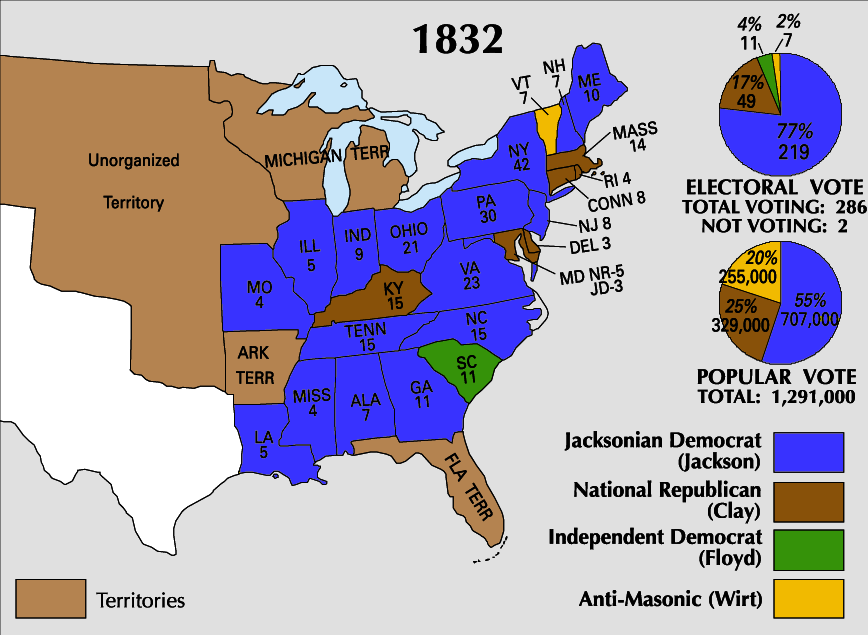
The map above shows the result of the 1832 US presidential election between Andrew Jackson, Henry Clay, John Floyd and William Wirt. Turnout for the election was 57.00%.
Here are the key details:
| Winner | Runner-Up | |
|---|---|---|
| Name: | Andrew Jackson | Henry Clay |
| Political Party: | Democratic | National Republican |
| Home state: | Tennessee | Kentucky |
| VP Name: | Martin Van Buren | John Sergeant |
| States: Won (Out of 24): | 16 | 6 |
| Electoral College Votes (out of 286): | 219 | 49 |
| Percentage of Popular Vote | 54.74% | 37.40% |
| Total Votes | 702,735 | 484,205 |
| Margin % | 17.81% | – |
| Margin (votes) | 228,628 | – |
| 3rd Place | 4th Place | |
|---|---|---|
| Name: | William Wirt | John Floyd |
| Political Party | Anti-Masonic | Nullifier |
| Electoral College Votes | 7 | 11 |
| Number of Votes: | 100,715 | NA |
| Percentage of Popular Vote: | 7.80% | NA |
5 Facts About the 1832 Election
Here are five interesting facts about the 1832 U.S. Presidential Election:
- First Use of National Party Conventions: The 1832 election was the first in U.S. history to feature national party conventions for nominating presidential candidates. The Democratic Party held its first national convention in Baltimore, where Andrew Jackson was nominated for re-election. This new approach to candidate selection became a cornerstone of future presidential elections and helped solidify the modern party system.
- The Key Issue: The Bank War: One of the central issues of the 1832 election was President Andrew Jackson’s opposition to the Second Bank of the United States. Jackson argued that the bank was a privileged institution that benefited the wealthy elite at the expense of ordinary citizens. His strong stance against the bank was a major campaign theme, and his victory was seen as a mandate to dismantle it, which he later did by vetoing the bank’s recharter and withdrawing federal funds.
- Formation of the Anti-Masonic Party: The 1832 election was notable for the emergence of the Anti-Masonic Party, the first third party in U.S. political history. The party was founded in response to widespread public suspicion of Freemasonry following the mysterious disappearance of William Morgan, a former Mason who threatened to expose the order’s secrets. The Anti-Masonic Party nominated former Attorney General William Wirt for president and campaigned on anti-Masonic and anti-elitist platforms.
- Jackson’s Victory and Re-election: Andrew Jackson secured a decisive victory in the 1832 election, defeating his main opponent, Henry Clay, who was nominated by the National Republican Party. Jackson received 219 electoral votes to Clay’s 49, reflecting his strong support among the general population and solidifying his position as a champion of the common man.
- Impact on the Political Landscape: The 1832 election further cemented the Democratic Party’s dominance and weakened the National Republican Party. It also set the stage for the formation of the Whig Party, which would soon emerge as the main opposition to the Democrats. The Whig Party was formed by a coalition of anti-Jackson forces, including former National Republicans, Anti-Masons, and disaffected Democrats, who opposed Jackson’s strong executive policies and his handling of the bank issue.
What were the key issues of the 1832 election?
The 1832 U.S. presidential election was primarily shaped by the following key issues: the national bank, states’ rights, tariffs, and federal power versus limited government. Four major candidates represented different perspectives on these issues:
1. Andrew Jackson (Democratic Party, Incumbent President)
- National Bank: Jackson strongly opposed the Second Bank of the United States, viewing it as a tool of elite interests that concentrated power away from the common people. He saw the Bank as corrupt and vetoed its recharter, framing his opposition as a fight against privileged monopolies.
- States’ Rights: While Jackson generally supported states’ rights, he rejected nullification (the idea that states could nullify federal laws they disagreed with). He maintained that states had to abide by federal law, as demonstrated by his actions during the Nullification Crisis.
- Tariffs: Jackson favored a more balanced approach to tariffs to prevent regional conflict but supported a moderate tariff policy to protect certain American industries.
- Federal Power: He advocated for a limited federal government but was willing to assert federal authority if it meant preserving the Union, as shown by his response to South Carolina’s nullification efforts.
2. Henry Clay (National Republican Party)
- National Bank: Clay was a strong supporter of the national bank and believed it was essential for stabilizing the economy and promoting growth. He ran on a platform of rechartering the Bank, positioning himself as a defender of economic stability against Jackson’s veto.
- States’ Rights: Clay supported federal supremacy in matters such as the Bank but advocated for compromises that could ease tensions between the federal government and states (like his 1833 compromise tariff).
- Tariffs: He was a proponent of the American System, which called for high tariffs to protect American industries, federal funding for infrastructure improvements, and a strong national bank.
- Federal Power: Clay favored a strong federal government with the power to implement policies that would unify and develop the nation economically.
3. John Floyd (Independent, supported by the Nullifier Party in South Carolina)
- National Bank: Floyd was generally opposed to a centralized national bank, aligning with Southern and states’ rights advocates who felt the Bank concentrated power away from individual states.
- States’ Rights: Floyd was a strong supporter of states’ rights, especially the idea of nullification, which allowed states to reject federal laws they deemed unconstitutional.
- Tariffs: He opposed protective tariffs, which he and many Southern leaders viewed as unfairly benefiting Northern industries at the expense of Southern economies.
- Federal Power: Floyd favored a limited federal government and championed state sovereignty, aligning with the Nullifier Party’s stance on states’ autonomy over federal authority.
4. William Wirt (Anti-Masonic Party)
- National Bank: Wirt’s stance on the Bank was not as central to his campaign as other issues. However, the Anti-Masonic Party was generally aligned with smaller government principles and would likely have leaned toward skepticism of the Bank’s power.
- States’ Rights: Wirt and the Anti-Masonic Party did not focus extensively on states’ rights, focusing instead on their opposition to Freemasonry and perceived secret elitism within government structures.
- Tariffs: The Anti-Masonic Party did not have a clear stance on tariffs, as their platform was less about economic policies and more about combating corruption and secret societies.
- Federal Power: Wirt’s platform emphasized a moral reform agenda and transparency, pushing for federal action against perceived corruption and secret influences, particularly those stemming from Freemasonry.
Why did Jackson win?
Here’s a closer look at why and how he achieved victory:
1. Popular Appeal and the “Common Man” Image
- Jackson had an image as a man of the people, stemming from his background as a self-made frontier man and war hero from the War of 1812. This appealed to the growing electorate of working-class Americans, farmers, and small business owners who felt alienated from elite Eastern interests.
- He portrayed himself as a defender of the people against what he saw as the corruption and privilege associated with elites in Washington and wealthy institutions like the national bank. This resonated strongly with voters who distrusted powerful institutions and preferred more democratic, populist leadership.
2. Stance Against the National Bank
- Jackson’s opposition to the Second Bank of the United States became a central issue in the election. He argued that the Bank was unconstitutional, corrupt, and an entity that concentrated power in the hands of a few wealthy individuals, thus threatening democratic principles.
- His veto of the Bank’s recharter became a defining moment. Jackson framed this action as a bold stand for ordinary Americans against an undemocratic monopoly, a message that resonated with many voters who feared elite control over their lives and economic prospects.
- The “Bank War” helped Jackson rally popular support, especially among the rural and Western populations, who were already suspicious of centralized financial power.
3. Expanding the Democratic Party and the First Party System
- Jackson’s campaign took advantage of the newly developed party structure, transforming his Democratic Party into a well-organized political force. The Democrats used new tactics like rallies, parades, and slogans to reach out to voters, creating excitement and fostering a sense of community around the Democratic cause.
- This early form of organized party politics helped mobilize voter turnout, which was further boosted by Jackson’s populist messaging.
4. Strength in the South and West
- Jackson was particularly popular in the Southern and Western states, where his views on states’ rights and his background as a military leader resonated strongly. These regions felt increasingly marginalized by the Northeast’s growing industrial power and were supportive of Jackson’s stance against the national bank.
- His moderate stance on states’ rights—opposing extreme actions like nullification but supporting state sovereignty in other areas—allowed him to appeal to both moderate and more radical voters in these regions.
5. Support from New Democratic Reforms in Voting
- Jackson benefited from the recent expansion of the electorate. By the 1832 election, many states had lowered or eliminated property requirements for voting, allowing more white men, particularly from lower economic classes, to participate in elections.
- Jackson’s image and policies appealed to these newly enfranchised voters, who saw him as someone who understood and represented their interests.
6. Opposition to Henry Clay and the National Republicans
- Jackson’s main opponent, Henry Clay, represented the interests of the National Republican Party and championed the American System, which included high tariffs, federal funding for infrastructure, and the national bank.
- Clay’s support for the Bank alienated many voters who viewed it as an elitist institution. Furthermore, his American System policies were not as popular in the South and West, where voters often saw federal intervention as threatening their autonomy and economic interests.
- Jackson successfully framed Clay and the National Republicans as being aligned with elite interests and out of touch with ordinary Americans’ needs, undermining Clay’s appeal.
7. Use of the Veto and Strong Executive Power
- Jackson’s use of the presidential veto to reject the Bank’s recharter, and his willingness to assert executive power, gave him the image of a strong, decisive leader. He appealed to those who wanted an active president who would use his power to challenge perceived injustices.
- Though controversial, his assertive style earned respect from many voters who felt that they finally had a president willing to take bold action to protect their interests.
1832 Election Results Map By County

1832 Map From The National Atlas of the United States (now sadly permanently offline)
Other US Presidential Election Maps: