
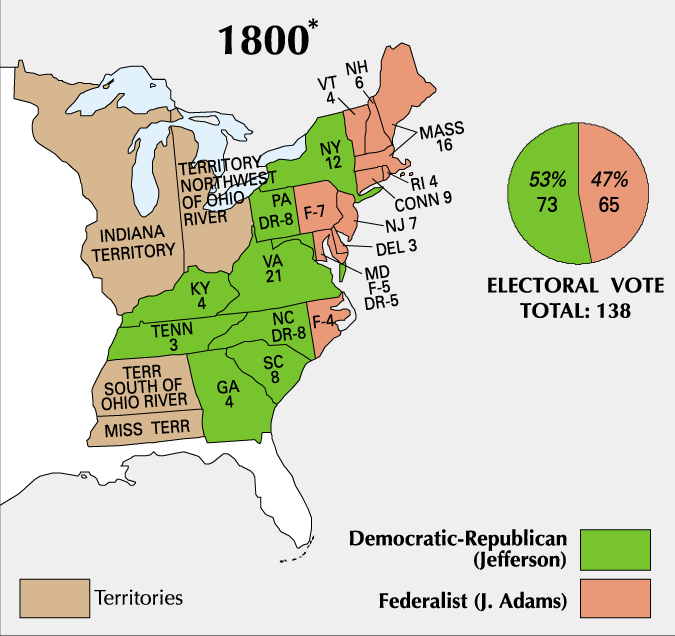
The map above shows the result of the 1800 US presidential election between Thomas Jefferson and John Adams. Turnout for the election was 32.30%.
Here are the key details:
| Winner: | Runner-Up: | |
|---|---|---|
| Name: | Thomas Jefferson | John Adams |
| Political Party: | Democratic-Republican | Federalist |
| Home state: | Virginia | Massachusetts |
| VP Name: | Aaron Burr | Charles C. Pinckney |
| States: Won (Out of 16): | 9 | 7 |
| Electoral College Votes (out of 138): | 73 | 65 |
| Percentage of Popular Vote | 61.43% | 39.40% |
| Total Votes | 45,467 | 29,621 |
| Margin % | 22.86% | – |
| Margin (votes) | 15,378 | – |
5 Facts About the 1800 Election
1. First Peaceful Transfer of Power Between Parties
The election of 1800 marked the first time in U.S. history that power was peacefully transferred from one political party to another. Thomas Jefferson’s victory over John Adams represented a significant moment in establishing the resilience and stability of the U.S. democratic system, which set an example for future transfers of power.
2. The Electoral College Tie
Thomas Jefferson and his running mate, Aaron Burr, ended up tied in the Electoral College with 73 votes each. At the time, electors cast two votes without distinguishing between president and vice president, leading to a dramatic tie that had to be resolved by the House of Representatives. This tie exposed flaws in the electoral process and led to the ratification of the 12th Amendment in 1804, which required separate votes for president and vice president.
3. Influence of Alexander Hamilton
Although Alexander Hamilton was a leading figure in the Federalist Party, he played a crucial role in Thomas Jefferson’s eventual victory. Hamilton detested Aaron Burr and worked behind the scenes to convince Federalist members of the House to support Jefferson, whom he believed, despite their ideological differences, was more honorable and trustworthy than Burr.
4. Bitter Campaigning and Personal Attacks
The 1800 election was one of the earliest examples of intense negative campaigning in U.S. politics. Supporters of both parties launched vicious attacks against the opposing candidate. Adams was labeled a “monarchist” by the Democratic-Republicans, while Jefferson was accused by Federalists of being an atheist and a radical who would bring chaos and destroy the nation’s religious fabric. The partisan press played a significant role in amplifying these attacks.
5. Aaron Burr’s Ambitions and Fallout
The tie between Jefferson and Burr had significant repercussions for Burr’s political career. Initially running as Jefferson’s vice-presidential candidate, Burr’s refusal to step aside during the tie-breaking vote in the House created suspicion about his ambitions. This move soured his relationship with Jefferson and led to his political marginalization. The incident also contributed to the longstanding enmity between Burr and Hamilton, culminating in their infamous duel in 1804, in which Hamilton was killed.
What were the key issues in the 1800 election?
The 1800 U.S. presidential election, often referred to as the “Revolution of 1800,” was a pivotal contest that showcased significant political and ideological differences between the two main candidates and their parties. The key issues and the candidates’ stances were as follows:
1. Federal Power vs. States’ Rights
- John Adams (Federalist Party): Adams and the Federalists believed in a strong centralized federal government. They argued that a robust national government was essential for maintaining order, stability, and unity in the young republic.
- Thomas Jefferson (Democratic-Republican Party): Jefferson, on the other hand, advocated for states’ rights and a limited federal government. He believed that individual states should have more power to govern themselves to prevent tyranny and protect personal liberties.
2. Alien and Sedition Acts
- John Adams: As president, Adams had overseen the passage of the Alien and Sedition Acts in 1798, which were aimed at reducing the influence of foreign nationals and silencing criticism of the government. The Federalists justified these acts as necessary for national security, particularly with the threat of war with France looming.
- Thomas Jefferson: Jefferson and the Democratic-Republicans strongly opposed the Alien and Sedition Acts, viewing them as overreaches of federal power and a violation of constitutional rights, particularly free speech and the freedom of the press. Jefferson’s campaign capitalized on public dissatisfaction with these acts.
3. Foreign Policy: France vs. Britain
- John Adams: The Federalists generally favored maintaining good relations with Britain, who was a major trading partner and seen as a stabilizing force against the revolutionary fervor spreading from France.
- Thomas Jefferson: The Democratic-Republicans were more sympathetic to France, especially considering the shared revolutionary ideals and the U.S. alliance with France during the American Revolution. Jefferson’s party criticized Adams’ administration for being too pro-British and abandoning the spirit of 1776.
4. Economic Policy
- John Adams: The Federalists supported policies that benefited commerce, industry, and the economic elite. This included the financial system established by Alexander Hamilton, such as the First Bank of the United States and tariffs that protected American manufacturers.
- Thomas Jefferson: Jefferson and his supporters favored an agrarian economy rooted in farming and opposed policies that they felt disproportionately favored merchants and financiers. They were critical of the national bank, which they saw as concentrating too much power in the hands of the federal government and wealthy elites.
5. Ideological Visions of America
- John Adams: The Federalists envisioned an America with a strong, centralized government that promoted industrial and commercial development. They feared that too much democracy and decentralization could lead to chaos and mob rule.
- Thomas Jefferson: Jefferson’s vision was one of an agrarian republic with a focus on individual liberties, small government, and a more democratic system that empowered ordinary citizens. He believed that farmers were the backbone of the country and that the best governance was one that was as close to the people as possible.
Why did Jefferson win?
Here are the main reasons and the process behind Jefferson’s victory:
1. Public Backlash Against the Federalists
- Alien and Sedition Acts: The Federalist-controlled Congress had passed the Alien and Sedition Acts in 1798, which were perceived as oppressive and a violation of constitutional rights, particularly the freedom of speech and the press. These acts were intended to curb dissent and silence Jeffersonian Republican critics, but they backfired by galvanizing public opposition against President John Adams and the Federalists.
- Taxes and Military Spending: The Federalists, under Adams, had increased taxes to fund a growing military amid concerns over potential war with France (the Quasi-War). Many Americans saw this as unnecessary and costly, contributing to widespread dissatisfaction, especially among rural and agrarian communities that were more aligned with Jefferson’s party.
2. Ideological and Political Appeal
- Jefferson’s Vision: Jefferson’s vision of an agrarian republic and limited federal government resonated with a significant portion of the electorate, particularly farmers and those wary of centralized power. His emphasis on individual rights and states’ sovereignty appealed to voters who felt marginalized by Federalist policies.
- Grassroots Campaigning: The Democratic-Republicans engaged in effective grassroots efforts to rally support, portraying Jefferson as a champion of the common man. They leveraged local political clubs and the press to spread their message and counter Federalist narratives.
3. Partisan and Regional Divisions
- Regional Support: Jefferson had strong support in the South and the Western frontier, areas where agriculture was predominant, and residents were skeptical of the Federalist push for commercial and urban development. Adams and the Federalists had a stronger base in the New England states but failed to build a broader coalition.
- Electoral Shifts: The population growth and westward expansion meant that the Democratic-Republicans could capitalize on newer states and territories that leaned more toward Jeffersonian ideals.
4. Political Alliances and Organization
- Strategic Alliances: Jefferson’s running mate, Aaron Burr, was instrumental in mobilizing support in key states like New York, which proved decisive. Burr’s political organization in New York helped flip the state from Federalist to Democratic-Republican, securing crucial electoral votes.
- Party Coordination: The Democratic-Republicans were better organized than the Federalists. They coordinated their electors to vote uniformly for Jefferson and Burr, unlike the Federalists, who faced internal divisions and lacked cohesive strategy.
5. The Tie and Resolution
- Electoral College Tie: Due to the electoral process at the time, Jefferson and Burr ended up tied with 73 electoral votes each. This tie sent the decision to the House of Representatives, which was controlled by the outgoing Federalists. The House was required to choose between Jefferson and Burr as president.
- Alexander Hamilton’s Influence: Although Hamilton was a Federalist, he disliked both Jefferson and Burr. However, he viewed Jefferson as the lesser of two evils, considering him more principled than Burr, whom he deemed untrustworthy and overly ambitious. Hamilton’s lobbying against Burr influenced key Federalist representatives to swing their support toward Jefferson.
- Resolution: After 36 ballots and significant political maneuvering, Jefferson was finally elected president in February 1801. The process highlighted flaws in the electoral system, leading to the passage of the 12th Amendment to prevent future ties by separating the votes for president and vice president.
6. Peaceful Transfer of Power
Jefferson’s victory was significant not just for his policies but also for the precedent it set. It marked the first peaceful transfer of power between opposing political parties in U.S. history, showcasing the strength of the nascent republic’s democratic institutions and establishing a model for future political transitions.
1800 Election Results Map By County

Map From The National Atlas of the United States (now sadly permanently offline)
Other US Presidential Election Maps: