Brilliant Maps

Making Sense Of The World, One Map At A Time

  • BOOK!
  • Newsletter
  • Board Games
  • Posters
  • Scratch Maps

1836 US Presidential Election Map: Van Buren vs Harrison vs White vs Webster

Click To Get My 10 Best Brilliant Maps For Free:

1836 US Presidential Election Map: Van Buren vs Harrison vs White vs Webster

The map above shows the result of the 1836 US presidential election between Martin Van Buren, William Henry Harrison, Hugh L. White and Daniel Webster. Turnout for the election was 56.50%.

Here are the key details:

Winner: Runner-Up:
Name: Martin Van Buren William Henry Harrison
Political Party: Democratic Whig
Home state: New York Ohio
VP Name: Richard M. Johnson Francis Granger
States: Won (Out of 26): 15 7
Electoral College Votes (out of 294): 170 73
Percentage of Popular Vote 50.79% 36.60%
Total Votes 763,291 549,907
Margin % 14.20% –
Margin (votes) 213,384 –


3rd Place 4th Place:
Name: Hugh L. White Daniel Webster
Political Party Whig Whig
Electoral College Votes 26 14
Number of Votes: 146,107 41,201
Percentage of Popular Vote: 9.70% 2.74%


5 Facts About the 1836 Election

Here are five interesting facts about the 1836 U.S. Presidential Election:

  1. Martin Van Buren’s Victory: The 1836 election was won by Martin Van Buren, who was Andrew Jackson’s chosen successor and vice president. Van Buren, a Democrat, secured the presidency with 170 electoral votes, defeating a fragmented opposition. His victory marked the continuation of Jacksonian policies and the dominance of the Democratic Party during this period.
  2. The Whig Party’s Strategy: The newly formed Whig Party adopted a unique strategy in the 1836 election by running multiple candidates to try to prevent Van Buren from winning a majority in the Electoral College. This would have forced the decision into the House of Representatives, where they hoped to have a better chance of winning. The Whigs ran four regional candidates: William Henry Harrison, Hugh Lawson White, Daniel Webster, and Willie Person Mangum. However, the strategy failed, and Van Buren won both the electoral and popular vote.
  3. First Vice Presidential Election Decided by the Senate: This election is notable for being the only one in U.S. history where the vice presidency was decided by the Senate. Van Buren’s running mate, Richard Mentor Johnson, did not receive a majority of the electoral votes for vice president due to split votes among electors. The decision was passed to the Senate, which elected Johnson as vice president in accordance with the 12th Amendment.
  4. Regional Appeal of the Whig Candidates: The Whig Party’s multi-candidate approach reflected the regional nature of its support. William Henry Harrison appealed to voters in the West and the North, Hugh Lawson White was popular in the South, Daniel Webster had support in New England, and Willie Mangum appealed in the Carolinas. This demonstrated the Whigs’ diverse coalition and regional focus, which would shape their future strategies as they became the primary opposition to the Democrats.
  5. Economic Issues Looming: Although Van Buren won the election, he inherited an economy on the brink of crisis. The Panic of 1837, a major financial downturn, struck shortly after he took office. The economic turmoil was partially rooted in the policies of the Jackson administration, such as the dismantling of the Second Bank of the United States and the Specie Circular, which required payment for government land to be in gold or silver. The economic difficulties that followed would overshadow Van Buren’s presidency and contribute to his defeat in the 1840 election.

What were the key issues in the 1836 election and why were there so many candidates?

The 1836 U.S. presidential election was marked by several unique aspects, including a major political shift and the emergence of multiple candidates.

Here’s a breakdown of the key issues and why there were so many contenders:

Key Issues

  1. Legacy of Andrew Jackson: The election followed the two-term presidency of Andrew Jackson, a polarizing figure whose policies and strong executive approach left the nation divided. Jackson’s popularity among Democrats made his vice president, Martin Van Buren, a natural successor. However, Jackson’s opponents, including the emerging Whig Party, vehemently opposed his policies, especially his stance on the national bank.
  2. The Second Bank of the United States: One of the central issues of the time was the role of the Second Bank of the United States. Jackson had famously opposed and dismantled it, claiming it favored the wealthy elite. This created economic uncertainty and set the stage for political opposition.
  3. State Rights and Federal Power: The debate over state sovereignty versus federal power was an ongoing issue, particularly around policies like tariffs and internal improvements (infrastructure projects). Jackson’s policies, which included opposition to federal funding for state projects, became a point of contention, and the Whigs aimed to reverse some of these policies.
  4. Economic Concerns: Economic instability, including the Panic of 1837, was brewing. Jackson’s fiscal policies, including the Specie Circular (requiring payments for government land to be in gold or silver), created concern over financial instability. Van Buren was closely associated with Jackson’s policies, so opponents blamed him for these economic problems.

Why Were There So Many Candidates?

The 1836 election was unique because the newly formed Whig Party, which opposed Jackson and Van Buren, took an unusual approach. Instead of rallying around a single candidate, the Whigs fielded multiple candidates in different regions. This strategy, known as “favorite son” candidacy, was intended to deny Van Buren an electoral majority and throw the election into the House of Representatives, where the Whigs hoped to have a better chance at influencing the outcome.

The Whig candidates were:

  • William Henry Harrison: Representing the West, Harrison was a popular military hero from the War of 1812.
  • Hugh Lawson White: Appealed to Southern voters and opposed Jackson’s policies on federal power.
  • Daniel Webster: Targeted Northern support and was a well-known senator from Massachusetts.
  • Willie Person Mangum: Although lesser-known, Mangum represented North Carolina’s Whig faction.

What differences were there between the various Whig candidates?

The Whig Party’s strategy in the 1836 election was unusual because they fielded multiple candidates to appeal to different regional interests and ideologies within the party.

Each Whig candidate represented distinct viewpoints, reflecting the regional and ideological diversity that made the Whig Party both broad and fragmented. Here’s a breakdown of the differences among the Whig candidates:

1. William Henry Harrison (Ohio)

  • Background: Harrison was a war hero, best known for his victory at the Battle of Tippecanoe in 1811 and for his military service in the War of 1812.
  • Appeal: He was the Whig candidate for the western states and appealed to voters who favored a strong military background.
  • Position on Issues: Harrison was generally moderate in his views. While he opposed Jackson’s autocratic style and supported economic development, he wasn’t as strongly aligned with the more activist, interventionist economic policies favored by other Whigs.
  • Strategy: The Whigs hoped Harrison’s military fame would make him popular in the West and among voters looking for stability and strength in leadership.

2. Hugh Lawson White (Tennessee)

  • Background: White was a senator from Tennessee and was considered a traditional Southern states’ rights advocate.
  • Appeal: White was favored in the South, especially among those who felt alienated by Jackson’s strong executive style, despite Jackson also being a Southerner. His advocacy for states’ rights made him appealing to Southerners who feared federal intervention.
  • Position on Issues: White opposed the use of federal power for internal improvements (like infrastructure) and was more conservative economically, preferring limited federal involvement. He represented Whigs who wanted a check on federal power but were skeptical of a strong national economic program.

3. Daniel Webster (Massachusetts)

  • Background: Webster was a prominent senator and lawyer from Massachusetts and one of the most influential figures in Northern politics.
  • Appeal: He appealed to Northeastern voters and the business community, particularly those who supported the protective tariff and a national bank.
  • Position on Issues: Webster was a strong advocate for a central bank, a high protective tariff, and federal funding for internal improvements. He was one of the most vocal opponents of Jackson’s economic policies, especially Jackson’s opposition to the national bank, and he represented the pro-business, pro-bank faction of the Whig Party.
  • Strategy: By running Webster, the Whigs aimed to appeal to Northern voters, especially those with economic interests tied to manufacturing and commerce.

4. Willie Person Mangum (North Carolina)

  • Background: Mangum was a senator from North Carolina and was not as well-known nationally as the other candidates.
  • Appeal: His candidacy was primarily regional, appealing to Whigs in North Carolina and some other Southern states.
  • Position on Issues: Mangum was a conservative, states’ rights advocate, similar to White, though he wasn’t as outspoken or well-defined in his policy positions.
  • Strategy: Mangum was likely chosen to split the Southern vote further in hopes of preventing Van Buren from winning a majority, especially in his home region.

Key Differences and Whig Strategy

The Whig candidates differed mainly in their regional bases and emphases on policy priorities:

  • Harrison focused on appealing to Westerners and moderates.
  • White appealed to Southern states’ rights advocates.
  • Webster represented the pro-business, pro-tariff interests in the Northeast.
  • Mangum served primarily as a regional spoiler in North Carolina.

The Whig strategy of running multiple candidates with varying platforms aimed to fragment the vote, preventing Van Buren from securing a majority and sending the election to the House of Representatives.

Although this plan didn’t work, it showcased the diversity within the Whig Party and the regional tensions that it tried to unify under one broad opposition to Jacksonian policies.

Why did Van Buren win?

Here’s a breakdown of how and why Van Buren managed to secure victory:

1. Jackson’s Endorsement and Popularity

  • Jackson’s Legacy: Andrew Jackson, a highly popular figure among many Americans, especially the “common man,” endorsed Van Buren as his successor. Jackson’s presidency had marked a shift towards empowering the average voter, and his policies appealed to a broad base.
  • “Jackson’s Third Term”: Many voters saw Van Buren as an extension of Jackson’s presidency, essentially “Jackson’s third term.” This endorsement brought the support of Jackson loyalists and those who wanted continuity in leadership and policies.

2. Strong Democratic Party Organization

  • Van Buren’s Political Skills: Known as the “Little Magician” for his political acumen, Van Buren was one of the most skilled organizers in U.S. politics at the time. He helped transform the Democratic Party into a disciplined national organization, emphasizing unity and loyalty, which gave Democrats an edge in mobilizing voters.
  • Campaign Infrastructure: The Democratic Party had a more organized and unified approach compared to the fragmented Whigs. Van Buren’s campaign was able to draw on a solid base, especially in the South and West, and made effective use of local party organizations, which helped boost voter turnout in critical states.

3. Whig Party Division and Strategy Failure

  • Fragmented Opposition: The Whig Party was still relatively new and lacked the cohesion of the Democrats. By running multiple candidates (Harrison, White, Webster, and Mangum), the Whigs hoped to deny Van Buren a majority in the Electoral College and force the election into the House of Representatives.
  • Backfire of the Multi-Candidate Strategy: Instead of effectively splitting the vote to block Van Buren, the multi-candidate strategy fragmented the anti-Jackson vote. None of the Whig candidates could muster enough electoral votes to challenge Van Buren’s broad appeal, leaving him with a clear majority.
  • Regional Division: Each Whig candidate had only regional appeal, whereas Van Buren, though not universally popular, had support across multiple regions, giving him a broader national base.

4. Van Buren’s Position on Key Issues

  • Support for Jacksonian Policies: Van Buren endorsed Jackson’s economic policies, such as opposition to the national bank and support for “hard money” policies. This stance appealed to Jackson supporters, who were wary of the bank’s influence and wanted to continue Jackson’s populist approach to the economy.
  • State Sovereignty and Federal Power: While not as extreme as some Southern Whigs, Van Buren held moderate positions that reassured Southerners on issues of state sovereignty. This helped him maintain Southern support without alienating Northern voters.

5. Popular Support for a Single, Stable Candidate

  • Contrast with Whig Complexity: Voters were likely drawn to Van Buren as a singular, identifiable candidate, especially when compared to the Whigs’ convoluted approach. With the Whigs splitting their focus, Van Buren’s clear and unified campaign message resonated with a public that had grown familiar with Jackson’s style and policies.
  • Avoidance of Controversy: Van Buren kept a relatively low profile on the more divisive issues of the day, which allowed him to avoid alienating major voting blocs. He campaigned on Jackson’s popular legacy rather than introducing new, potentially polarizing ideas.

Election Results

Van Buren won 170 electoral votes to the combined 124 for all Whig candidates, securing the presidency without the election going to the House. He won key states across different regions, including New York, Pennsylvania, and several Southern states, demonstrating a broad appeal that none of the individual Whig candidates could match.

1836 Election Results Map By County

1836 US Presidential Election Results Map By County

1836 Map From The National Atlas of the United States (now sadly permanently offline)
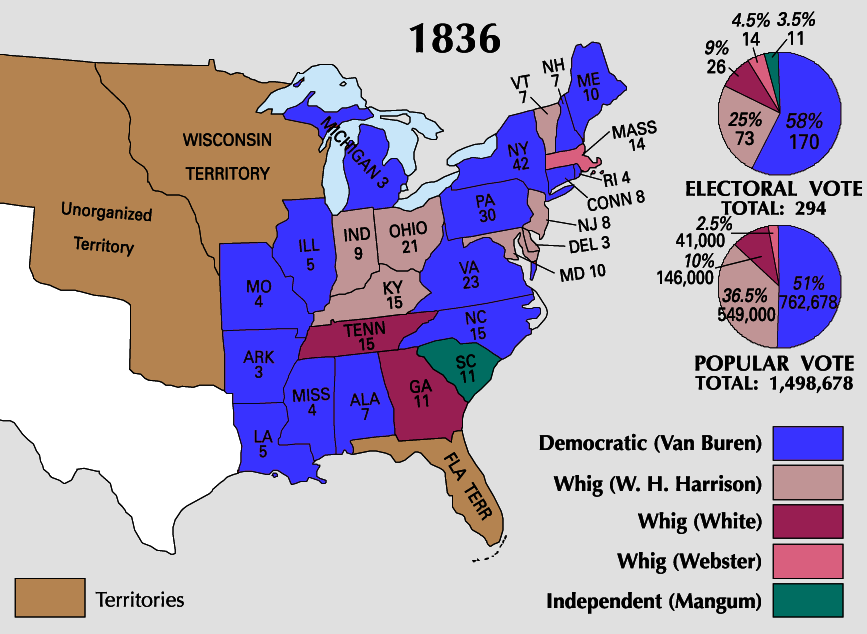
1836 United States Presidential Election Map from the National Atlas of the United States

Other US Presidential Election Maps:

1788 1792 1796 1800 1804 1808
1812 1816 1820 1824 1828 1832
1836 1840 1844 1848 1852 1856
1860 1864 1868 1872 1876 1880
1884 1888 1892 1896 1900 1904
1908 1912 1916 1920 1924 1928
1932 1936 1940 1944 1948 1952
1956 1960 1964 1968 1972 1976
1980 1984 1988 1992 1996 2000
2004 2008 2012 2016 2020 2024


Product Reviews · World Atlas · Settlers of Catan · Risk · Game of Thrones · Coloring Books
Globes · Monopoly · Star Wars · Game of Life · Pandemic · Ticket To Ride · Drinks Cabinets
US Locations · UK Locations· Fleet Management
Copyright © 2026 · Privacy Policy · Fair Use, Attribution & Copyright · Contact Us
Follow Us: Newsletter · Facebook · Youtube · Twitter · Threads · BlueSky · LinkedIn · Instagram · Pinterest · Flipboard