
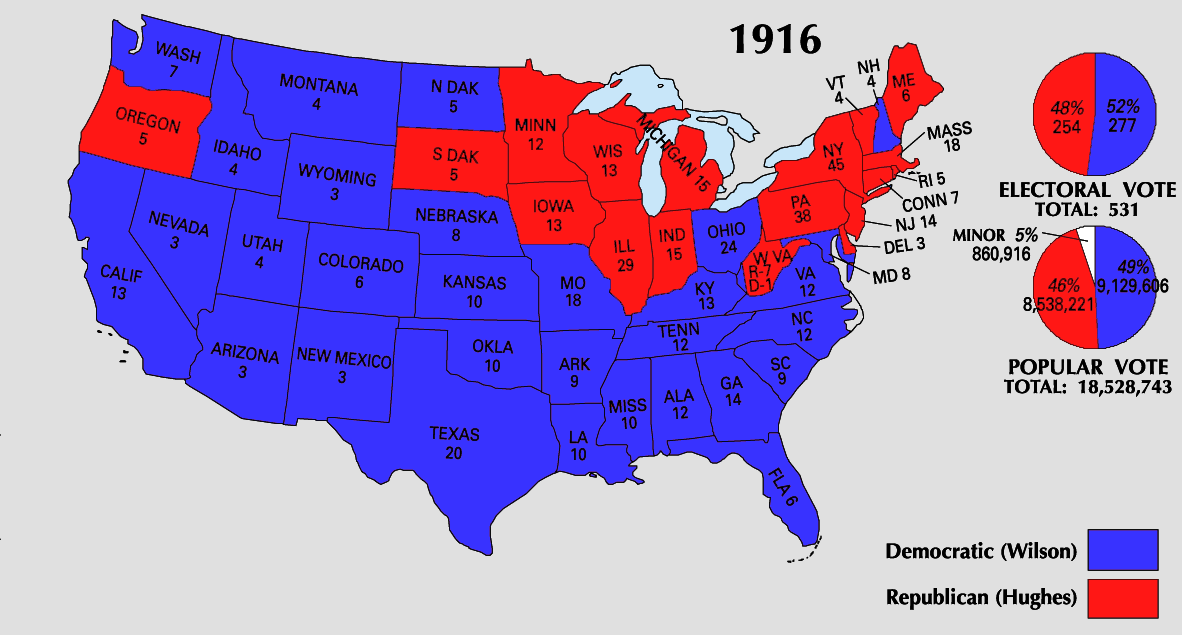
The map above shows the result of the 1916 US presidential election between Woodrow Wilson and Charles Evans Hughes. Turnout for the election was 61.80%.
Here are the key details:
| Winner: | Runner-Up: | |
|---|---|---|
| Name: | Woodrow Wilson | Charles Evans Hughes |
| Political Party: | Democratic | Republican |
| Home state: | New Jersey | New York |
| VP Name: | Thomas R. Marshall | Charles W. Fairbanks |
| States: Won (Out of 48): | 30 | 18 |
| Electoral College Votes (out of 531): | 277 | 254 |
| Percentage of Popular Vote | 49.24% | 46.10% |
| Total Votes | 9,126,868 | 8,548,728 |
| Margin % | 3.12% | – |
| Margin (votes) | 578,140 | – |
| 3rd Place | 4th Place: | |
|---|---|---|
| Name: | Allan L. Benson | Frank Hanly |
| Political Party | Socialist | Prohibition |
| Electoral College Votes | 0 | 0 |
| Number of Votes: | 590,524 | 221,302 |
| Percentage of Popular Vote: | 3.19% | 1.19% |
Key Issues in the 1916 Election
Here’s where each candidate stood on the key issues:
1. World War I and Foreign Policy
Woodrow Wilson (Democrat): Wilson campaigned on the slogan “He kept us out of war,” emphasizing his success in keeping the United States neutral during World War I, which was then ravaging Europe.
He wanted to maintain neutrality while preparing for potential involvement. He stressed the need for diplomatic efforts and peace without victory, seeking to avoid unnecessary entanglements.
Charles Evans Hughes (Republican): Hughes was more critical of Wilson’s foreign policy, especially regarding preparedness. Although he didn’t explicitly advocate for entering the war, he favored a stronger military posture and readiness in case the U.S. needed to intervene.
Hughes criticized Wilson for being too lenient on Germany, particularly after the sinking of the Lusitania in 1915, and called for a firmer stance in defense of American rights.
2. Trade and Economic Issues
Wilson: Wilson supported free trade policies and was a proponent of the Underwood Tariff, which lowered tariffs and reformed the tax system. He also introduced the Federal Reserve Act to stabilize the economy and provide a flexible currency system. Additionally, he was seen as the champion of progressive economic reforms, such as labor rights and antitrust regulations.
Hughes: The Republican Party traditionally favored higher protective tariffs to protect American businesses and industries from foreign competition.
Hughes advocated for more protectionist policies, critiquing Wilson’s tariff reforms for harming American industries. He was also seen as more sympathetic to big business compared to Wilson.
3. Progressive Reforms and Labor Rights
Wilson: Wilson embraced progressive reforms, including support for labor rights, and he successfully pushed for laws like the Adamson Act (which established an eight-hour workday for railroad workers). Wilson also expanded antitrust legislation and established the Federal Trade Commission to regulate big business.
Hughes: Hughes had a more mixed record on progressive issues. While he wasn’t opposed to all reforms, he was more aligned with conservative economic interests and was perceived as less sympathetic to labor unions than Wilson. His judicial background as a Supreme Court justice showed a commitment to enforcing laws fairly, but labor groups viewed him as less supportive than Wilson.
4. Women’s Suffrage
Wilson: Wilson initially did not strongly support women’s suffrage at the national level but gradually became more favorable to it under pressure from suffragists and the growing national movement.
In 1916, he had not yet fully committed to pushing for a constitutional amendment but was open to allowing states to decide on women’s voting rights.
Hughes: Hughes was more overtly supportive of women’s suffrage, endorsing the cause more explicitly during his campaign. He called for national recognition of women’s right to vote, which aligned him with progressives who were increasingly backing suffrage.
5. Mexican Revolution
Wilson: Wilson’s foreign policy toward Mexico was controversial. He sent troops under General Pershing to pursue the Mexican revolutionary Pancho Villa after Villa’s forces attacked Columbus, New Mexico. Wilson’s handling of the Mexican Revolution was criticized for being inconsistent and indecisive. Nonetheless, he avoided a full-scale war with Mexico.
Hughes: Hughes criticized Wilson’s Mexican policy as weak and indecisive, suggesting that a firmer hand was needed to restore stability and protect American interests along the border.
6. Overall Vision
Wilson: Wilson’s campaign emphasized peace and progressivism. His vision for America was centered on staying out of war, continuing economic reforms, and promoting social progress, particularly for workers and consumers.
Hughes: Hughes presented himself as a stronger and more reliable leader, ready to assert American strength abroad and return to more traditional Republican values of business protectionism and military preparedness.
Why did Wilson win?
Here are the primary reasons for his win:
1. “He Kept Us Out of War” Slogan
One of the most important reasons for Wilson’s success was his strong appeal to the peace sentiment among the American electorate. World War I was devastating Europe, and many Americans were deeply anxious about the possibility of being dragged into the conflict.
Wilson’s slogan, “He kept us out of war,” resonated with voters who were thankful that the U.S. had stayed neutral thus far.
Wilson’s diplomatic approach and efforts to mediate peace in Europe, rather than jump into the war, gave him credibility as a peacemaker. Many voters saw him as the safer choice to avoid war, while Hughes was perceived as more likely to lead the country into conflict due to his calls for military preparedness and criticism of Wilson’s handling of foreign policy.
2. Support from Progressive Voters
Wilson successfully captured a significant portion of the Progressive vote, which was crucial in a tight election. The Republican Party had fractured in the 1912 election, with Theodore Roosevelt running as a Progressive candidate and splitting the vote, leading to Wilson’s victory in that election.
In 1916, Wilson was able to appeal to many Progressive reformers by continuing to support progressive policies such as labor rights, antitrust regulations, and social justice reforms.
While Hughes had some progressive credentials from his time as governor of New York, he was seen as more conservative and aligned with business interests. This perception hurt him among the progressives, many of whom decided to stick with Wilson.
3. Labor Support
Wilson’s administration had enacted significant legislation that benefited workers and labor unions, most notably the Adamson Act of 1916, which established an eight-hour workday for railroad workers.
This won Wilson strong support from organized labor, which played an important role in delivering votes, especially in critical industrial states.
Labor unions saw Wilson as more sympathetic to their causes than Hughes, who was seen as more aligned with business interests. Wilson’s support for workers’ rights helped him secure votes in key industrial areas.
4. Wilson’s Domestic Reforms
Wilson’s progressive domestic agenda had achieved tangible results, such as the Federal Reserve Act, which reformed the banking system, and the Federal Trade Commission, which aimed to prevent unfair business practices.
His record on progressive reforms helped him maintain strong support from voters who favored a more activist government and economic regulation.
The Democrats successfully presented Wilson as a champion of the common man and someone who had enacted meaningful reforms to benefit ordinary Americans. This appealed to many voters, especially in states where these reforms had a direct impact on daily life.
5. Republican Party Division
While the Republican Party had formally reunited in 1916, some lingering divisions remained from the split caused by the 1912 election, when former President Theodore Roosevelt ran on the Progressive (“Bull Moose”) ticket, fracturing the Republican base.
Although Roosevelt endorsed Hughes in 1916, many Progressives were still skeptical of the Republican Party and felt that Wilson was a better option for continuing the reform agenda.
The Republicans were not fully unified behind Hughes, and he struggled to generate enthusiasm among the Progressive wing of the party. This lack of strong unity within the Republican ranks may have contributed to Hughes underperforming in key states.
6. Hughes’ Lack of Strong Campaigning
Charles Evans Hughes faced criticism for running a somewhat lackluster and inconsistent campaign. While he was a respected former Supreme Court Justice and Governor of New York, Hughes lacked the charisma and clear messaging that Wilson had.
His campaign failed to galvanize support across the board, particularly with the Progressive and working-class voters.
Hughes’ perceived failure to take a firm stance on certain issues, especially regarding foreign policy and neutrality, made it difficult for him to present a clear contrast to Wilson’s peace-oriented approach.
In some instances, Hughes’ campaign messaging appeared contradictory, which hurt his ability to rally voters.
7. The Swing States and Key Regional Victories
Wilson’s narrow victory was largely due to his success in a few critical swing states, particularly California. He won California by just over 3,800 votes, securing the state’s 13 electoral votes, which ultimately made the difference in the Electoral College. Had Hughes won California, he would have won the presidency.
Wilson also performed well in the West and Midwest, where his policies on labor and progressive reforms had significant support. His appeal to rural voters and labor groups in those regions was stronger than Hughes’, who did better in the industrial Northeast but failed to win enough votes outside his strongholds.
8. Women’s Vote in the West
In some Western states, women had already been granted the right to vote at the state level before the passage of the 19th Amendment in 1920. Wilson received strong support from women voters in these states, particularly because of his peace stance and his gradual shift toward supporting women’s suffrage.
Although Hughes also supported women’s suffrage, Wilson’s broader appeal to women voters, coupled with his record on labor rights and social reforms, helped him secure the female vote in key Western states.
1916 Election Results Map By County

1916 Map From The National Atlas of the United States (now sadly permanently offline)
Other US Presidential Election Maps: