
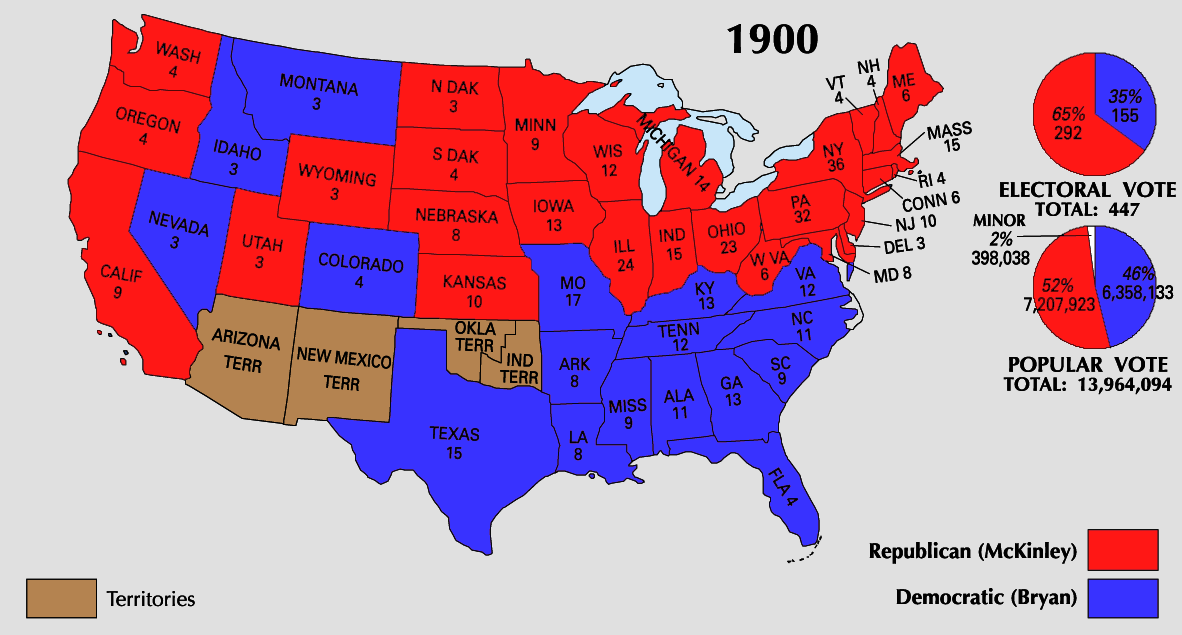
The map above shows the result of the 1900 US presidential election between William McKinley and William Jennings Bryan. Turnout for the election was 73.70%.
Here are the key details:
| Winner: | Runner-Up: | |
|---|---|---|
| Name: | William McKinley | William Jennings Bryan |
| Political Party: | Republican | Democratic |
| Home state: | Ohio | Nebraska |
| VP Name: | Theodore Roosevelt | Adlai Stevenson I |
| States: Won (Out of 45): | 28 | 17 |
| Electoral College Votes (out of 447): | 292 | 155 |
| Percentage of Popular Vote | 51.64% | 45.50% |
| Total Votes | 7,228,864 | 6,370,932 |
| Margin % | 6.12% | – |
| Margin (votes) | 857,932 | – |
| 3rd Place | 4th Place | |
|---|---|---|
| Name: | John G. Woolley | Eugene V. Debs |
| Political Party | Prohibition | Social Democratic |
| Electoral College Votes | 0 | 0 |
| Number of Votes: | 210,864 | 87,945 |
| Percentage of Popular Vote: | 1.51% | 0.63% |
What Were the Key Issues In the 1900 Election?
The 1900 U.S. presidential election primarily focused on three major issues: imperialism, economic prosperity, and the gold standard.
The election saw incumbent President William McKinley, a Republican, running against William Jennings Bryan, a Democrat, in a rematch of the 1896 election.
1. Imperialism
- McKinley (Republican): McKinley supported the U.S. expansion and acquisition of overseas territories, particularly after the Spanish-American War in 1898. He favored the continued annexation of territories like Puerto Rico, Guam, and the Philippines, arguing that this expansion would benefit both the U.S. and the territories by bringing economic opportunities and civilization. McKinley believed that maintaining control of the Philippines was necessary to prevent instability or foreign intervention there.
- Bryan (Democrat): Bryan strongly opposed imperialism, viewing it as a betrayal of American principles. He argued that controlling foreign territories contradicted the values of freedom and self-determination. Bryan’s slogan, “The Republic, Not an Empire,” emphasized his belief that America should be a force for freedom rather than an imperial power. He warned that imperialism would entangle the U.S. in foreign conflicts and undermine its democratic values.
2. Economic Prosperity and the “Full Dinner Pail”
- McKinley (Republican): McKinley’s campaign focused on the theme of economic prosperity, using the slogan “Four More Years of the Full Dinner Pail” to symbolize stability and growth. He argued that his administration’s policies, such as protective tariffs, had led to a period of economic expansion and recovery after the economic downturns of the early 1890s. This was particularly effective among working-class voters who saw improved conditions under McKinley.
- Bryan (Democrat): While Bryan did not directly oppose economic prosperity, he criticized what he saw as McKinley’s pro-business stance, which he believed favored wealthy industrialists at the expense of ordinary workers and farmers. Bryan advocated for policies that would support working people, limit the power of large corporations, and prevent monopolies from dominating the economy.
3. The Gold Standard vs. Free Silver
- McKinley (Republican): McKinley was a firm supporter of the gold standard, which had been the basis of U.S. currency since the Coinage Act of 1873. He argued that sticking to gold alone would ensure economic stability and maintain investor confidence. This appealed to bankers, industrialists, and many middle- and upper-class voters who valued financial stability.
- Bryan (Democrat): Bryan continued his campaign for “free silver,” which he had championed in 1896. He argued that allowing both silver and gold to back the currency (bimetallism) would increase the money supply, making it easier for farmers and small business owners to pay debts and recover from economic hardships. His famous “Cross of Gold” speech captured this stance, where he claimed that a reliance on gold would crucify the working class.
Why did McKinley win?
Here’s a look at the factors that contributed to McKinley’s victory:
1. Economic Prosperity (“The Full Dinner Pail”)
- After the economic struggles of the early 1890s, the U.S. economy was strong by 1900, with growth, low unemployment, and rising wages. McKinley’s administration had fostered this economic upturn with policies like protective tariffs, which were designed to protect American industry. McKinley’s slogan of “a full dinner pail” resonated with voters, who appreciated the stability and prosperity of his term.
- In contrast, many people saw Bryan’s advocacy for “free silver” as unnecessary, even risky, given that the economy was thriving under the gold standard. Voters felt that McKinley’s policies provided security, while Bryan’s proposals seemed disruptive and perhaps even dangerous to the current economic gains.
2. National Pride and Imperialism
- The Spanish-American War in 1898 had recently boosted national pride and patriotism. The war resulted in the U.S. gaining territories such as Puerto Rico, Guam, and the Philippines, marking the nation’s emergence as a global power. Many Americans were proud of these new holdings and saw them as evidence of the country’s growing influence.
- McKinley supported the continued governance of these new territories, arguing that the U.S. had a duty to “civilize” and stabilize them. Many voters agreed with this view, seeing imperialism as a way to spread American values and strength abroad.
- Conversely, Bryan’s anti-imperialist stance didn’t resonate as strongly. He argued that imperialism was against American values, but this message had limited appeal amid the nationalistic fervor of the time. Many voters saw his platform as overly idealistic and unpatriotic, especially as it seemed to criticize America’s recent success in the war.
3. Popular Vice Presidential Candidate: Theodore Roosevelt
- McKinley’s choice of Theodore Roosevelt as his running mate brought energy and enthusiasm to the Republican ticket. Roosevelt was a national hero after leading the Rough Riders during the Spanish-American War, and his personality was popular with voters.
- Roosevelt’s charisma and popularity helped draw votes to McKinley, particularly from younger and more progressive-minded voters who saw him as a symbol of America’s strength and adventurous spirit.
4. Effective Campaign Messaging and Strategy
- The Republicans ran a disciplined, well-funded, and organized campaign. They used slogans like “Four More Years of the Full Dinner Pail,” which focused on economic stability and prosperity, appealing to working-class voters and those who feared economic instability.
- Bryan, on the other hand, struggled to gain the same level of support as in 1896. His rhetoric around anti-imperialism and free silver did not attract enough support among an electorate that valued stability. Furthermore, the Democratic campaign had fewer financial resources than the Republicans, making it challenging for Bryan to reach as many voters effectively.
5. Limited Appeal of Bryan’s Platform
- In 1896, Bryan’s platform of free silver had resonated because many people were struggling economically. By 1900, with the economy improving, fewer people felt the need for radical economic reforms. The gold standard felt stable, and the appeal of bimetallism had faded.
- Bryan’s anti-imperialist message also didn’t gain much traction, especially since many Americans felt that the newly acquired territories were proof of the nation’s strength and progress. Some viewed his opposition to imperialism as unpatriotic or out of touch with the mood of the country.
1900 Election Results Map By County

1900 Map From The National Atlas of the United States (now sadly permanently offline)
Other US Presidential Election Maps: