
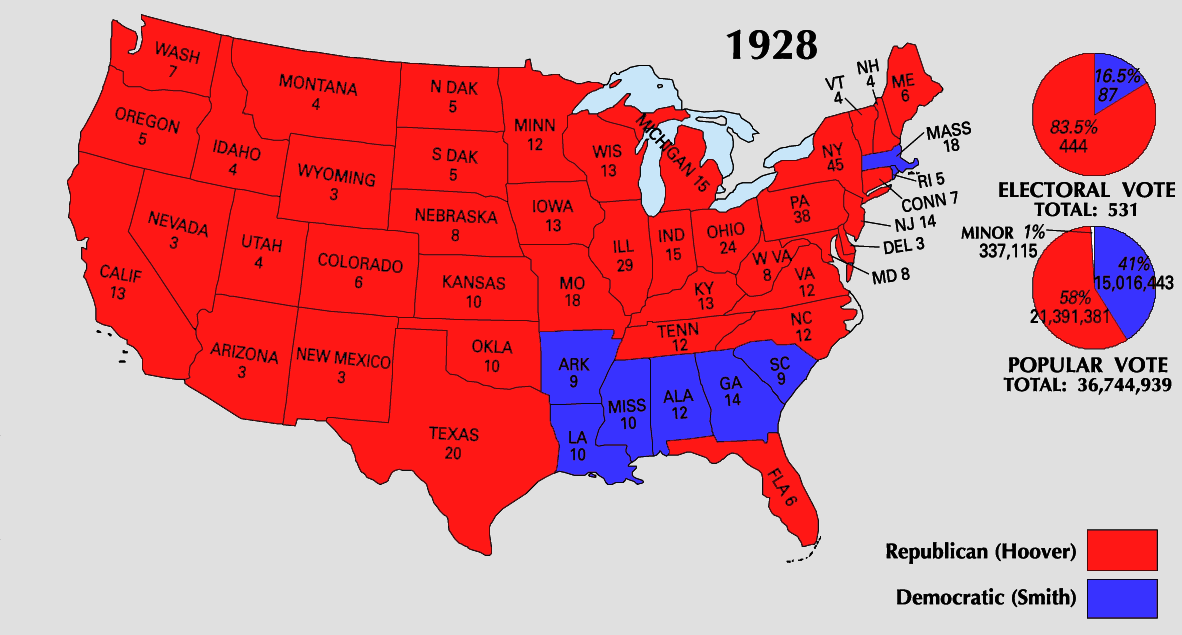
The map above shows the result of the 1928 US presidential election between Herbert Hoover and Al Smith. Turnout for the election was 56.90%.
Here are the key details:
| Winner: | Runner-Up: | |
|---|---|---|
| Name: | Herbert Hoover | Al Smith |
| Political Party: | Republican | Democratic |
| Home state: | California | New York |
| VP Name: | Charles Curtis | Joseph T. Robinson |
| States: Won (Out of 48): | 40 | 8 |
| Electoral College Votes (out of 531): | 444 | 87 |
| Percentage of Popular Vote | 58.21% | 40.80% |
| Total Votes | 21,427,123 | 15,015,464 |
| Margin % | 17.41% | – |
| Margin (votes) | 6,411,659 | – |
| 3rd Place | 4th Place: | |
|---|---|---|
| Name: | Norman Thomas | William Z. Foster |
| Political Party | Socialist | Communist |
| Electoral College Votes | 0 | 0 |
| Number of Votes: | 267,478 | 48,551 |
| Percentage of Popular Vote: | 0.73% | 0.13% |
Key issues in the 1928 election
The 1928 United States presidential election was held during a time of relative prosperity in the country, shortly before the onset of the Great Depression.
Here are the key issues:
1. Prohibition
Herbert Hoover: Supported Prohibition, which was the law of the land due to the 18th Amendment. Hoover referred to it as a “noble experiment” that should be refined rather than repealed, believing that it could be made to work with better enforcement.
Al Smith: Opposed Prohibition and advocated for its repeal. Smith argued that Prohibition had led to a rise in crime and corruption and that regulating alcohol would be a better policy.
2. Religion
Herbert Hoover: Hoover did not make religion a significant part of his campaign, but his supporters often played on the religious fears of the electorate. Hoover was a Quaker, and his religion was considered noncontroversial in this election.
Al Smith: Smith was the first Catholic to be nominated by a major party for president, which became a major issue in the campaign. Anti-Catholic sentiments were strong in parts of the country, and Smith faced significant opposition, especially from Protestant voters who feared that he would take orders from the Pope or alter American values based on his faith.
3. Economic Policies
Herbert Hoover: Hoover campaigned on the success of Republican economic policies under Presidents Warren G. Harding and Calvin Coolidge. He emphasized prosperity, low taxes, and a continuation of the laissez-faire approach to business. Hoover argued that the economy was booming and should not be disrupted by major government intervention.
Al Smith: Smith took a more progressive stance on economic issues, advocating for greater government intervention in certain areas, such as labor rights and infrastructure. He was seen as more sympathetic to working-class Americans and wanted to improve conditions for farmers and industrial workers, though he did not have a clear alternative to Hoover’s policies on maintaining economic growth.
4. Immigration
Herbert Hoover: As part of the Republican platform, Hoover supported the strict immigration policies that were enacted in the 1920s, including the 1924 Immigration Act, which imposed quotas on immigrants from certain countries, especially Southern and Eastern Europe.
Al Smith: Smith, being the son of immigrants from Ireland, opposed strict immigration quotas and argued that they were discriminatory. He believed that immigration was a fundamental part of America’s strength and prosperity, though he did not propose specific reforms to reverse the policies.
5. Rural vs. Urban Divide
Herbert Hoover: Hoover appealed more to rural America, which was predominantly Republican and supportive of Prohibition, traditional values, and conservative economic policies. Rural voters generally distrusted Smith because of his urban background and his association with New York City’s political machine.
Al Smith: Smith represented urban America, especially the immigrant and working-class populations of large cities. He promoted policies that would benefit city dwellers, such as infrastructure development, public housing, and labor rights. His opposition to Prohibition also resonated with urban voters, many of whom saw the law as unenforceable.
6. Labor and Social Issues
Herbert Hoover: Hoover had a generally conservative stance on labor issues, emphasizing voluntary cooperation between businesses and workers rather than government intervention. He supported continued economic growth as the best way to improve living standards.
Al Smith: Smith, having grown up in the tenements of New York City, was more sympathetic to the needs of labor and the poor. He supported stronger labor rights, including the right to unionize and measures to improve working conditions, but his platform was not as focused on social welfare policies as later Democratic candidates like Franklin D. Roosevelt.
7. Tariffs and Trade
Herbert Hoover: Supported high tariffs to protect American industries from foreign competition. This was a continuation of Republican policies aimed at fostering domestic growth and maintaining economic self-sufficiency.
Al Smith: Smith opposed high tariffs, believing they hurt consumers and led to retaliation from other countries that harmed American exports, particularly in agriculture.
Why did Hover win?
Here are the key reasons why Hoover won:
1. The Economic Prosperity of the 1920s
The Roaring Twenties were a time of unprecedented economic growth and prosperity in the United States. The stock market was booming, unemployment was low, and industries were expanding.
Many Americans credited the Republican administrations of Warren G. Harding and Calvin Coolidge for the strong economy, and Hoover, as the Republican candidate, was seen as the natural successor to continue these policies.
Hoover’s message of maintaining the status quo and extending the prosperity resonated with voters who wanted to preserve the good economic times. He promised a “final triumph over poverty,” which appealed to the optimism of the era.
2. Hoover’s Reputation and Experience
Hoover had built a strong reputation as a self-made businessman and a humanitarian. His successful efforts in managing food relief efforts during World War I and his role as Secretary of Commerce under Harding and Coolidge earned him a reputation as a competent, efficient, and non-political figure.
He was seen as a problem-solver and a man of action, which made him appealing to voters. Hoover’s campaign emphasized his technical expertise and ability to manage the economy and keep it thriving.
3. Weaknesses of Al Smith’s Campaign
Al Smith, the Democratic candidate, faced significant challenges that hurt his chances, particularly in rural and conservative areas:
- Religious Bigotry: Smith was the first Catholic to run for president as a major party candidate, and this provoked widespread anti-Catholic sentiment. Many Protestant voters feared that Smith, as a Catholic, would be loyal to the Pope over the U.S. government. There were unfounded rumors that he would allow the Vatican to influence American policies or that his election would undermine Protestant values.
- Opposition to Prohibition: Smith’s opposition to Prohibition alienated many voters, especially in rural America, where support for the 18th Amendment was strongest. Many voters associated Smith’s anti-Prohibition stance with urban crime, immorality, and the influence of corrupt political machines.
- Urban-Urban vs. Rural Divide: Smith was closely associated with New York City and its political machine, Tammany Hall, which made him seem like an urban candidate who couldn’t relate to the rural population. The country was still predominantly rural, and many rural voters viewed Smith as too focused on the interests of the cities.
4. The Urban-Rural Divide
Hoover’s support was strongest in rural areas, while Smith’s strength lay in the urban centers, particularly among immigrants, Catholics, and working-class voters. However, the urban vote was not large enough at the time to offset Hoover’s overwhelming support in rural areas. The rural population was deeply suspicious of Smith’s urban, immigrant background and his progressive views on social issues like Prohibition.
The cultural divide between urban and rural America played a major role in Hoover’s victory. Rural voters tended to favor conservative values and saw Hoover as more aligned with their way of life.
5. The Legacy of the Republican Party
The Republican Party had dominated presidential politics throughout the 1920s. Both Harding and Coolidge had overseen economic growth and stability, and their policies were popular with the electorate. The Republicans were seen as the party of prosperity, and Hoover benefitted from this association.
Smith, on the other hand, represented a Democratic Party that had struggled to win national elections in the previous decades. The party had been divided between northern urban progressives and southern conservatives, which weakened its national appeal.
6. A Clean Campaign Image
Hoover ran a clean and professional campaign that emphasized his experience, competence, and ability to manage the economy. He avoided personal attacks on Smith and focused on his qualifications and policy positions.
On the other hand, Smith’s campaign was often overshadowed by attacks on his religion and character, which made it difficult for him to build momentum outside of urban areas. Smith’s progressive policies, particularly on Prohibition and government intervention, were also seen as too radical for many voters in the conservative political climate of the 1920s.
7. The Role of Media and Technology
Hoover took advantage of modern media, particularly radio, to reach a wide audience. His use of radio allowed him to communicate directly with voters, presenting himself as calm, logical, and competent.
This helped Hoover cultivate an image of professionalism and efficiency, which resonated with middle-class and rural voters who valued stability.
Smith, meanwhile, struggled to appeal to voters in rural areas, where radio access was growing but still less widespread, and where he was seen as an outsider due to his background and policy positions.
1928 Election Results Map By County

1928 Map From The National Atlas of the United States (now sadly permanently offline)
Other US Presidential Election Maps: