
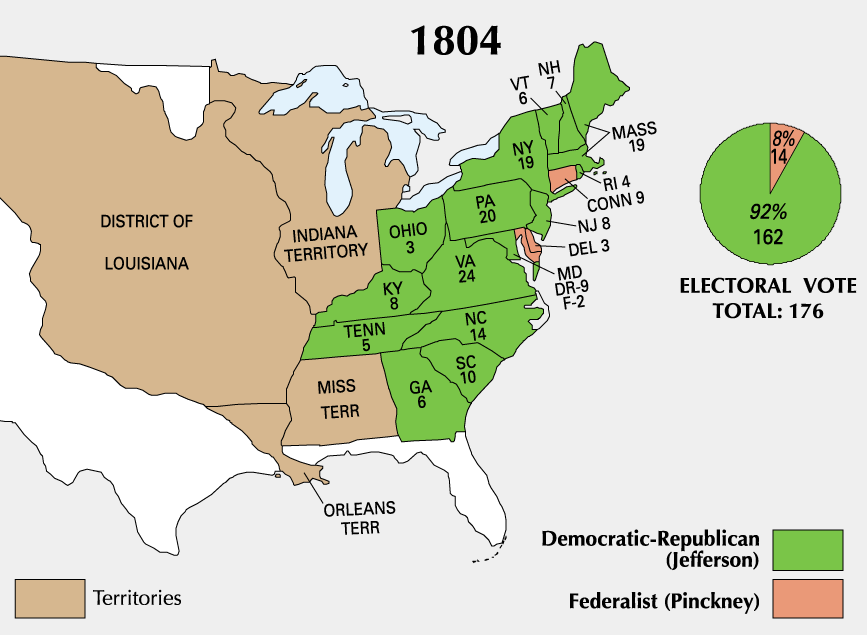
The map above shows the result of the 1804 US presidential election between Thomas Jefferson and Charles C. Pinckney. Turnout for the election was 23.80%.
Here are the key details:
| Winner: | Runner-Up: | |
|---|---|---|
| Name: | Thomas Jefferson | Charles C. Pinckney |
| Political Party: | Democraticic-Republican | Federalist |
| Home state: | Virginia | South Carolina |
| VP Name: | George Clinton | Rufus King |
| States: Won (Out of 17): | 15 | 2 |
| Electoral College Votes (out of 176): | 162 | 14 |
| Percentage of Popular Vote | 72.79% | 27.20% |
| Total Votes | 104,110 | 38,919 |
| Margin % | 45.58% | – |
| Margin (votes) | 65,191 | – |
Facts About the 1804 Election
1. First Election Under the 12th Amendment
The 1804 election was the first to be held following the ratification of the 12th Amendment to the U.S. Constitution. This amendment changed the process for electing the president and vice president, requiring electors to cast separate votes for each office.
The amendment was a direct response to the confusion in the 1800 election, where Thomas Jefferson and Aaron Burr received an equal number of electoral votes, leading to a contingent election in the House of Representatives.
2. A Landslide Victory
Thomas Jefferson won by an overwhelming margin, securing 162 electoral votes to Charles C. Pinckney’s 14.
This decisive victory remains one of the most lopsided in U.S. presidential election history, reflecting widespread public support for Jefferson’s policies and the decline of the Federalist Party.
3. Introduction of Running Mates as Ticket Partners
The 1804 election marked a clearer delineation of running mates as an electoral ticket. Jefferson chose George Clinton, a prominent figure and former governor of New York, as his vice-presidential running mate.
This partnership was strategic, ensuring regional support and strengthening the Democratic-Republican ticket.
4. Diminished Federalist Influence
The 1804 election highlighted the significant decline of the Federalist Party. Federalists were increasingly seen as the party of the elite and as out of touch with the needs of the average American.
Their criticisms of popular policies, such as the Louisiana Purchase, further eroded their public support, and the election results confirmed their waning influence in national politics.
5. First Election After Alexander Hamilton’s Death
The election occurred shortly after Alexander Hamilton’s death in July 1804, following his infamous duel with Aaron Burr. Hamilton, a leading Federalist and influential political figure, had been critical of both Jefferson and Burr.
His death weakened the Federalist Party, removing one of its most prominent voices and contributing to the party’s inability to effectively challenge Jefferson’s re-election bid.
What were the key issues in the 1804 election?
The 1804 U.S. presidential election, which saw President Thomas Jefferson running for re-election against Charles C. Pinckney, centered on a few significant issues reflective of the political and social landscape of the time.
Here are the key issues and where each candidate stood on them:
1. Partisan Politics and the First Party System
- The election was one of the first major contests between the Democratic-Republican Party, led by Thomas Jefferson, and the Federalist Party, led by Charles C. Pinckney.
- Jefferson’s Position: Jefferson and the Democratic-Republicans advocated for a limited federal government, emphasizing states’ rights, agrarian interests, and the idea of a decentralized republic that aligned with the common man.
- Pinckney’s Position: Pinckney and the Federalists favored a stronger central government, with policies that supported commerce, a more robust national bank, and stronger ties with Britain. This stance appealed to more urban and elite segments of the population.
2. The Louisiana Purchase
- One of the most significant developments of Jefferson’s first term was the Louisiana Purchase in 1803, which doubled the size of the United States.
- Jefferson’s Position: Jefferson championed the purchase as a means of expanding the nation’s territory for agrarian growth and securing American control over the Mississippi River, despite initial constitutional concerns over federal authority.
- Pinckney’s Position: Many Federalists, including Pinckney, criticized the Louisiana Purchase, viewing it as an overreach of executive power and a move that could dilute the power of Eastern states by expanding the western frontier.
3. Foreign Policy and Relations with Britain and France
- The Napoleonic Wars in Europe put pressure on U.S. foreign policy, as the nation sought to maintain neutrality while trading with both Britain and France.
- Jefferson’s Position: Jefferson aimed to maintain neutrality and advocated for peaceful trade policies, though his administration’s response (such as the later Embargo Act of 1807) had mixed results. During the 1804 election itself, Jefferson was seen as trying to avoid entangling alliances and keeping the U.S. out of European conflicts.
- Pinckney’s Position: Pinckney and the Federalists were generally more sympathetic to Britain and critical of Jefferson’s perceived weakness in standing up to France’s ambitions under Napoleon.
4. Domestic Policies and the Economy
- Economic policy, including the role of the national bank and federal involvement in infrastructure, was a matter of debate.
- Jefferson’s Position: Jefferson opposed the Federalist economic policies established under Alexander Hamilton, including extensive federal spending and banking programs. He worked to reduce the national debt and scale back government influence, promoting a more agrarian-focused economy.
- Pinckney’s Position: Pinckney supported Hamiltonian policies that involved a strong national bank and federal support for industry, appealing to merchants and economic elites who favored centralized economic growth.
5. States’ Rights vs. Federal Power
- The balance between state and federal authority was a recurring issue.
- Jefferson’s Position: Jefferson and the Democratic-Republicans strongly emphasized states’ rights, advocating for minimal federal interference in local and state matters.
- Pinckney’s Position: Pinckney, as a Federalist, supported a stronger federal government that could exercise more control over the states, believing that a unified approach was essential for a prosperous and secure nation.
Why did Jefferson win?
Thomas Jefferson won the 1804 presidential election in a decisive landslide for several key reasons:
1. Popularity of Jefferson’s First Term Policies
- Success of the Louisiana Purchase: Jefferson’s acquisition of the Louisiana Territory in 1803 was immensely popular. It doubled the size of the United States, opening vast tracts of land for settlement and expanding opportunities for agrarian growth. This aligned with Jefferson’s vision of an “Empire of Liberty” and was well-received by the public, particularly farmers and settlers who formed a significant part of the electorate.
- Reduction of Government Size and National Debt: Jefferson’s administration made efforts to reduce the size and influence of the federal government, cut taxes, and pay down the national debt. These policies resonated with the Democratic-Republican base that favored limited government and states’ rights.
2. Weakness of the Federalist Party
- Declining Influence: The Federalist Party was already in decline by 1804, suffering from internal divisions and a shrinking base of support. The party’s positions on issues like centralized power and strong federal control increasingly alienated the predominantly agrarian and rural electorate, who felt more connected to Jefferson’s vision of governance.
- Unpopular Stance on the Louisiana Purchase: The Federalists’ criticism of the Louisiana Purchase backfired. Their objections were seen as out of touch with public sentiment, as the vast majority of Americans viewed the acquisition as a boon for the country’s future.
3. Effective Political Strategy
- Strong Organization: Jefferson’s Democratic-Republican Party had built a more cohesive and effective political machine than the Federalists. This organization helped Jefferson secure strong grassroots support and ensured high voter turnout in his favor.
- Use of the 12th Amendment: The 1804 election was the first presidential election held after the ratification of the 12th Amendment, which separated the voting for president and vice president in the Electoral College. This amendment streamlined the election process and helped avoid the confusion of the 1800 election, where Jefferson had tied with his running mate, Aaron Burr. In 1804, Jefferson’s choice of George Clinton as his running mate was strategic and further solidified support.
4. Peace and Stability
- Maintenance of Neutrality: Jefferson managed to keep the U.S. out of the European conflicts stemming from the Napoleonic Wars, at least during his first term. This peace and stability were appealing to a country still developing its identity and wary of foreign entanglements.
- Economic Growth: Despite some economic challenges, the general prosperity and expansion of the U.S. economy under Jefferson’s policies contributed to his widespread popularity.
5. Personal Appeal and Public Perception
- Jefferson’s Image: Jefferson was seen as a man of the people, in contrast to the Federalists, who were often perceived as elitist and more aligned with wealthy commercial interests. Jefferson’s personal philosophy, centered on republicanism and a more inclusive vision of governance, resonated with voters who favored agrarian values and local autonomy.
6. Charles C. Pinckney’s Limitations as a Candidate
- Lack of Strong Support: Pinckney did not have the broad appeal that Jefferson had. While Pinckney was respected as a military officer and diplomat, he lacked the charismatic pull and the widespread political support necessary to galvanize the electorate.
- Association with Unpopular Federalist Policies: Pinckney’s campaign suffered from the association with unpopular Federalist positions, including those that were perceived as pro-British. The Federalists were also seen as the party of the past, having been in power during the unpopular Alien and Sedition Acts of 1798, which still lingered in public memory.
1804 Election Results Map By County

Map From The National Atlas of the United States (now sadly permanently offline)
Other US Presidential Election Maps: