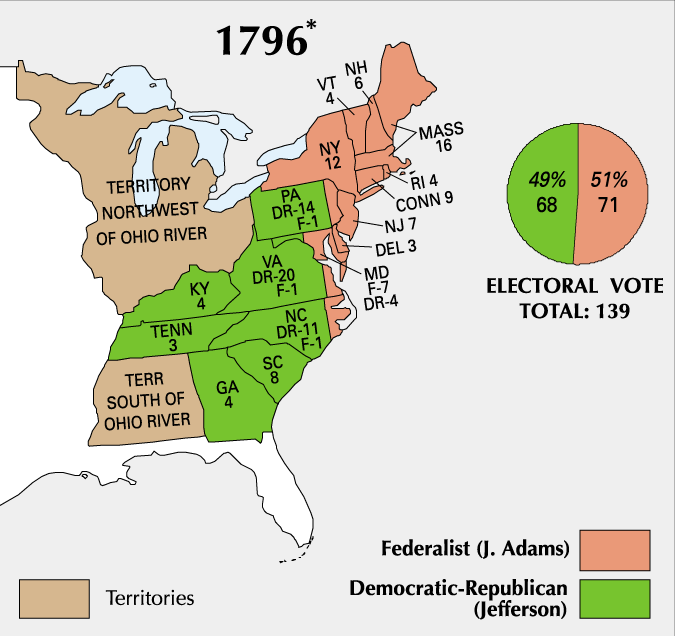
The map above shows the result of the 1796 US presidential election between John Adams and Thomas Jefferson. Turnout for the election was 20.10%.
Here are the key details:
| Winner: | Runner-Up: | |
|---|---|---|
| Name: | John Adams | Thomas Jefferson |
| Political Party: | Federalist | Democratic-Republican |
| Home state: | Massachusetts | Virginia |
| Running Mate | Thomas Pinckney | Aaron Burr |
| States: Won (Out of 16): | 9 | 7 |
| Electoral College Votes (out of 138): | 71 | 68 |
| Percentage of Popular Vote | 53.45% | 46.60% |
| Total Votes | 35,726 | 31,115 |
| Margin % | 6.90% | – |
| Margin (votes) | 4,611 | – |
5 Facts About the Election
1. First Contested Presidential Election
The 1796 election was the first in U.S. history to feature clear political party competition. George Washington’s presidency had been nonpartisan, but by the time of his retirement, political factions had coalesced into two main parties: the Federalists, led by John Adams and Alexander Hamilton, and the Democratic-Republicans, led by Thomas Jefferson and James Madison.
2. Unique Outcome with Opposing Parties
This election was the only one in which the president and vice president were from opposing political parties. John Adams, a Federalist, won the presidency, while Thomas Jefferson, a Democratic-Republican, became vice president.
This happened due to the original electoral process, where the candidate with the second-highest number of electoral votes became vice president. The result led to significant friction between the president and vice president during Adams’ term.
3. The Role of Alexander Hamilton’s Scheme
Alexander Hamilton, a prominent Federalist leader, tried to manipulate the election by encouraging some electors to vote strategically for Thomas Pinckney, hoping Pinckney would surpass Adams.
However, this plan backfired when other Federalist electors, suspicious of Hamilton’s motives, withheld votes from Pinckney to ensure Adams’ victory. This maneuver inadvertently weakened the Federalist strategy and highlighted internal party conflicts.
4. First Election Involving a Campaign
Although the candidates themselves did not campaign in the modern sense (it was considered unseemly for presidential hopefuls to campaign directly), their supporters were very active in promoting their causes.
Newspapers, pamphlets, and political rallies were used to advocate for the Federalist and Democratic-Republican positions. The election marked the beginning of more overt political campaigning and the use of media to influence voters.
5. Electors Had Two Votes
Under the electoral rules at the time, each elector cast two votes without indicating which was for president or vice president. The candidate with the most votes would become president, and the second-place candidate would become vice president.
This system contributed to the outcome where Adams became president and Jefferson, his political rival, became vice president. This rule was later changed by the 12th Amendment in 1804, ensuring that electors cast separate votes for president and vice president to prevent such mismatched administrations.
What were the key issues in the 1796 election?
The two main candidates were John Adams, representing the Federalist Party, and Thomas Jefferson, representing the Democratic-Republican Party. Here are the key issues and where each candidate stood on them:
1. Federal Power vs. States’ Rights
- John Adams (Federalist Party): Supported a strong central government. Adams and the Federalists believed in the importance of a robust national government that could maintain order, support economic growth, and uphold laws effectively. They feared that too much power in the hands of individual states would weaken the nation.
- Thomas Jefferson (Democratic-Republican Party): Advocated for states’ rights and a more limited federal government. Jefferson and his party believed that power should reside primarily with state governments to better preserve individual liberties and prevent potential tyranny from a centralized authority.
2. Relations with Britain and France
- John Adams: Favored maintaining a strong relationship with Britain, the primary trading partner of the U.S. The Federalists were wary of the radical elements of the French Revolution and viewed closer ties with Britain as crucial for economic and political stability.
- Thomas Jefferson: Supported France, especially given the shared revolutionary ideals between the U.S. and France. The Democratic-Republicans were more sympathetic to the French Revolution and sought to distance the U.S. from British influence. Jefferson believed that the U.S. should honor its alliance with France from the Revolutionary War period.
3. Economic Policy
- John Adams: Backed policies that would strengthen the national economy, such as the establishment of the Bank of the United States and support for manufacturing and commerce. The Federalists believed that a thriving economy required a strong financial foundation and promoted industry as essential for growth.
- Thomas Jefferson: Favored an agrarian-based economy and was critical of centralized financial institutions like the Bank of the United States. Jefferson and his party viewed the expansion of agriculture as vital to ensuring that power remained with the common people rather than with the industrial elite or wealthy financiers.
4. Interpretation of the Constitution
- John Adams: Advocated for a more flexible interpretation of the Constitution, allowing for implied powers of the federal government. The Federalists believed that a broader interpretation would enable the government to address issues and challenges that arose as the nation grew.
- Thomas Jefferson: Championed a strict interpretation of the Constitution. He believed that the federal government should only exercise powers explicitly outlined in the document to prevent overreach and ensure the rights of states and individuals were protected.
5. Internal Security and the Role of Government
- John Adams: Supported the idea of a strong government role in maintaining order, which later influenced measures like the Alien and Sedition Acts (though these were enacted during his presidency, not the campaign). Adams and his party were concerned about internal dissent and believed that stronger government authority was necessary for national stability.
- Thomas Jefferson: Opposed government overreach and measures that curtailed free speech or individual liberties. He was concerned that an overly powerful central government could threaten the freedoms won during the American Revolution.
Summary of Their Platforms:
- Federalists (John Adams): Advocated for strong federal power, closer ties with Britain, industrial and commercial development, and a flexible interpretation of the Constitution.
- Democratic-Republicans (Thomas Jefferson): Emphasized states’ rights, support for France, an agrarian economy, and a strict constitutional interpretation to limit federal power.
Why did Adams win?
John Adams won the 1796 U.S. presidential election due to a combination of political, structural, and strategic factors:
1. Electoral Process of the Time
The election of 1796 was the first U.S. presidential election where political parties played a significant role. At that time, electors in the Electoral College cast two votes for president, and the candidate with the most votes became president, while the runner-up became vice president. This system contributed to strategic voting and alliances within each party.
2. Federalist Party’s Organization and Influence
The Federalist Party, led by figures like Alexander Hamilton, was better organized in many states compared to the Democratic-Republicans. The Federalists had a stronger base in the more populous and economically powerful states in the Northeast, which allowed them to leverage influence more effectively. The support from influential Federalist politicians and wealthy backers helped Adams secure votes from key states.
3. Perceived Stability and Experience
Adams had the advantage of being the incumbent vice president under George Washington, which gave him significant national exposure and an association with stability and continuity. Many voters trusted Adams’ experience and statesmanship, viewing him as a steady hand who could lead the country in the wake of Washington’s presidency. His reputation as a strong patriot during the Revolutionary War and his role in diplomacy also bolstered his credibility.
4. Party Divisions Among Democratic-Republicans
Although the Democratic-Republican Party, led by Thomas Jefferson, had broad support among farmers, southern states, and those wary of centralized power, there were divisions within their ranks. The party was less organized than the Federalists, and there was not as cohesive a national strategy for securing electoral votes. This lack of unity impacted Jefferson’s ability to consolidate support across all regions effectively.
5. Strategic Mistakes by Alexander Hamilton
Ironically, Alexander Hamilton, a leading Federalist, tried to manipulate the outcome in favor of Thomas Pinckney, another Federalist candidate, in an attempt to prevent Adams from having full control. Hamilton believed Pinckney would be more easily influenced by him. However, this backfired when some Federalist electors withheld votes from Pinckney to ensure Adams would not lose. The maneuver ended up splitting some votes but was not enough to prevent Adams from winning overall.
6. Regional Electoral Votes
Adams gained strong support from the Northeastern states, which were Federalist strongholds. States like Massachusetts, Connecticut, and New York played pivotal roles in tipping the electoral balance in favor of Adams. Jefferson’s support, on the other hand, was concentrated more heavily in the Southern and Western states, which, although substantial, did not provide enough votes to surpass Adams’ total.
1796 Election Results Map By County

Map From The National Atlas of the United States (now sadly permanently offline)