
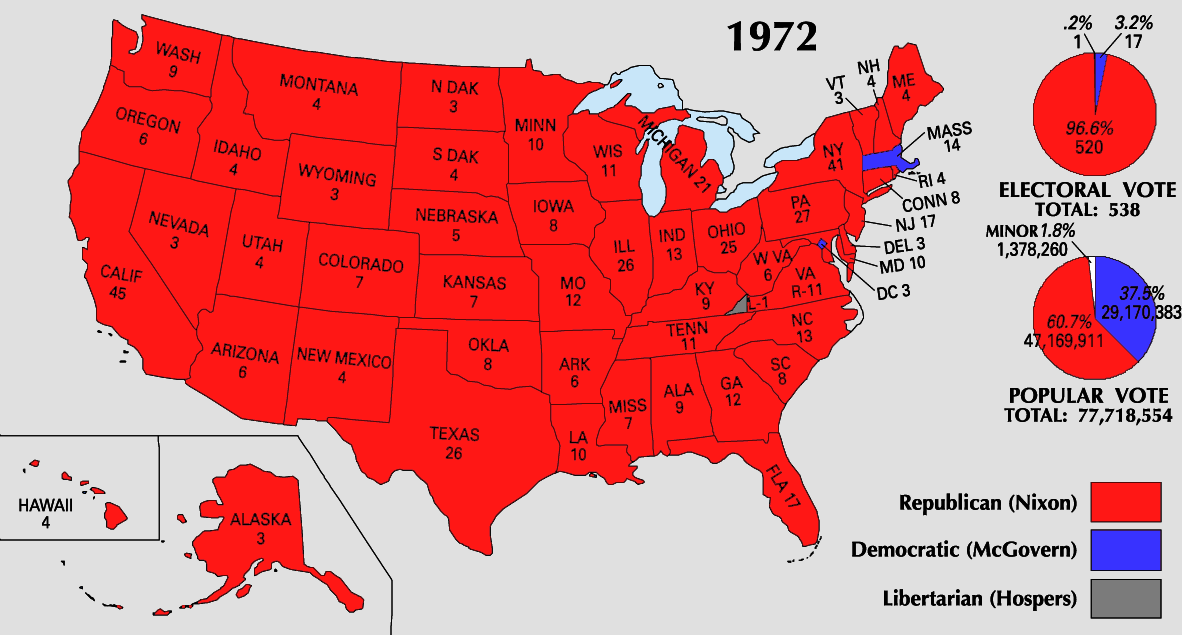
The map above shows the result of the 1972 US presidential election between Richard Nixon and George McGovern. Turnout for the election was 56.20%.
Here are the key details:
| Winner: | Runner-Up: | |
|---|---|---|
| Name: | Richard Nixon | George McGovern |
| Political Party: | Republican | Democratic |
| Home state: | California | South Dakota |
| VP Name: | Spiro Agnew | Sargent Shriver |
| States: Won (Out of 51): | 49 | 1 |
| Electoral College Votes (out of 538): | 520 | 17 |
| Percentage of Popular Vote | 60.67% | 37.50% |
| Total Votes | 47,168,710 | 29,173,222 |
| Margin % | 23.15% | – |
| Margin (votes) | 17,995,488 | – |
| 3rd Place | 4th Place: | |
|---|---|---|
| Name: | John G. Schmitz | Linda Jenness |
| Political Party | American Independent | Socialist Workers |
| Electoral College Votes | 0 | 0 |
| Number of Votes: | 1,100,896 | 83,380 |
| Percentage of Popular Vote: | 1.42% | 0.11% |
Key Issues of The 1972 Election
Here’s an overview of the main issues and how the candidates differed:
1. The Vietnam War
- Richard Nixon: As the incumbent president, Nixon campaigned on a platform of “peace with honor.” He promoted his administration’s efforts to gradually withdraw U.S. troops from Vietnam while maintaining military and diplomatic pressure on North Vietnam. Nixon also emphasized his administration’s progress in achieving détente with the Soviet Union and opening relations with China, which he argued would contribute to ending the war.
- George McGovern: McGovern was an outspoken critic of the Vietnam War and ran on a platform calling for an immediate and unconditional withdrawal of U.S. troops. He argued that the war was immoral and unwinnable and that the U.S. should focus on domestic issues instead. McGovern’s anti-war stance was a central theme of his campaign and was particularly popular among younger voters and those in the anti-war movement.
2. Economic Issues
- Richard Nixon: Nixon’s administration faced inflation and unemployment, known as “stagflation.” He implemented wage and price controls and promoted his economic policies as measures to stabilize the economy. Nixon’s approach was cautious, emphasizing continuity and gradual improvement.
- George McGovern: McGovern proposed a more aggressive approach to economic reform. His platform included a significant expansion of social welfare programs, a guaranteed minimum income through a program called “Demogrant,” and deep cuts in defense spending to fund these initiatives. McGovern’s economic proposals were seen as highly progressive and drew criticism for their perceived radicalism.
3. Civil Rights and Social Issues
- Richard Nixon: Nixon sought to appeal to what he called the “silent majority,” including conservative and middle-class voters who were uneasy with the social changes of the 1960s. His administration supported “law and order” policies, which resonated with voters concerned about crime and unrest. Nixon also took a more conservative stance on civil rights, advocating for “benign neglect” regarding racial issues.
- George McGovern: McGovern was more progressive on civil rights and social issues. He supported affirmative action, stronger anti-discrimination laws, and policies aimed at reducing poverty and inequality. McGovern also advocated for women’s rights and was more supportive of the counterculture movements of the time.
4. Foreign Policy
- Richard Nixon: Nixon’s foreign policy was focused on realpolitik, emphasizing pragmatic and strategic relationships rather than ideological alignment. His opening of relations with China and the pursuit of détente with the Soviet Union were central to his foreign policy achievements. Nixon argued that his experience made him the better candidate to navigate the complexities of the Cold War.
- George McGovern: McGovern was more skeptical of Cold War interventions and advocated for a reduction in military commitments abroad. He was critical of Nixon’s policies towards the Soviet Union and China, arguing that they were too accommodating. McGovern’s foreign policy was rooted in a more idealistic vision of international relations, emphasizing human rights and global justice.
5. Environmental Issues
- Richard Nixon: Nixon’s administration had established the Environmental Protection Agency (EPA) in 1970, and he promoted his environmental record as part of his campaign. Nixon took credit for the Clean Air Act and other environmental initiatives, although he was not seen as a particularly strong environmental advocate by today’s standards.
- George McGovern: McGovern was more vocal in his support for stronger environmental protections. He criticized Nixon for not going far enough in addressing environmental issues and proposed more aggressive policies to combat pollution and protect natural resources.
Why Did Nixon Win?
Richard Nixon’s landslide victory in the 1972 U.S. presidential election can be attributed to several key factors that resonated with the electorate and marginalized his opponent, George McGovern. Here are the main reasons Nixon won so decisively:
1. “Peace with Honor” and the Vietnam War
- Public Perception of the Vietnam War: Nixon campaigned on a platform of achieving “peace with honor” in Vietnam, which appealed to a broad segment of the electorate. Although the war was still ongoing, Nixon’s strategy of Vietnamization—gradually withdrawing American troops while transferring combat roles to South Vietnamese forces—was seen as a pragmatic approach to ending U.S. involvement. In contrast, McGovern’s call for an immediate and unconditional withdrawal was viewed by many as too extreme and potentially reckless.
2. Economic Stability
- Perceived Economic Competence: Despite economic challenges like inflation and unemployment, Nixon was able to present himself as a steady hand capable of managing the economy. His implementation of wage and price controls, although controversial, was perceived by some as a necessary step to curb inflation. McGovern’s economic proposals, particularly his “Demogrant” plan for a guaranteed minimum income, were criticized as unrealistic and too radical, which caused concern among middle-class voters.
3. Law and Order
- Appeal to the “Silent Majority”: Nixon effectively tapped into the concerns of the so-called “silent majority,” a demographic comprising conservative, middle-class Americans who were disillusioned with the social upheaval and perceived lawlessness of the 1960s. Nixon’s “law and order” platform, which emphasized cracking down on crime and civil unrest, resonated with voters who were uneasy about the civil rights protests, anti-war demonstrations, and urban riots of the previous decade. McGovern, by contrast, was seen as too sympathetic to the counterculture and too liberal on social issues.
4. Foreign Policy Successes
- Diplomatic Achievements: Nixon’s foreign policy successes, particularly the opening of relations with China and the détente with the Soviet Union, bolstered his image as a statesman capable of navigating the complexities of the Cold War. These achievements were well-publicized and contributed to a sense of stability and progress under Nixon’s leadership, further distancing him from McGovern, who was perceived as inexperienced in foreign affairs.
5. Campaign Strategy and Organization
- Effective Campaigning: Nixon’s campaign was highly organized, well-funded, and used modern techniques such as targeted television advertising to shape public perceptions. His campaign successfully painted McGovern as an out-of-touch radical, which hurt McGovern’s appeal to the broader electorate. Nixon’s campaign also avoided major missteps, while McGovern’s was plagued by internal discord, including the controversy over his vice-presidential pick, Senator Thomas Eagleton, who was replaced after it was revealed he had undergone electroshock therapy for depression.
6. Party Unity and Fragmentation
- Democratic Disarray: The Democratic Party was deeply divided in 1972, with McGovern representing the more liberal wing of the party. Many traditional Democratic voters, particularly those in the working class, felt alienated by McGovern’s positions, leading to a lack of enthusiasm and support from key demographics. In contrast, Nixon was able to consolidate Republican support and appeal to conservative Democrats and independents, broadening his base.
7. Watergate Scandal’s Limited Impact
- Timing of the Watergate Scandal: Although the Watergate break-in occurred in 1972, the full scope of the scandal did not become apparent until after the election. Thus, the scandal had little impact on Nixon’s re-election campaign. Most voters were either unaware of or indifferent to the early reports, allowing Nixon to maintain his public image largely unscathed during the election period.
8. Incumbency Advantage
- Power of Incumbency: As the incumbent, Nixon benefited from the advantages of the presidency, including greater media exposure, the ability to shape the national agenda, and the perception of experience and leadership. This made it difficult for McGovern to effectively challenge Nixon’s record or present himself as a viable alternative.
What role did Watergate play?
The Watergate scandal, while eventually becoming one of the most significant political scandals in American history, played a surprisingly limited role in the 1972 presidential election itself. Here’s a detailed look at how Watergate influenced, or did not influence, the election:
1. Initial Break-In and Early Coverage
- The Watergate break-in occurred on June 17, 1972, when five men were arrested for breaking into the Democratic National Committee headquarters at the Watergate office complex in Washington, D.C. Initially, the story received relatively limited attention from the broader public and media. The break-in was seen by many as a minor incident or “third-rate burglary,” and the connection to the Nixon campaign was not immediately clear to the public.
2. Nixon’s Denials and Campaign Strategy
- Richard Nixon and his campaign team quickly distanced themselves from the break-in. Nixon publicly denied any involvement, and his campaign largely succeeded in keeping the issue out of the spotlight during the election season. The campaign portrayed the story as a political ploy by the Democrats, which resonated with voters who were more concerned with other issues such as the Vietnam War, the economy, and law and order.
3. Impact on the Election
- During the 1972 campaign, the Watergate scandal had little to no impact on Nixon’s re-election prospects. The scandal was not a significant issue for most voters, and Nixon’s landslide victory—winning 49 out of 50 states and 60.7% of the popular vote—demonstrated that Watergate was not a major factor in their decision. The public was largely unaware of the full extent of the scandal, and Nixon’s campaign was successful in deflecting attention away from it.
4. Post-Election Developments
- After Nixon’s overwhelming victory, the investigation into the Watergate break-in began to pick up steam. Journalists Bob Woodward and Carl Bernstein of The Washington Post continued to investigate the story, gradually uncovering the extensive nature of the cover-up and the involvement of high-level officials in the Nixon administration. Congressional hearings, particularly those led by the Senate Watergate Committee in 1973, brought more attention to the scandal.
5. The Scandal Unfolds
- As more information came to light, it became clear that the break-in was part of a broader pattern of illegal activities and abuses of power orchestrated by Nixon’s administration to undermine political opponents. This led to the unraveling of Nixon’s presidency, culminating in his resignation on August 8, 1974, to avoid impeachment.
6. Watergate’s Long-Term Impact
- While Watergate did not affect the 1972 election directly, its long-term impact was profound. It led to a crisis of confidence in the U.S. government, widespread public distrust of political leaders, and significant changes in campaign finance laws and governmental oversight. The scandal also permanently tarnished Nixon’s legacy, transforming him from a landslide victor in 1972 to the only U.S. president to resign from office.
1972 Election Results Map By County

1972 Map From The National Atlas of the United States (now sadly permanently offline)
Other US Presidential Election Maps: