
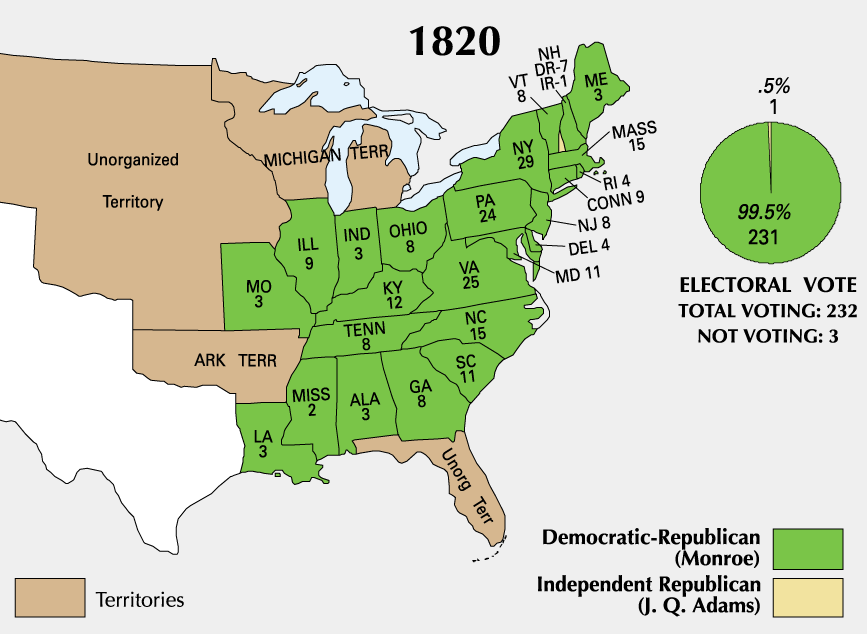
The map above shows the result of the 1820 US presidential election between James Monroe and John Quincy Adams. Turnout for the election was 10.10%.
Here are the key details:
| Winner: | Runner-Up: | |
|---|---|---|
| Name: | James Monroe | John Quincy Adams |
| Political Party: | Democraticic-Republican | Democraticic-Republican |
| Home state: | Virginia | Massachusetts |
| VP Name: | Daniel D. Tompkins | Richard Rush |
| States: Won (Out of 24): | 23 | NA |
| Electoral College Votes (out of 232): | 231 | 1 |
| Percentage of Popular Vote | 80.61% | NA |
| Total Votes | 87,343 | NA |
| Margin % | 64.69% | – |
| Margin (votes) | 69,878 | – |
5 Facts About the 1820 Election
Here are five interesting facts about the 1820 U.S. Presidential Election:
What were the key issues of the 1820 election?
The 1820 U.S. presidential election, in which James Monroe ran for his second term, was essentially uncontested, marking a unique moment in American politics. Here’s an overview of the key issues and why Monroe faced no real opposition:
1. Era of Good Feelings
- Monroe’s presidency marked the so-called “Era of Good Feelings,” a period of relative political unity and lack of major partisan conflict. Following the War of 1812, national pride was high, and Monroe’s administration benefited from a spirit of nationalism and unity. The Federalist Party, which had previously been the main opposition to Monroe’s Democratic-Republican Party, had virtually disbanded by this time. This left Monroe as the dominant figure in American politics.
2. Decline of the Federalist Party
- The Federalist Party’s influence was already waning by the 1816 election due to its opposition to the War of 1812 and perceived elitism. The Hartford Convention in 1814, where some Federalists discussed the possibility of secession, further damaged their reputation. By 1820, the Federalist Party had dissolved to the point where it could not field a viable candidate, leaving Monroe virtually unchallenged.
3. Missouri Compromise of 1820
- One of the key issues during Monroe’s first term was the Missouri Compromise, which dealt with the balance of power between free and slave states. The compromise allowed Missouri to enter the Union as a slave state and Maine as a free state, maintaining balance in the Senate. This compromise helped defuse sectional tensions temporarily and was seen as a success for Monroe’s administration, further securing his popularity.
4. Economic Stability and the Panic of 1819
- The Panic of 1819, the first major economic downturn in the U.S., had caused financial hardship, especially in the Western and Southern states. However, Monroe’s response to the crisis (largely by allowing the economy to recover without significant federal intervention) did not hurt his popularity severely. While the panic exposed weaknesses in the economy, Monroe was still able to retain public support due to the overall stability and prosperity of his first term.
5. Unopposed Re-election
- Due to the lack of a major opposing party, Monroe ran effectively unopposed in the 1820 election. He received nearly all electoral votes (231 out of 232), with only one elector casting a dissenting vote, reportedly to preserve George Washington’s legacy as the only president unanimously elected. This election marked one of the few times in U.S. history that a candidate faced no real opposition, largely due to the unique political environment of the time.
1820 Election Results Map By County

1820 Map From The National Atlas of the United States (now sadly permanently offline)
Other US Presidential Election Maps: