
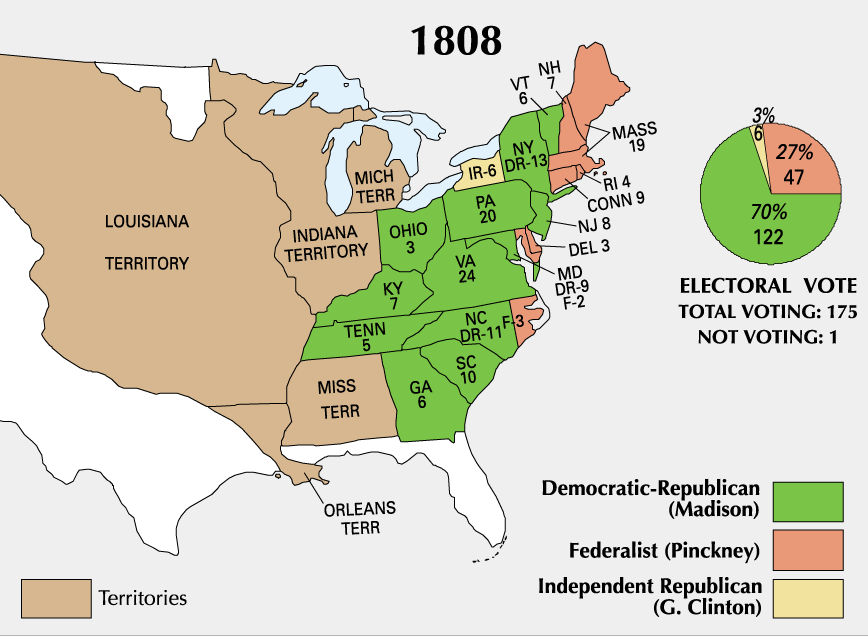
The map above shows the result of the 1808 US presidential election between James Madison and Charles C. Pinckney. Turnout for the election was 32.40%.
Here are the key details:
| Winner: | Runner-Up: | |
|---|---|---|
| Name: | James Madison | Charles C. Pinckney |
| Political Party: | Democratic-Republican | Federalist |
| Home state: | Virginia | South Carolina |
| VP Name: | George Clinton | Rufus King |
| States: Won (Out of 17): | 12 | 5 |
| Electoral College Votes (out of 175): | 122 | 47 |
| Percentage of Popular Vote | 64.74% | 32.40% |
| Total Votes | 124,732 | 62,431 |
| Margin % | 32.33% | – |
| Margin (votes) | 62,301 | – |
1808 Election Facts
Here are five interesting facts about the 1808 U.S. presidential election:
- First Time a Sitting Secretary of State Became President: James Madison’s election marked the first time a sitting Secretary of State ascended directly to the presidency. This set a precedent for a pattern where many future presidents, such as James Monroe and John Quincy Adams, would come from this position.
- Divisions Within the Democratic-Republican Party: While Madison was the main Democratic-Republican candidate, he faced significant internal challenges. Some factions within the party, particularly those led by John Randolph and the “Quids,” opposed Madison, believing he was too aligned with Jefferson’s policies and not sufficiently committed to their own strict interpretation of states’ rights.
- The Embargo Act’s Impact: The Embargo Act of 1807 was a major point of contention and shaped the campaign. It was so unpopular in New England that it bolstered Federalist support in those states. However, outside of these regions, voters viewed it as a measure to preserve American independence and avoid war.
- High Voter Turnout for the Time: Although still far from modern numbers, the 1808 election saw an increase in voter turnout compared to earlier contests. This was partly due to the strong feelings about the Embargo Act and the foreign policy stances of both candidates, which galvanized voters.
- Charles Cotesworth Pinckney’s Repeat Candidacy: Pinckney had previously run for president as the Federalist candidate in 1804, making 1808 his second attempt. Both times, he lost to a candidate backed by Thomas Jefferson, underscoring the continuing decline of the Federalist Party and the dominance of the Democratic-Republicans in early 19th-century politics.
What were the key issues of the 1808 election?
The main issues centered around foreign policy, particularly tensions with Britain and France, economic policies, and the legacy of Thomas Jefferson’s presidency.
Here’s an overview of the key issues and where each candidate stood on them:
1. The Embargo Act of 1807
Key Issue: The Embargo Act, enacted under President Thomas Jefferson, was a response to British and French interference with American shipping during the Napoleonic Wars. The act aimed to pressure Britain and France to respect U.S. neutrality by prohibiting American ships from trading with foreign ports. However, it severely hurt the U.S. economy, especially in port cities and areas reliant on trade.
- Candidates’ Stances:
- James Madison (Democratic-Republican): As Jefferson’s Secretary of State and a key architect of U.S. foreign policy, Madison supported the Embargo Act, although he recognized its unpopularity and economic impact. He favored finding ways to adjust or replace the act with measures that could be more effective without crippling American commerce.
- Charles Cotesworth Pinckney (Federalist): Pinckney and the Federalists were strongly opposed to the Embargo Act, viewing it as disastrous to American trade and prosperity. They argued that it weakened the U.S. economy while failing to force Britain or France to change their policies. Pinckney called for more aggressive measures against Britain and France, along with a return to open trade.
2. Tensions with Britain and France
Key Issue: The Napoleonic Wars between Britain and France created significant challenges for the U.S., as both European powers sought to restrict neutral trade that could aid their enemy. British impressment of American sailors and restrictions on U.S. shipping heightened tensions.
- Candidates’ Stances:
- James Madison: Advocated for diplomacy but was willing to take strong measures to defend American interests. Madison supported efforts to negotiate with Britain and France but maintained that U.S. sovereignty and neutral rights must be respected.
- Charles Cotesworth Pinckney: Criticized the Democratic-Republican administration for being too weak in response to British provocations. The Federalists argued for a more forceful stance that included measures such as strengthening the navy to protect American shipping.
3. Economic Policy and Trade
Key Issue: The impact of the Embargo Act and subsequent economic hardship were central to the election. Debates about how best to manage trade and economic relations with Europe were highly contentious.
- Candidates’ Stances:
- James Madison: Believed in upholding American independence in economic matters and maintaining a non-interventionist policy that did not favor Britain or France. He was open to revising the embargo strategy to relieve economic pressure while continuing to safeguard American interests.
- Charles Cotesworth Pinckney: Advocated for lifting the embargo to reinvigorate the economy and return to international trade. The Federalists argued that a strong economic policy would bolster national strength and allow the U.S. to better protect itself against European powers.
4. Legacy of Jefferson’s Presidency
Key Issue: As the outgoing president, Thomas Jefferson’s policies heavily influenced the election. His Embargo Act and handling of foreign relations were central points of contention.
- Candidates’ Stances:
- James Madison: As Jefferson’s close ally and the Democratic-Republican choice, Madison was seen as a continuation of Jefferson’s policies. He defended Jefferson’s decisions while acknowledging the need for adaptation to changing circumstances.
- Charles Cotesworth Pinckney: Positioned himself and the Federalist Party as a contrast to the perceived failures of Jefferson’s administration. Pinckney emphasized the economic damage of the Embargo Act and criticized the administration’s foreign policy as ineffective.
Summary
- James Madison campaigned on his experience and commitment to upholding American rights while maintaining peace and avoiding entanglement in European conflicts, though with an openness to modify the Embargo Act to mitigate economic harm.
- Charles Cotesworth Pinckney and the Federalists campaigned on reversing the embargo, resuming trade, and taking a stronger stance against European interference, appealing to voters frustrated by economic downturns and perceived government weakness.
Why did Madison win?
James Madison’s victory in the 1808 presidential election can be attributed to several key factors:
1. Endorsement and Support of Thomas Jefferson
- Jefferson’s Popularity: Despite the controversies surrounding the Embargo Act, Thomas Jefferson remained a popular figure among many Americans, especially in the South and West. His endorsement of Madison as his preferred successor carried significant weight, as Jefferson’s Democratic-Republican Party was dominant at the time.
- Party Loyalty: Madison benefited from being Jefferson’s Secretary of State and an established Democratic-Republican leader. This association reassured voters who still trusted Jefferson’s vision for the country, even if some of his policies, such as the embargo, had been unpopular.
2. Dominance of the Democratic-Republican Party
- Strong Political Base: The Democratic-Republican Party was the majority party and had widespread support, especially outside of New England. Their political strength was reflected in Congress and local governments, giving Madison an advantage in voter loyalty and organizational support.
- Federalist Weakness: The Federalist Party, led by Charles Cotesworth Pinckney in this election, had been on the decline since their loss in 1800. They were viewed by many as elitist and primarily concerned with the interests of merchants and the Northeast. Their lack of widespread appeal across different regions and socioeconomic groups limited their influence.
3. Public Perception of the Embargo Act
- Support for Non-Intervention: While the Embargo Act of 1807 had caused significant economic difficulties, particularly in New England and other trade-dependent regions, it was viewed by many Democratic-Republican supporters as a necessary sacrifice to maintain U.S. neutrality. Madison’s stance of seeking a peaceful resolution while safeguarding American rights resonated with voters who feared war with Britain or France.
- Hopes for Policy Revision: Madison hinted at revising the Embargo Act to make it more effective and less harmful to American interests. This moderate approach appealed to those who were frustrated with the economic impact but still preferred peaceful measures over conflict.
4. Madison’s Political Experience and Reputation
- Established Statesman: Madison’s extensive experience, including his role in drafting the U.S. Constitution and serving as Secretary of State, lent him significant credibility. He was seen as knowledgeable and capable of navigating complex domestic and foreign policy challenges.
- Reputation for Diplomacy: Voters viewed Madison as a skilled diplomat who could potentially navigate the tumultuous international situation and protect U.S. interests without resorting to war.
5. Lack of a Strong Federalist Platform
- Perception of Federalist Policies: The Federalist Party’s focus on opposing Jefferson’s policies, including their advocacy for a stronger alignment with Britain, did not resonate well with the broader public. Many Americans were still wary of strong ties to Britain due to lingering resentment from the Revolutionary War.
- Regional Limitations: Federalist support was largely confined to New England and some mid-Atlantic areas. This limited geographic appeal prevented Pinckney from securing enough electoral votes across a diverse range of states.
6. Avoidance of War
- Desire for Peace: Many voters wanted to avoid entanglement in the Napoleonic Wars. Madison’s campaign maintained that the U.S. should continue to seek neutrality and protect its interests without engaging in conflict, a stance that was preferable to war-weary citizens.
1808 Election Results Map By County

Map From The National Atlas of the United States (now sadly permanently offline)
Other US Presidential Election Maps: