
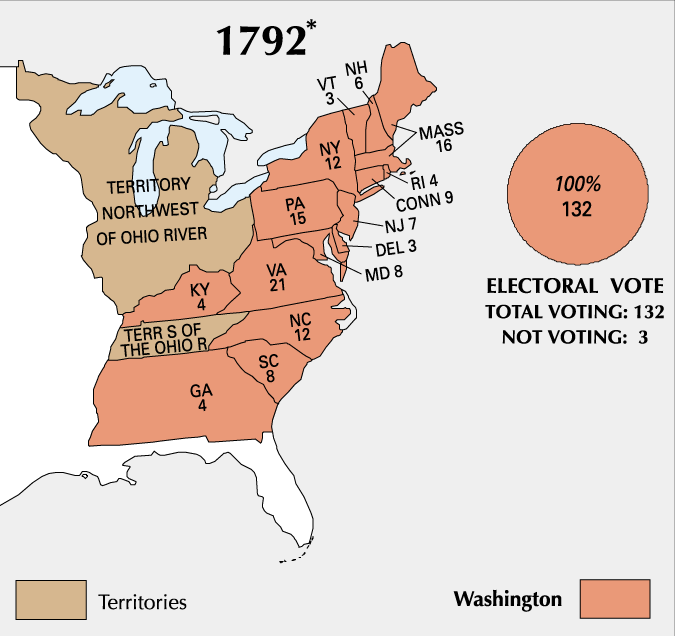
The map above shows the result of the 1792 US presidential election between George Washington and No candidate. Turnout for the election was 6.30%.
Here are the key details:
| Winner: | Runner-Up: | |
|---|---|---|
| Name: | George Washington | No candidate |
| Political Party: | Ind. | NA |
| Home state: | Virginia | No candidate |
| VP Name: | John Adams | No candidate |
| States: Won (Out of 15): | 15 | NA |
| Electoral College Votes (out of 132): | 132 | NA |
| Percentage of Popular Vote | 100% | NA |
| Total Votes | 28,579 | NA |
| Margin % | 100% | – |
| Margin (votes) | 28,579 | – |
5 Facts About the 1792 Election
Here are five interesting facts about the 1792 U.S. presidential election:
- First Election with Multiple States Participating Under the New Constitution: The 1792 election was the first presidential election in which all 15 states that had ratified the Constitution participated, as Vermont joined the Union in 1791 and voted for the first time.
- George Washington’s Reluctance: Despite running unopposed, Washington initially did not want to seek a second term. He felt weary of political life and desired to retire to Mount Vernon. However, he was persuaded by his peers that the country needed his leadership to maintain stability.
- Unanimous Electoral Votes for Washington: George Washington received unanimous support in the Electoral College, securing all available electoral votes (132). This solidified his status as the only president in U.S. history to be unanimously elected not just once but twice.
- The Vice Presidential Contest: While Washington was unchallenged for the presidency, there was more competition for the vice presidency. John Adams faced opponents like George Clinton, the governor of New York, who received a significant number of votes (50 electoral votes) compared to Adams’ 77, showing an early divide in political preferences.
- No Formal Campaigning: The concept of political campaigning as we know it today did not exist in 1792. Candidates did not travel or give speeches to promote themselves. Washington’s reputation and stature were sufficient to secure his re-election, and most of the political maneuvering was done quietly behind the scenes by influential political figures like Alexander Hamilton and Thomas Jefferson.
What were the key issues in 1792 Presidential election?
Here’s an overview of the main issues and why George Washington ran unopposed:
1. Key Issues of the 1792 Presidential Election:
Unity and Stability: The young nation was still in a formative phase, and unity was crucial. The election came at a time when the country was working to stabilize its government and institutions under the new Constitution, which had only been ratified a few years earlier (1787).
Emerging Political Factions: Although formal political parties had not yet solidified, two emerging factions were beginning to form around the policies of Alexander Hamilton (Federalists) and Thomas Jefferson and James Madison (Democratic-Republicans).
These factions debated key issues such as:
-
- Economic Policy: Hamilton’s financial plan, including the establishment of the First Bank of the United States, assumption of state debts, and promotion of manufacturing, was contentious and polarized opinion.
- State vs. Federal Power: The balance between state sovereignty and federal authority was a recurring theme. Hamilton’s vision favored a strong central government, while Jefferson and Madison argued for more power to the states.
- Foreign Policy: Relations with Britain and France were becoming divisive. The French Revolution (which began in 1789) and its radical turn by 1792 created debates over how the U.S. should align itself internationally, adding to domestic political tensions.
2. Why Washington Ran Unopposed:
Universal Respect and Trust: George Washington was widely respected as a unifying figure and was considered above the emerging factional politics. His leadership in the American Revolution and role as the presiding officer at the Constitutional Convention solidified his image as the father of the nation. He was seen as a stabilizing presence necessary for the young country’s survival.
Reluctance to Step Down: Washington initially expressed a desire to retire after his first term, but his advisors, including Alexander Hamilton and Thomas Jefferson, urged him to remain in office for the sake of national unity. They feared that the nascent republic might become destabilized without his leadership.
No Organized Opposition: At that time, there were no established political parties to field an opposing candidate. Although factions were forming, they did not yet have the infrastructure to organize an effective presidential campaign against Washington. His re-election was essentially a foregone conclusion because no other leader had comparable national support or prestige.
1792 Election Results Map By County

Map from the National Atlas of the United States (now sadly permanently offline)
Other US Presidential Election Maps: