
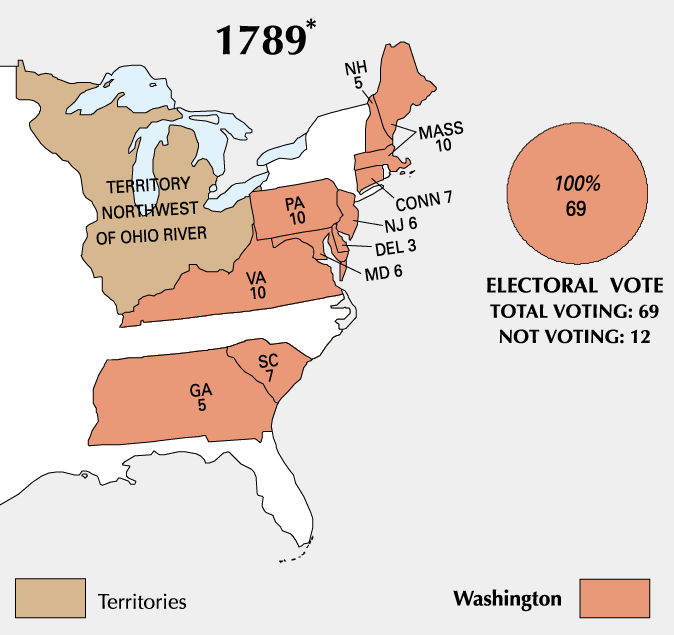
The map above shows the result of the 1788–89 US presidential election between George Washington and No candidate. Turnout for the election was 11.60%.
Here are the key details:
| Winner: | Runner-Up: | |
|---|---|---|
| Name: | George Washington | No candidate |
| Political Party: | Ind. | NA |
| Home state: | Virginia | No candidate |
| VP Name: | John Adams | No candidate |
| States: Won (Out of 13): | 10 | NA |
| Electoral College Votes (out of 69): | 69 | NA |
| Percentage of Popular Vote | 100% | NA |
| Total Votes | 43,782 | NA |
| Margin % | 100% | – |
| Margin (votes) | 43,782 | – |
5 Facts About the 1788–89 Election
Here are 5 interesting facts about the 1788–1789 U.S. presidential election:
- First Unanimous Election: George Washington remains the only president in U.S. history to be elected unanimously (twice!). He received all 69 electoral votes from the states participating in the election, showcasing his widespread popularity and the lack of any substantial opposition.
- Electoral College Voting Structure: The election was conducted under a unique system in which each elector cast two votes. The candidate with the most votes became president, and the runner-up became vice president. John Adams, who came in second with 34 electoral votes, thus became the first vice president.
- Limited Voter Participation: Only a small segment of the population was eligible to vote in this election. Voting rights were generally restricted to white male property owners, which significantly limited participation compared to modern standards.
- Staggered Voting Period: Unlike today’s elections, which are held on a single day, the 1788–1789 presidential election took place over several weeks. Voting began on December 15, 1788, and concluded on January 10, 1789, allowing time for electors to travel and cast their votes.
- Inaugural Ceremony Location: George Washington’s first inauguration did not take place in Washington, D.C., as the city did not yet exist as the capital. Instead, the ceremony was held in New York City at Federal Hall on April 30, 1789, marking the beginning of Washington’s first term as president.
Key Issues
The 1788–1789 U.S. presidential election was unique as the first presidential election in American history, setting foundational precedents for future electoral processes.
Here are the key issues and reasons George Washington ran unopposed:
Key Issues of the 1788–89 Election:
- Establishing a Stable Government: The most pressing issue was forming a strong and stable national government under the new U.S. Constitution, which had been ratified in 1787. The election was held to put the newly established government into effect and provide legitimacy and structure to the nascent nation.
- Trust in Leadership: The country needed a leader who could unify the differing states and political factions. There was widespread concern about maintaining unity and preventing regional rivalries from destabilizing the young country.
- Federal vs. State Power: Though not a contentious campaign issue yet, there were ongoing debates about the balance of power between the federal government and individual states. The new Constitution was designed to address some of the weaknesses of the Articles of Confederation by creating a stronger central authority, and this balance would become more defined under the leadership of the first president.
- Setting Precedents: There was an implicit understanding that the first election would shape norms and traditions, such as how presidential powers would be interpreted and the manner in which elections would be conducted.
Why George Washington Ran Unopposed:
- Unifying Figure: George Washington was a universally respected leader who had gained unparalleled prestige as the Commander-in-Chief of the Continental Army during the American Revolutionary War. His reputation for integrity, leadership, and dedication to the public good made him the natural and uncontested choice to be the nation’s first president.
- Broad Support Across Political Divides: Washington had the rare quality of being respected by different political factions. Although political parties had not yet fully formed, there were emerging groups with differing views, such as the Federalists, who supported a strong national government, and anti-Federalists, who were wary of centralized power. Washington’s nonpartisan stance reassured both sides.
- Reluctance to Appear Power-Hungry: Washington was initially reluctant to assume the presidency because he did not seek power for its own sake. This reluctance further enhanced his reputation as a man committed to serving only for the public good, making it clear that he was not seeking the position out of ambition.
- Absence of Viable Opposition: No one else had Washington’s level of trust and recognition across all 13 states. While other influential figures existed (e.g., John Adams, Alexander Hamilton, and Thomas Jefferson), none could rival Washington’s broad appeal or statesmanship.
Outcome:
Due to these factors, Washington ran unopposed and won the unanimous support of the electors in the Electoral College. He was inaugurated as the first President of the United States on April 30, 1789, marking the start of a new era under the U.S. Constitution.
What states did not appoint Electors?
In the 1788–1789 U.S. presidential election, three states did not participate in appointing electors for the Electoral College:
- North Carolina: North Carolina had not yet ratified the U.S. Constitution at the time of the election. It ratified the Constitution later, on November 21, 1789, after the election was completed.
- Rhode Island: Rhode Island also had not ratified the Constitution by the time of the election. It was the last of the original 13 states to do so, finally ratifying it on May 29, 1790.
- New York: Although New York had ratified the Constitution in 1788, it faced significant internal political disputes that prevented its legislature from appointing electors in time for the presidential election. As a result, New York did not participate in the voting for president.
Map From The National Atlas of the United States (now sadly permanently offline)
Other US Presidential Election Maps: