Brilliant Maps

Making Sense Of The World, One Map At A Time

  • BOOK!
  • Newsletter
  • Board Games
  • Posters
  • Scratch Maps

2012 US Presidential Election Map: Obama vs Romney

Click To Get My 10 Best Brilliant Maps For Free:

2012 US Presidential Election Map

The map above shows the result of the 2012 US presidential election between Barack Obama and Mitt Romney. Turnout for the election was 58.60%.

Here are the key details:

Winner: Runner-Up:
Name: Barack Obama Mitt Romney
Political Party: Democratic Republican
Home state: Illinois Massachusetts
VP Name: Joe Biden Paul Ryan
States: Won (Out of 51): 27 24
Electoral College Votes (out of 538): 332 206
Percentage of Popular Vote 51.06% 47.20%
Total Votes 65,915,795 60,933,504
Margin % 3.86% –
Margin (votes) 4,982,291 –


Other Parties

3rd Place 4th Place:
Name: Gary Johnson Jill Stein
Political Party Libertarian Green
Electoral College Votes 0 0
Number of Votes: 1,275,971 469,627
Percentage of Popular Vote: 0.99% 0.36%


Key Issues of The 2012 Election

The 2012 U.S. presidential election was primarily contested between the incumbent President Barack Obama, a Democrat, and the Republican challenger, former Massachusetts Governor Mitt Romney.
The key issues of the 2012 election included:

1. Economy and Jobs

  • Recovery from the Great Recession: The U.S. was still recovering from the 2008 financial crisis, and the state of the economy was a central issue. High unemployment, slow economic growth, and the national debt were significant concerns.
  • Job Creation: Both candidates emphasized job creation. Obama focused on supporting the middle class and argued for policies to help them recover, including investing in education and clean energy. Romney criticized Obama’s economic policies, promoting a pro-business agenda and promising to create 12 million jobs.

2. Healthcare

  • Affordable Care Act (ACA): Commonly known as “Obamacare,” the ACA was a landmark piece of legislation passed during Obama’s first term. Romney and the Republicans criticized the ACA, promising to repeal and replace it if elected. This was a defining issue, particularly for conservative voters.

3. Federal Deficit and National Debt

  • The rising national debt and budget deficits were significant concerns. Romney criticized Obama’s administration for increasing the debt and promised to reduce the deficit through spending cuts and entitlement reform. Obama defended his administration’s spending, arguing it was necessary to prevent a deeper recession.

4. Tax Policy

  • Tax Cuts and Reform: Romney proposed cutting taxes, particularly for high earners, to stimulate economic growth. He advocated for a simpler tax code with lower rates across the board. Obama argued that tax cuts should be extended for middle-class families but not for the wealthy, promoting the idea that the rich should pay their “fair share.”

5. Social Issues

  • Same-Sex Marriage: The 2012 election was significant for its focus on same-sex marriage, especially after Obama publicly supported it during his campaign, becoming the first sitting U.S. president to do so. Romney opposed same-sex marriage, reflecting the views of much of the Republican base at the time.
  • Women’s Rights: Issues such as access to contraception and abortion were also prominent. Obama supported access to birth control through the ACA and defended a woman’s right to choose, while Romney took a more conservative stance, appealing to the Republican base.

6. Foreign Policy

  • War in Afghanistan: Obama promised to wind down the war in Afghanistan and bring troops home, while Romney criticized Obama’s foreign policy as weak, arguing for a stronger U.S. presence on the global stage.
  • Libya and Benghazi Attack: The attack on the U.S. consulate in Benghazi, Libya, which resulted in the deaths of four Americans, including the ambassador, became a contentious issue. Romney criticized the Obama administration’s handling of the situation, while Obama defended his administration’s actions.

7. Immigration

  • Immigration reform was also a significant issue, with Obama supporting a path to citizenship for undocumented immigrants, particularly through the Deferred Action for Childhood Arrivals (DACA) policy. Romney took a more hardline stance, emphasizing border security and opposing amnesty for undocumented immigrants.

8. Energy and the Environment

  • Energy Policy: Romney advocated for increased domestic energy production, including fossil fuels, and criticized Obama’s support for renewable energy, which he argued was costly and ineffective. Obama promoted an “all of the above” energy strategy, including investments in renewable energy and reducing dependence on foreign oil.

Why Did Barack Obama Win?

Barack Obama’s victory in the 2012 U.S. presidential election can be attributed to several key factors:

1. Incumbency Advantage

  • As the sitting president, Obama benefited from the natural advantages of incumbency, including greater media exposure, established campaign infrastructure, and the ability to shape the national agenda. Voters generally tend to give incumbents the benefit of the doubt, especially if the country is not in crisis.

2. Economic Recovery

  • While the economy was still a major concern, there were signs of recovery from the Great Recession during the latter part of Obama’s first term. Unemployment was gradually decreasing, and there were improvements in key economic indicators like the stock market and consumer confidence. Obama successfully argued that his policies were helping the economy recover and that it was risky to change course.

3. Strong Ground Game

  • Obama’s campaign was known for its highly effective ground game. The campaign had a robust and sophisticated grassroots operation, utilizing data analytics to target voters, particularly in swing states. This allowed the campaign to mobilize key demographic groups, including young voters, women, and minorities, who were crucial to Obama’s coalition.

4. Demographic Shifts

  • Obama capitalized on the changing demographics of the U.S. electorate. His campaign effectively appealed to minorities, particularly African Americans, Hispanics, and Asian Americans, who turned out in large numbers and overwhelmingly supported him. Obama also maintained strong support among young voters and women, particularly single women, who were drawn to his positions on social issues.

5. Mitt Romney’s Weaknesses

  • While Mitt Romney was a strong candidate with a solid business background, he faced several challenges:
    • Image Problems: Romney struggled with an image of being out of touch with ordinary Americans, which was exacerbated by gaffes such as the infamous “47 percent” comment, where he was secretly recorded saying that 47% of Americans were dependent on government and unlikely to vote for him.
    • Lack of Clear Vision: Romney’s campaign was criticized for lacking a clear and consistent message. His shifting positions on issues, particularly healthcare (given his role in implementing a healthcare plan in Massachusetts similar to Obamacare), led to accusations of flip-flopping.
    • Difficulty Connecting with Voters: Romney often struggled to connect with middle-class and working-class voters, who were crucial in battleground states. This was in contrast to Obama, who was seen as more relatable and empathetic.

6. Effective Use of Social Issues

  • Obama effectively used social issues to galvanize key segments of his base. His support for same-sex marriage, reproductive rights, and healthcare access for women resonated strongly with progressive voters, young people, and women. Romney’s more conservative stances on these issues alienated some moderate and independent voters.

7. Foreign Policy Record

  • Obama’s foreign policy record, particularly the killing of Osama bin Laden and the drawdown of U.S. troops in Iraq and Afghanistan, bolstered his credentials as a strong leader. While foreign policy was not the dominant issue in the election, it reinforced Obama’s image as a competent and steady hand in international affairs.

8. Electoral College Strategy

  • Obama’s campaign focused heavily on winning key battleground states like Ohio, Florida, Virginia, and Colorado. The campaign’s targeted efforts in these swing states paid off, as Obama was able to secure victories in most of them, which were crucial for his electoral college win.

9. Positive Campaigning and Vision for the Future

  • Obama’s campaign was successful in presenting a positive vision for the future, emphasizing themes of hope and progress. While the campaign did attack Romney, it also focused on what Obama would do in his second term, which contrasted with Romney’s more negative messaging.

2012 Election Results Map By County

2012 US Presidential Election Results Map By County

2012 Map From The National Atlas of the United States (now sadly permanently offline)
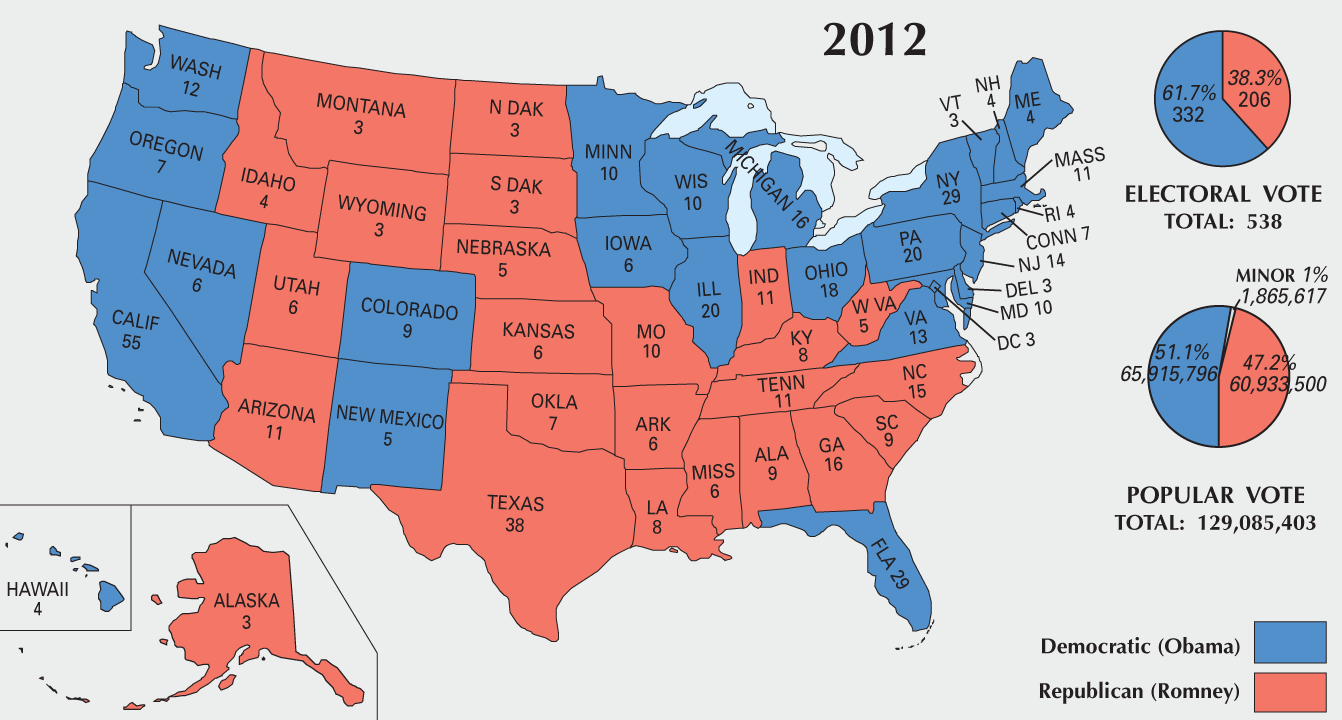
2012 United States Presidential Election Map from the National Atlas of the United States

Other US Presidential Election Maps:

1788 1792 1796 1800 1804 1808
1812 1816 1820 1824 1828 1832
1836 1840 1844 1848 1852 1856
1860 1864 1868 1872 1876 1880
1884 1888 1892 1896 1900 1904
1908 1912 1916 1920 1924 1928
1932 1936 1940 1944 1948 1952
1956 1960 1964 1968 1972 1976
1980 1984 1988 1992 1996 2000
2004 2008 2012 2016 2020 2024


Product Reviews · World Atlas · Settlers of Catan · Risk · Game of Thrones · Coloring Books
Globes · Monopoly · Star Wars · Game of Life · Pandemic · Ticket To Ride · Drinks Cabinets
US Locations · UK Locations· Fleet Management
Copyright © 2026 · Privacy Policy · Fair Use, Attribution & Copyright · Contact Us
Follow Us: Newsletter · Facebook · Youtube · Twitter · Threads · BlueSky · LinkedIn · Instagram · Pinterest · Flipboard