
One of CIA’s oldest and most recognizable intelligence publications, The World Factbook, has sunset. The World Factbook served the Intelligence Community and the general public as a longstanding, one-stop basic reference about countries and communities around the globe.
Link to the History of The World Factbook.
Libya Location Map

Libya Facts
Full Official Name: State of Libya
Demonym: Libyan
Flag:

Area
Total Area: 1,759,540 km²
Total Land Area: 1,759,540 km²
Total Water Area: 0 km²
Demographics
Population: 7,361,263
Population Growth Rate: 1.44% (2024 est.)
Largest City: Tripoli (Population: 1,183,000)
Ethnic Groups: Amazigh and Arab 97%, other 3% (includes Egyptian, Greek, Indian, Italian, Maltese, Pakistani, Tunisian, and Turkish)
Languages: Arabic (official), Italian, English (all widely understood in the major cities); Tamazight (Nafusi, Ghadamis, Suknah, Awjilah, Tamasheq)
Religions: Muslim (official; virtually all Sunni) 96.6%, Christian 2.7%, Buddhist <1%, Hindu <1%, Jewish <1%, folk religion <1%, other <1%, unaffiliated <1% (2020 est.)
Economy
Currency: Libyan dinar
Real GDP at Purchasing Power Parity ($ PPP): $121.951 billion (2023 est.)
GDP per capita (PPP): $17,700 (2023 est.)
Exports Value Per Year: $32.38 billion (2021 est.)
Biggest Export Partners: Italy 26%, Spain 10%, Germany 9%, China 7%, France 6% (2022)
Imports Value Per Year: $25.406 billion (2021 est.)
Biggest Import Partners: Turkey 15%, China 12%, Italy 12%, Greece 10%, UAE 7% (2022)
Government
Type: in transition
Capital City: Tripoli (Tarabulus) (Population: 1,183,000)
Other Facts
Time Zone: UTC+2:00 (EET)
Country Code: LY
Internet TLD: .ly
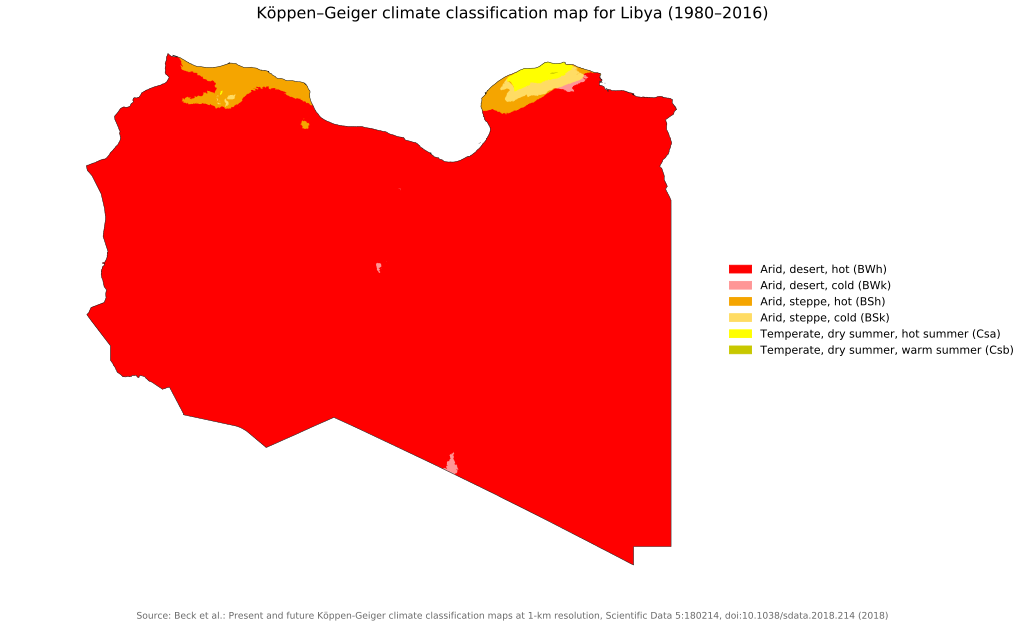
Climate Map of Libya
Topographic Map of Libya

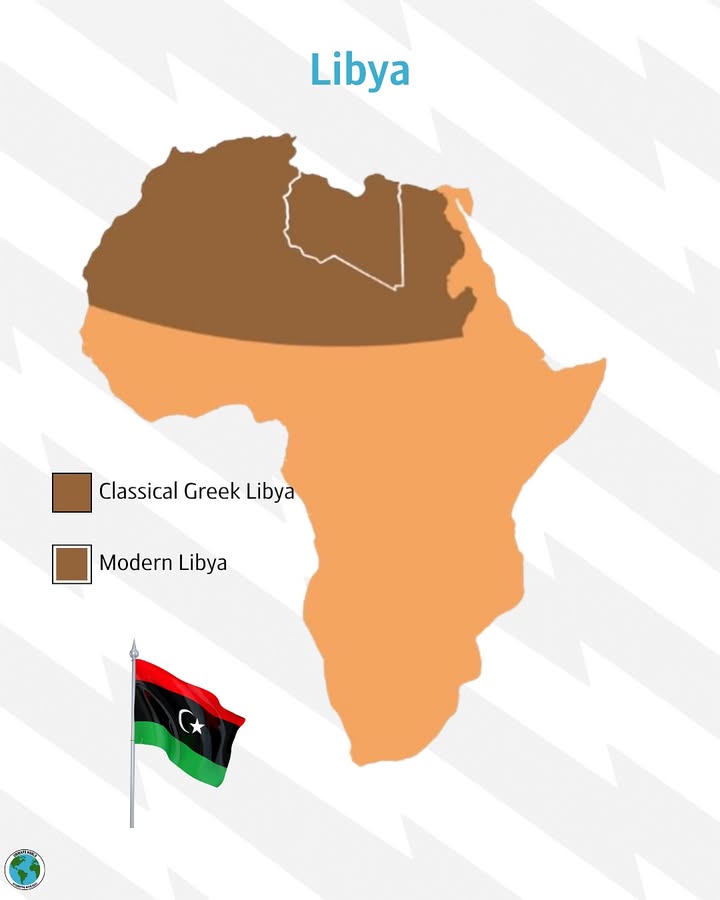
Classical vs Modern Libya
The Ancient Egyptian origin
The earliest known form comes from ancient Egyptian records that mention a people called “Libu” or “R’bw”.
- These were Berber tribes living west of the Nile in North Africa.
- Egyptian inscriptions from around 2000-1200 BC refer to them as enemies or neighbors of Egypt.
Over time, the tribal name Libu became associated with the entire region west of Egypt.
The Greek adaptation
When the ancient Greeks learned about the region, they adopted a similar name:
- Greek: Λιβύη (Libýē)
- Meaning: the land of the Libyans
For the Greeks, “Libya” didn’t mean the modern country. It often meant all of North Africa west of Egypt, and sometimes even the whole African continent.
Roman and later usage
The Romans continued using the name Libya for parts of North Africa. Later historical and geographical traditions preserved it.
Adoption as the modern country name
The modern state name was officially adopted in 1951 when the country gained independence as the Kingdom of Libya.