
Greece Location Map

Greece Facts
Full Official Name: Hellenic Republic
Demonym: Greek, Hellene
Flag:

Area
Total Area: 131,957 km²
Total Land Area: 130,647 km²
Total Water Area: 1,310 km²
Demographics
Population: 10,461,091
Population Growth Rate: -0.35% (2024 est.)
Largest City: Athens (Population: 643,452)
Ethnic Groups: Greek 91.6%, Albanian 4.4%, other 4% (2011 est.)
Languages: Greek (official) 99%, other (includes English and French) 1%
Religions: Greek Orthodox 81-90%, Muslim 2%, other 3%, none 4-15%, unspecified 1% (2015 est.)
Economy
Currency: Euro
Real GDP at Purchasing Power Parity ($ PPP): $375.78 billion (2023 est.)
GDP per capita (PPP): $36,300 (2023 est.)
Exports Value Per Year: $106.65 billion (2023 est.)
Biggest Export Partners: Italy 10%, Bulgaria 7%, Germany 6%, Cyprus 5%, Turkey 5% (2022)
Imports Value Per Year: $1.609 billion (2021 est.)
Biggest Import Partners: China 12%, Germany 9%, Russia 9%, Italy 7%, Iraq 7% (2022)
Government
Type: parliamentary republic
Capital City: Athens (Population: 643,452)
Other Facts
Time Zone: UTC+2 (EET), UTC+3 (EEST) (DST)
Country Code: GR
Internet TLD: .gr
Climate Map of Greece

Topographic Map of Greece

What Is Greece Called In Other Languages?
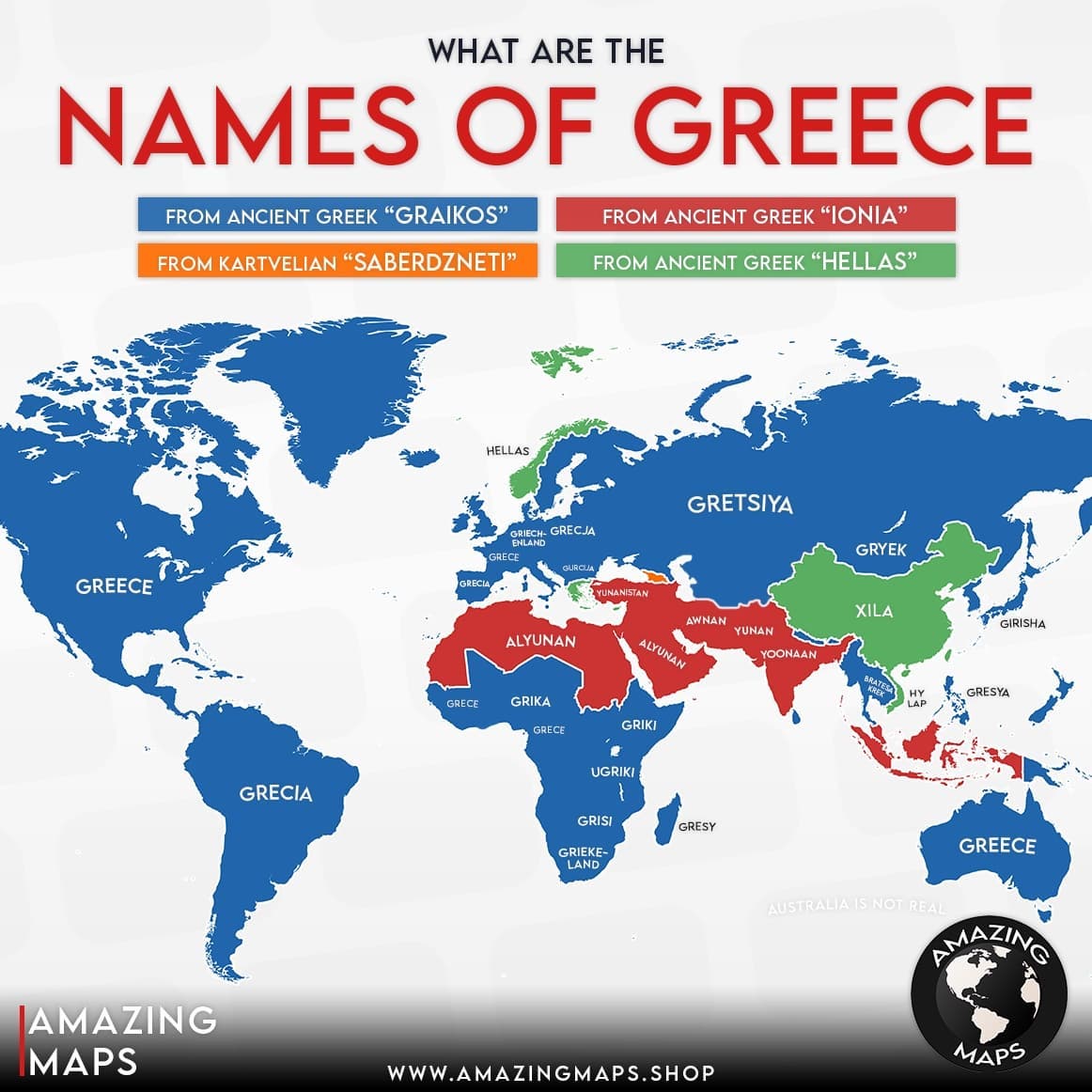
Hellas (Ἑλλάς) — the Greek self-name 🇬🇷
Who uses it: Greeks themselves, and languages influenced directly by Greek
Examples: Hellas, Elláda, Xila
- This is the native name of the country in Greek.
- Ancient Greeks called their land Hellas and themselves Hellenes.
- It comes from Greek mythology (Hellen, ancestor of the Hellenes).
- You see this root in academic terms like Hellenistic and Hellenic.
Graikos → Greece – the Roman / Western name
Who uses it: Most of Western Europe and the Americas
Examples: Greece, Grèce, Grecia, Griekenland
- The Romans encountered a Greek tribe called the Graikoi.
- They generalized that name to all Greeks: Graecus → Graecia.
- Latin spread this form across Europe through Roman rule, Christianity, and scholarship.
This is why English says Greece, not Hellas.
Ionia → Yunan / Yunān, the Eastern name
Who uses it: Middle East, South Asia, Central Asia
Examples: Yunanistan (Turkish), Yūnān (Arabic/Persian), Yavana (Sanskrit)
- Eastern peoples first met Greeks from Ionia (western Anatolia).
- They named all Greeks after that region.
- The name spread through Persian, then Arabic, then Islamic and Indian worlds.
Saberdzneti : the Georgian “philosophers” name
Who uses it: Georgian (Kartvelian) language only
Example: Saberdzneti
- This one is special and unique.
- It comes from the Georgian root brdzeni (“wise”).
- Literally means “land of the wise people.”
- Reflects Georgia’s early admiration for Greek philosophy and learning.