
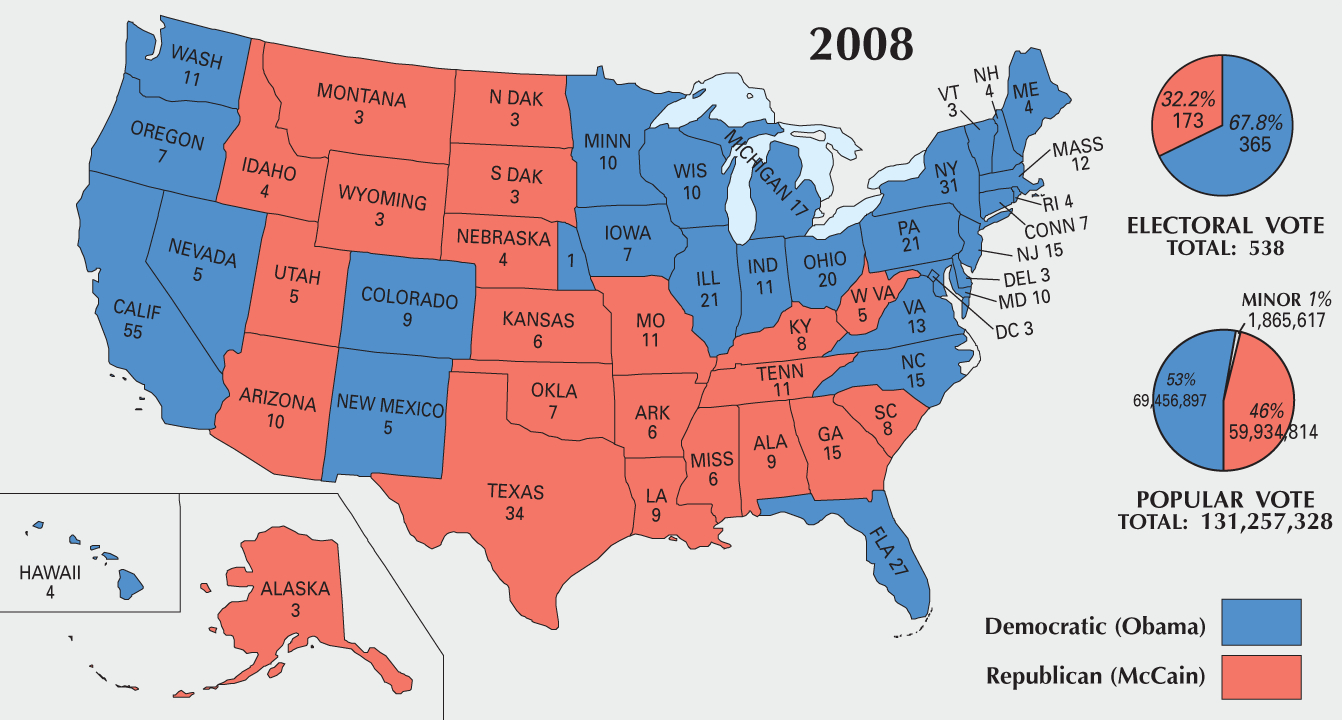
The map above shows the result of the 2008 US presidential election between Barack Obama and John McCain. Turnout for the election was 61.60%.
Here are the key details:
| Winner: | Runner-Up: | |
|---|---|---|
| Name: | Barack Obama | John McCain |
| Political Party: | Democratic | Republican |
| Home state: | Illinois | Arizona |
| VP Name: | Joe Biden | Sarah Palin |
| States: Won (Out of 51): | 29 | 22 |
| Electoral College Votes (out of 538): | 365 | 173 |
| Percentage of Popular Vote | 52.93% | 45.70% |
| Total Votes | 69,498,516 | 59,948,323 |
| Margin % | 7.27% | – |
| Margin (votes) | 9,550,193 | – |
Other Parties:
| 3rd Place | 4th Place: | |
|---|---|---|
| Name: | Ralph Nader | Bob Barr |
| Political Party | Independent | Libertarian |
| Electoral College Votes | 0 | 0 |
| Number of Votes: | 739,034 | 523,715 |
| Percentage of Popular Vote: | 0.56% | 0.40% |
Key Issues of The 2008 Election
The 2008 U.S. presidential election was a highly significant and transformative election with several key issues that shaped the campaign and influenced voters.
Here are the major issues that played a crucial role:
1. Economic Crisis
- The 2008 election occurred in the midst of the worst financial crisis since the Great Depression. The collapse of major financial institutions, the stock market crash, and the subsequent recession were central to the campaign. Voters were deeply concerned about job losses, home foreclosures, and the overall economic stability of the country.
- The candidates’ plans to address the economic crisis, including proposals for economic stimulus, financial regulation, and support for struggling industries like the automotive sector, were intensely debated.
2. Health Care
- Health care was a major issue, with rising costs and the number of uninsured Americans being significant concerns. Barack Obama advocated for comprehensive health care reform, proposing a plan that would eventually become the Affordable Care Act (Obamacare).
- John McCain, the Republican candidate, also focused on health care, proposing reforms that would rely more on market-based solutions and tax incentives.
3. The War in Iraq and Afghanistan
- The wars in Iraq and Afghanistan were key foreign policy issues. The American public was increasingly weary of the prolonged conflict in Iraq, and there was significant debate over the future course of U.S. involvement.
- Obama, who had opposed the Iraq War from the beginning, promised to end the war responsibly and focus on the conflict in Afghanistan. McCain, who supported the war, advocated for a continued strong military presence to ensure stability.
4. Energy Policy and Climate Change
- Energy independence and climate change were important issues, particularly with rising gas prices and growing concerns about global warming. Both candidates proposed different strategies for addressing energy needs and environmental sustainability.
- Obama emphasized renewable energy and investments in green technology, while McCain supported a mix of alternative energy sources and increased drilling for oil domestically.
5. Change and Leadership
- The theme of “change” was central to Obama’s campaign. He positioned himself as a transformative figure who would bring new ideas and a different approach to Washington, contrasting his campaign against the Bush administration’s policies, which were unpopular by the end of George W. Bush’s presidency.
- McCain, a seasoned politician with extensive military experience, campaigned on his record of service and experience, arguing that he had the judgment and expertise needed to lead the country in a time of crisis.
6. Social Issues
- Social issues such as abortion, same-sex marriage, and gun rights were also discussed, though they were less central than economic and foreign policy issues. However, these issues still played a role in mobilizing certain voter bases, particularly among conservatives and religious groups.
7. Race and Identity
- Barack Obama’s candidacy as the first African American nominee of a major political party brought issues of race and identity into the national conversation. His election was seen as a historic moment in American politics, and discussions around race, equality, and the significance of his candidacy were prevalent.
Why Did Obama Win?
Here are the key reasons why Obama won:
1. Effective Campaign Strategy
- Message of Change: Obama’s campaign was built around the theme of “change,” which resonated strongly with voters who were dissatisfied with the status quo, particularly after eight years of George W. Bush’s presidency. His message of hope, unity, and change was compelling and mobilized a broad coalition of voters.
- Digital and Grassroots Campaigning: The Obama campaign effectively utilized social media and digital platforms to reach and engage voters, especially younger ones. His campaign’s use of the internet for fundraising, organizing, and communication was unprecedented and set a new standard for future campaigns.
2. Economic Crisis
- Public Concern Over the Economy: The 2008 financial crisis significantly impacted the election. With the economy in turmoil, voters were looking for a leader who could address their economic concerns. Obama’s calm and measured response to the crisis, contrasted with the perception of McCain’s initial erratic reaction, helped him gain trust among voters.
- Association with Bush Administration: The economic downturn was largely blamed on the policies of the Bush administration, with which John McCain was associated, despite his efforts to distance himself. Obama was able to capitalize on the public’s desire for a new direction.
3. Broad and Diverse Coalition
- Appeal to a Wide Range of Voters: Obama’s candidacy appealed to a diverse array of voters, including young people, minorities, and independents. He won a significant portion of the youth vote, African American voters, and Latino voters, as well as women and first-time voters.
- High Voter Turnout: Obama’s campaign was successful in registering and turning out a large number of voters, including many who had not participated in previous elections. His ability to inspire and mobilize these groups was critical to his success.
4. Opponent’s Weaknesses
- John McCain’s Challenges: McCain faced several challenges, including a less cohesive campaign and the burden of running as the candidate of the incumbent party during an unpopular presidency. His selection of Sarah Palin as a running mate initially energized his base but later became a liability due to questions about her qualifications.
- Contrast in Leadership Styles: Obama’s calm, steady, and intellectual demeanor contrasted with McCain’s sometimes impulsive style, particularly in the context of the economic crisis. Voters viewed Obama as more presidential and capable of handling the challenges facing the nation.
5. Historic Candidacy
- The Significance of Obama’s Identity: As the first African American candidate for a major political party, Obama’s candidacy was historic. This energized not only African American voters but also a wide range of voters who were inspired by the possibility of breaking racial barriers in the highest office.
6. Strategic Electoral Gains
- Swing States and Electoral College: Obama was able to win key battleground states, including Florida, Ohio, and Virginia, which were crucial to his victory in the Electoral College. His campaign’s strategic focus on these states, combined with a strong ground game, allowed him to secure the necessary electoral votes.
7. Public Dissatisfaction with the Republican Party
- Desire for a New Direction: After eight years of the Bush administration, many Americans were ready for a change in leadership and a new direction for the country. The unpopularity of the Iraq War, the handling of Hurricane Katrina, and the economic crisis all contributed to a general dissatisfaction with the Republican Party, benefiting Obama.
2008 Election Results Map By County

2008 Map From The National Atlas of the United States (now sadly permanently offline)
Other US Presidential Election Maps: