
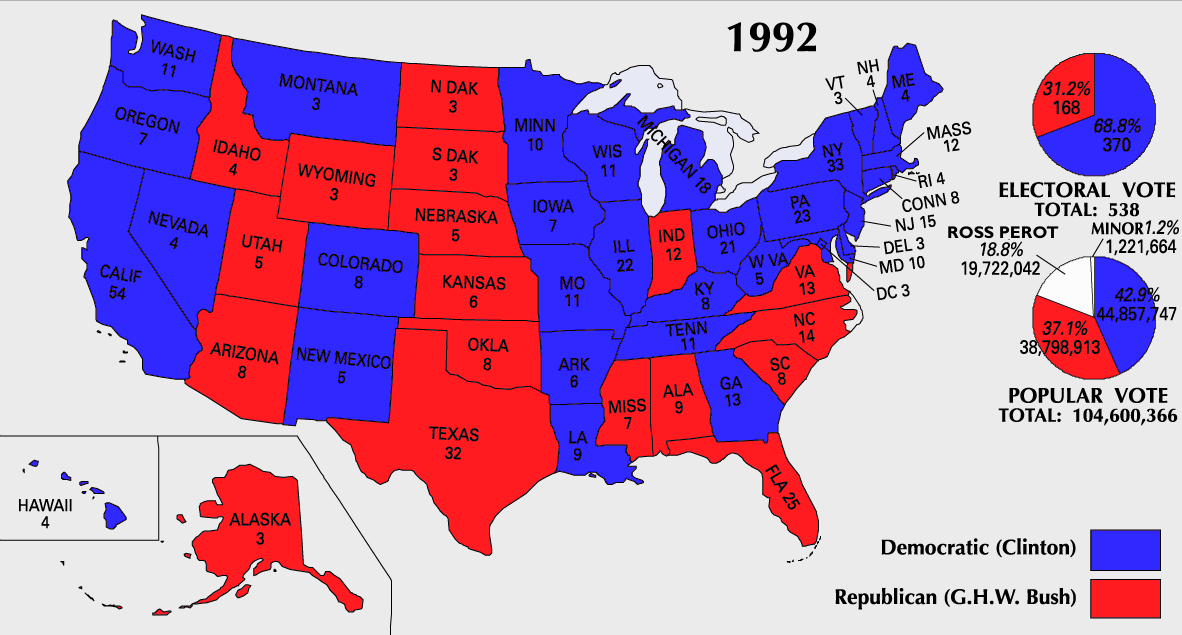
The map above shows the result of the 1992 US presidential election between Bill Clinton and George H. W. Bush. Turnout for the election was 58.10%.
Here are the key details:
| Winner: | Runner-Up: | |
|---|---|---|
| Name: | Bill Clinton | George H. W. Bush |
| Political Party: | Democratic | Republican |
| Home state: | Arkansas | Texas |
| VP Name: | Al Gore | Dan Quayle |
| States: Won (Out of 51): | 33 | 18 |
| Electoral College Votes (out of 538): | 370 | 168 |
| Percentage of Popular Vote | 43.01% | 37.40% |
| Total Votes | 44,909,806 | 39,104,550 |
| Margin % | 5.56% | – |
| Margin (votes) | 5,805,256 | – |
Other Parties
| 3rd Place | 4th Place | |
|---|---|---|
| Name: | Ross Perot | Andre Marrou |
| Political Party | Independent | Libertarian |
| Electoral College Votes | 0 | 0 |
| Number of Votes: | 19,743,821 | 290,087 |
| Percentage of Popular Vote: | 18.90% | 0.28% |
Key Issues of The 1992 Election
The 1992 U.S. presidential election was a significant and complex contest involving three major candidates: incumbent President George H.W. Bush (Republican), Governor Bill Clinton (Democrat), and businessman Ross Perot (Independent).
The election was shaped by several key issues, which each candidate approached differently.
1. The Economy
The economy was the most pressing issue of the 1992 election. The United States was experiencing a recession, with rising unemployment and a growing federal deficit.
- George H.W. Bush: Bush, despite his foreign policy successes, struggled to address the economic downturn effectively. He was criticized for being out of touch with the economic concerns of ordinary Americans, a perception reinforced when he seemed surprised by a supermarket scanner—a moment that his opponents used to suggest he was disconnected from the struggles of everyday citizens. Bush’s economic strategy focused on continuing policies of fiscal conservatism, including spending cuts and opposing tax increases. However, he was hurt by his broken 1988 campaign promise of “no new taxes,” which he had been forced to abandon during his presidency.
- Bill Clinton: Clinton capitalized on the economic woes with his campaign slogan “It’s the economy, stupid.” He presented himself as a “New Democrat” who would be pragmatic rather than ideologically rigid. Clinton’s economic platform emphasized investment in education, infrastructure, and technology to stimulate growth. He also promised to reform welfare and reduce the deficit, advocating for a middle-class tax cut and higher taxes on the wealthy.
- Ross Perot: Perot, running as an independent, made the economy his central issue, focusing on the national debt and fiscal responsibility. He argued that both parties had failed to address the deficit, and he proposed significant cuts in government spending and a balanced budget amendment. Perot’s straightforward, no-nonsense style and use of charts and graphs to illustrate the economic problems resonated with voters frustrated by the existing political system.
2. Government Reform and Trust in Government
There was widespread disillusionment with the federal government, fueled by the economic downturn and scandals such as the Iran-Contra affair and the Savings and Loan crisis.
- George H.W. Bush: Bush tried to defend his administration’s record while emphasizing his experience and leadership, particularly in foreign policy. However, he struggled to shake off the perception that he was part of a political elite disconnected from the average voter.
- Bill Clinton: Clinton positioned himself as a fresh start, promising to restore trust in government through ethical reforms and a focus on “reinventing government.” He aimed to make government more efficient and responsive to citizens’ needs.
- Ross Perot: Perot’s outsider status was central to his appeal. He criticized both parties for their inability to solve problems and promoted the idea of direct democracy, suggesting more referendums and citizen involvement in decision-making.
3. Healthcare Reform
Healthcare was another significant issue, with rising costs and concerns about accessibility.
- George H.W. Bush: Bush proposed modest reforms, emphasizing market-based solutions like tax credits for the uninsured and reforms to reduce malpractice lawsuits.
- Bill Clinton: Clinton made healthcare reform a key part of his platform, advocating for a system that would provide universal coverage. He argued that healthcare costs were harming American competitiveness and needed comprehensive reform.
- Ross Perot: Perot supported some form of healthcare reform but was less specific in his proposals than Clinton. He generally advocated for cutting waste and improving efficiency across all areas of government, including healthcare.
4. Foreign Policy
Foreign policy was less central than in previous elections, but it still played a role, particularly in light of the end of the Cold War and the Gulf War.
- George H.W. Bush: Bush’s strength was in foreign policy, where he was widely respected for his handling of the Gulf War and the peaceful end of the Cold War. However, this was less of a focus for voters concerned primarily with domestic issues.
- Bill Clinton: Clinton had less experience in foreign policy, but he argued that the post-Cold War world required a focus on economic issues at home to maintain U.S. leadership abroad.
- Ross Perot: Perot’s foreign policy views were generally isolationist; he argued that the U.S. should focus more on domestic issues, including the economy, and less on international engagements.
Why Did Clinton Win?
Bill Clinton’s victory in the 1992 presidential election can be attributed to several key factors:
1. The Economy
The economic downturn was the most significant issue of the election, and Clinton successfully capitalized on voters’ economic concerns. The U.S. was in the midst of a recession, with rising unemployment and a growing federal deficit. Clinton’s campaign slogan, “It’s the economy, stupid,” highlighted his focus on economic issues. He presented himself as a candidate who understood the struggles of ordinary Americans and promised to revitalize the economy through investment in education, infrastructure, and technology, as well as by reducing the deficit and cutting middle-class taxes. This resonated with voters who were dissatisfied with the state of the economy under President George H.W. Bush.
2. Bush’s Vulnerability
George H.W. Bush, despite his foreign policy successes, was vulnerable on domestic issues, particularly the economy. His administration was seen as out of touch with the concerns of everyday Americans, a perception reinforced by moments like his surprise at a grocery store scanner, which became emblematic of his disconnect. Additionally, Bush’s decision to raise taxes, despite his famous 1988 campaign promise of “no new taxes,” alienated many conservatives and undermined his credibility.
3. Clinton’s Appeal as a “New Democrat”
Clinton presented himself as a “New Democrat,” someone who was not bound by the traditional liberal positions of the Democratic Party. He emphasized a centrist platform that combined traditional Democratic values, such as support for social programs, with more conservative positions, such as welfare reform and fiscal responsibility. This approach helped Clinton appeal to a broad spectrum of voters, including moderates and disaffected Republicans.
4. Third-Party Candidacy of Ross Perot
Ross Perot’s independent candidacy played a crucial role in the election. Perot focused on the national debt and the economy, attracting a significant portion of the electorate frustrated with both major parties. While Perot did not win any electoral votes, he garnered about 19% of the popular vote, one of the highest percentages ever for a third-party candidate. His presence in the race likely split the vote, particularly among voters who might have otherwise supported Bush, contributing to Clinton’s victory.
5. Clinton’s Effective Campaign Strategy
Clinton’s campaign was well-organized, disciplined, and effective in communicating his message. He used a combination of traditional campaigning and new media strategies, including appearances on talk shows and other non-traditional venues, to reach a wide audience. Clinton also benefited from his charisma and ability to connect with voters on a personal level, contrasting with Bush’s more reserved style.
6. Desire for Change
After 12 years of Republican control of the White House, many voters were ready for change. Clinton, as a young and dynamic candidate, symbolized a new generation of leadership. His message of change resonated with voters who were looking for a break from the status quo, particularly in the face of economic difficulties.
7. Effective Debate Performances
Clinton’s strong performances in the presidential debates helped solidify his image as a capable and articulate leader. He effectively used the debates to present his policy ideas and connect with voters, contrasting himself with Bush and Perot.
8. Bush’s Focus on Foreign Policy Over Domestic Issues
While Bush was widely respected for his handling of foreign policy, including the Gulf War and the end of the Cold War, these issues were less important to voters in 1992, who were more concerned with domestic economic issues. Clinton’s focus on the economy allowed him to better connect with the electorate’s priorities.
1992 Election Results Map By County

1992 Map From The National Atlas of the United States (now sadly permanently offline)
Other US Presidential Election Maps: