
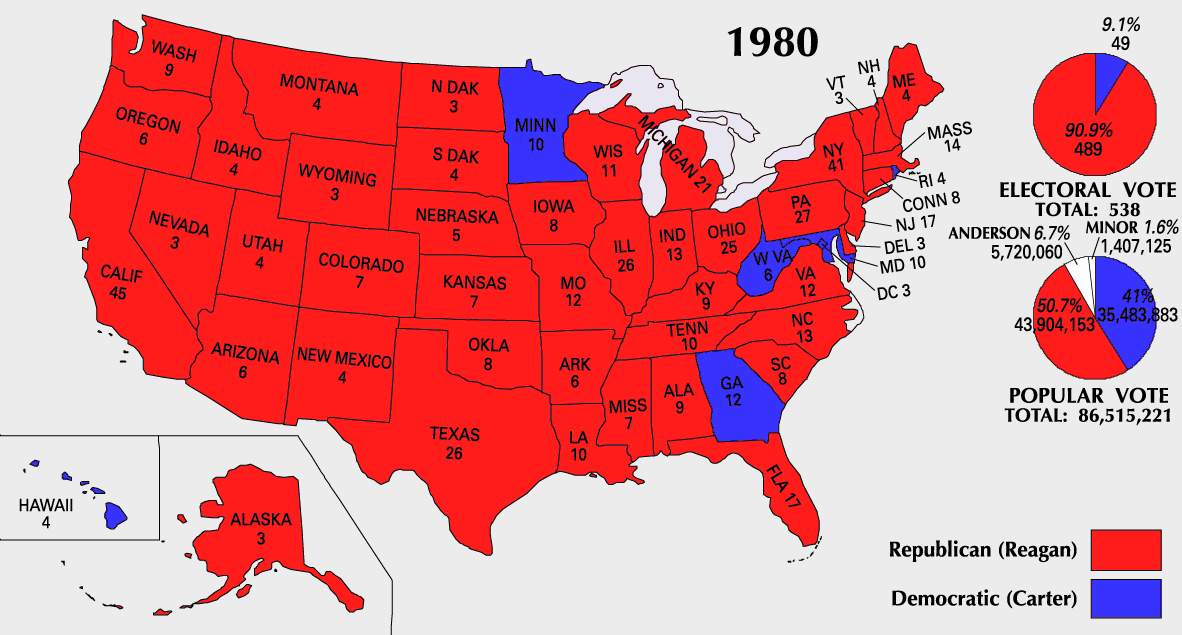
The map above shows the result of the 1980 US presidential election between Ronald Reagan and Jimmy Carter. Turnout for the election was 54.20%.
Here are the key details:
| Winner: | Runner-Up: | |
|---|---|---|
| Name: | Ronald Reagan | Jimmy Carter |
| Political Party: | Republican | Democratic |
| Home state: | California | Georgia |
| VP Name: | George H. W. Bush | Walter Mondale |
| States: Won (Out of 51): | 44 | 6 |
| Electoral College Votes (out of 538): | 489 | 49 |
| Percentage of Popular Vote | 50.75% | 41.00% |
| Total Votes | 43,903,230 | 35,480,115 |
| Margin % | 9.74% | – |
| Margin (votes) | 8,423,115 | – |
Other Parties
| 3rd Place | 4th Place: | |
|---|---|---|
| Name: | John B. Anderson | Ed Clark |
| Political Party | Independent | Libertarian |
| Electoral College Votes | 0 | 0 |
| Number of Votes: | 5,719,850 | 921,128 |
| Percentage of Popular Vote: | 6.60% | 1.06% |
Key Issues of The 1980 Election
The key issues of the election and how the candidates, Ronald Reagan (Republican) and Jimmy Carter (Democrat, the incumbent president), differed on them are outlined below:
1. Economic Problems
- Stagflation: The U.S. economy was suffering from “stagflation,” a combination of high inflation, high unemployment, and slow economic growth.
- Jimmy Carter: Carter’s approach was to manage inflation through tight monetary policies, including higher interest rates, which he believed would eventually lead to economic recovery. However, this led to higher unemployment, making him unpopular.
- Ronald Reagan: Reagan criticized Carter’s handling of the economy and proposed a new economic plan called “Reaganomics.” This involved significant tax cuts, deregulation, and a reduction in government spending (except for defense), which he argued would stimulate economic growth and reduce inflation by boosting private sector investment.
2. Foreign Policy
- Iran Hostage Crisis: The ongoing hostage crisis, where 52 American diplomats and citizens were held captive in Iran for 444 days, was a major issue.
- Jimmy Carter: Carter’s attempts to negotiate the release of the hostages were unsuccessful by the time of the election. His failure to resolve the crisis was perceived as a sign of weak leadership and contributed to a perception of American decline on the global stage.
- Ronald Reagan: Reagan took a hardline stance, criticizing Carter’s handling of the situation. He promised a stronger, more assertive U.S. foreign policy that would restore America’s standing in the world. Reagan’s tough rhetoric resonated with voters who were frustrated with the ongoing crisis.
3. National Defense
- Perception of Soviet Threat: The Cold War was still in full swing, and there was a growing perception that the Soviet Union was gaining an advantage over the U.S., especially after the Soviet invasion of Afghanistan in 1979.
- Jimmy Carter: Carter had attempted to respond to Soviet actions with policies like the grain embargo and the boycott of the 1980 Moscow Olympics. However, his defense policies were often seen as inadequate by his critics.
- Ronald Reagan: Reagan advocated for a massive buildup of the U.S. military to counter the Soviet threat. He believed in a more confrontational approach to the Cold War, emphasizing peace through strength. Reagan’s promise to rebuild American military power was a central theme of his campaign.
4. Government Size and Role
- Size of Government: There was a significant debate over the role of the federal government in American life.
- Jimmy Carter: Carter supported a relatively expansive role for the federal government, particularly in social programs. However, he also tried to address budget concerns, leading to cuts in some areas, which left him without strong support from either fiscal conservatives or liberals.
- Ronald Reagan: Reagan ran on a platform of reducing the size of the federal government, advocating for less regulation, lower taxes, and more power to state and local governments. His message of limiting government resonated with voters who felt that federal bureaucracy was out of control and inefficient.
5. Social Issues
- Moral and Cultural Values: The late 1970s saw the rise of the Religious Right, which became a powerful force in American politics.
- Jimmy Carter: As a born-again Christian, Carter had some appeal to religious voters, but his policies on issues like abortion and civil rights were seen as too liberal by many in the religious community.
- Ronald Reagan: Reagan aligned closely with the Religious Right, championing traditional family values, opposing abortion, and supporting school prayer. His stance on these issues helped to galvanize conservative Christians and played a key role in his electoral coalition.
6. Energy Crisis
- Energy Policy: The 1979 oil crisis led to fuel shortages and high energy prices, which were significant concerns for voters.
- Jimmy Carter: Carter had promoted energy conservation and attempted to implement policies to reduce America’s dependence on foreign oil, but these measures were seen as ineffective or insufficient by many Americans.
- Ronald Reagan: Reagan criticized Carter’s energy policies and called for a greater focus on increasing domestic oil production, including deregulating the oil industry. He promised that his policies would lead to lower energy prices and greater energy independence.
Why Did Reagan Win?
Ronald Reagan’s victory in the 1980 U.S. presidential election was the result of a combination of factors that reflected the political, economic, and social climate of the time. Here’s a breakdown of the key reasons why Reagan won:
1. Economic Discontent
- Stagflation: The U.S. economy was in poor shape, characterized by high inflation, high unemployment, and slow economic growth. This “stagflation” made the electorate deeply unhappy, and many blamed President Jimmy Carter for the economic malaise. Reagan capitalized on this discontent by presenting a clear alternative with his “Reaganomics” plan, promising tax cuts, reduced government spending (except for defense), and deregulation to stimulate the economy.
2. Iran Hostage Crisis
- Crisis of Confidence: The Iran Hostage Crisis, where 52 Americans were held captive in Tehran for 444 days, became a symbol of Carter’s perceived weakness in foreign policy. His inability to resolve the crisis before the election made him appear ineffective, damaging his image as a leader. Reagan, on the other hand, promised to restore American strength and resolve, which resonated with voters who felt humiliated by the prolonged crisis.
3. National Defense and Cold War Concerns
- Perceived Weakness Against the Soviet Union: The late 1970s were marked by concerns that the U.S. was losing its global dominance to the Soviet Union, especially after the Soviet invasion of Afghanistan in 1979. Reagan’s call for a strong military buildup and his confrontational stance against the Soviet Union contrasted sharply with Carter’s more cautious approach, appealing to voters who were worried about national security.
4. A Return to Traditional Values
- Rise of the Religious Right: The 1980 election saw the growing influence of the Religious Right, a movement that felt alienated by the social changes of the 1960s and 1970s. Reagan successfully appealed to this group by emphasizing traditional values, opposing abortion, supporting school prayer, and championing the family. His alignment with these values mobilized a significant and motivated voting bloc that had been less active in previous elections.
5. Effective Campaign Strategy
- Optimism and Clarity: Reagan’s campaign was marked by a clear and optimistic message. His slogan, “Are you better off than you were four years ago?” directly challenged voters to assess Carter’s performance, which many found lacking. Reagan’s communication style, often dubbed “The Great Communicator,” was warm, confident, and reassuring, contrasting sharply with Carter’s more dour and technical approach.
- Televised Debate Performance: Reagan’s performance in the lone presidential debate on October 28, 1980, was a pivotal moment. His famous closing line, “Are you better off than you were four years ago?” was simple yet powerful, reinforcing the central theme of his campaign. He appeared more confident, personable, and in control, which helped sway undecided voters.
6. Carter’s Political Vulnerabilities
- Intraparty Challenges: Carter faced significant challenges within his own party. He had to fend off a strong primary challenge from Senator Ted Kennedy, which exposed deep divisions within the Democratic Party. This infighting weakened Carter and made it difficult for him to present a united front in the general election.
- Perception of Ineffectiveness: Many voters perceived Carter’s presidency as ineffective, marked by crises both at home and abroad. This perception was exacerbated by his struggle to deal with Congress and the impression that his administration was overwhelmed by the challenges it faced.
7. Desire for Change
- Anti-Establishment Sentiment: By 1980, there was a strong desire for change among the American electorate. After four years of Carter and the preceding years of the post-Watergate era, many Americans were ready for a fresh start. Reagan, with his outsider status (he had been governor of California but not part of the Washington establishment), represented a break from the perceived failures of the past.
8. Landslide Electoral Victory
- Broad Coalition: Reagan managed to build a broad coalition of conservatives, including traditional Republicans, economic conservatives, social conservatives, and disaffected Democrats (often called “Reagan Democrats”). This coalition allowed him to win not just a majority, but a landslide in the Electoral College, carrying 44 states to Carter’s 6.
Who was John B. Anderson and why did he run in 1980?
John B. Anderson was an American politician who ran as an independent candidate in the 1980 U.S. presidential election.
Here’s a breakdown of who he was, why he ran, and his impact on the election:
1980 Election Results Map By County

Map From The National Atlas of the United States (now sadly permanently offline)
Other US Presidential Election Maps: