
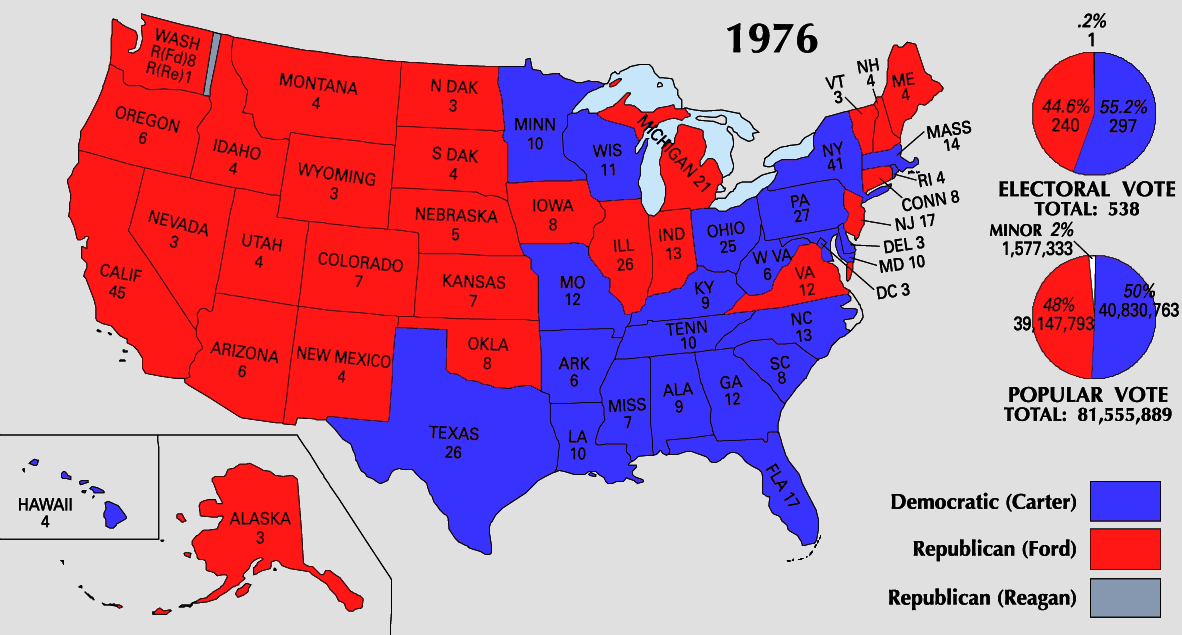
The map above shows the result of the 1976 US presidential election between Jimmy Carter and Gerald Ford. Turnout for the election was 54.80%.
Here are the key details:
| Winner: | Runner-Up: | |
|---|---|---|
| Name: | Jimmy Carter | Gerald Ford |
| Political Party: | Democratic | Republican |
| Home state: | Georgia | Michigan |
| VP Name: | Walter Mondale | Bob Dole |
| States: Won (Out of 51): | 23 | 27 |
| Electoral College Votes (out of 538): | 297 | 240 |
| Percentage of Popular Vote | 50.08% | 48.00% |
| Total Votes | 40,831,881 | 39,148,634 |
| Margin % | 2.06% | – |
| Margin (votes) | 1,683,247 | – |
Other Parties:
| 3rd Place | 4th Place: | |
|---|---|---|
| Name: | Eugene McCarthy | Roger MacBride |
| Political Party | None | Libertarian |
| Electoral College Votes | 0 | 0 |
| Number of Votes: | 744,763 | 172,557 |
| Percentage of Popular Vote: | 0.91% | 0.21% |
Key Issues of The 1976 Election
Here’s a summary of the major issues and how the candidates differed on them:
1. Trust and Integrity in Government:
- Issue: The 1976 election was the first presidential election after the Watergate scandal and the resignation of President Richard Nixon, which had severely damaged public trust in the government.
- Carter: Emphasized the need to restore honesty and integrity to the presidency. As a political outsider and a former governor of Georgia, he campaigned on a promise to be a trustworthy and transparent leader, often saying, “I will never lie to you.”
- Ford: As the sitting president who had pardoned Nixon, Ford faced significant skepticism. He defended the pardon as necessary to help the nation move forward but struggled to shake the association with the Nixon administration’s scandals.
2. The Economy:
- Issue: The U.S. economy in the mid-1970s was experiencing high inflation, unemployment, and slow growth, a condition known as “stagflation.”
- Carter: Criticized Ford’s handling of the economy, arguing that new leadership was needed to address the economic challenges. He advocated for tax reform, cutting government waste, and improving job training programs to combat unemployment.
- Ford: Defended his economic policies, emphasizing the importance of reducing government spending and controlling inflation. He promoted tax cuts as a way to stimulate economic growth, though he also supported a limited government role in managing the economy.
3. Energy Crisis:
- Issue: The 1970s energy crisis, including oil shortages and rising prices, was a significant concern for Americans.
- Carter: Advocated for a comprehensive energy policy that included conservation, the development of alternative energy sources, and reducing dependence on foreign oil. He highlighted the need for a national energy strategy.
- Ford: Supported the continued development of domestic energy sources, including coal and nuclear energy, and promoted energy conservation. However, his administration was seen as less proactive in addressing the crisis compared to Carter’s proposals.
4. Foreign Policy:
- Issue: The Cold War, the ongoing conflict in the Middle East, and détente with the Soviet Union were central foreign policy concerns.
- Carter: Criticized Ford’s foreign policy for being too focused on détente and not paying enough attention to human rights. Carter proposed a foreign policy that would prioritize human rights and moral principles, arguing that the U.S. should lead by example.
- Ford: Defended his administration’s policy of détente with the Soviet Union, arguing that it was necessary for global stability. He also highlighted his experience in dealing with international crises, including his efforts in the Middle East peace process.
5. Social Issues:
- Issue: Social issues like civil rights, women’s rights, and crime were also important in the 1976 election.
- Carter: Positioned himself as a moderate on social issues, supporting civil rights and equal opportunities but with a more conservative approach to law and order. He appealed to a broad range of voters, including many in the South.
- Ford: Also supported civil rights but was more conservative on issues like crime, emphasizing law and order. He had a more cautious approach to expanding federal involvement in social programs.
Why Did Jimmy Carter Win?
Jimmy Carter’s victory in the 1976 U.S. Presidential election can be attributed to several key factors:
1. Watergate and the Post-Nixon Atmosphere:
- The election took place in the shadow of the Watergate scandal, which had severely damaged public trust in government. Many Americans were disillusioned with the political establishment, and Carter successfully positioned himself as an outsider who could restore honesty and integrity to the presidency.
- Carter’s pledge, “I’ll never lie to you,” resonated with voters who were eager for a leader they could trust after the scandals of the Nixon era.
2. Anti-Washington Sentiment:
- As a Washington outsider and former governor of Georgia, Carter was able to distance himself from the political elites in Washington, D.C. He presented himself as a fresh face who could bring new ideas and a different approach to governance, which appealed to voters tired of politics as usual.
- This outsider status contrasted sharply with Gerald Ford, who was seen as part of the Washington establishment, particularly given his association with Nixon and his decision to pardon him.
3. Economic Concerns:
- The economy was in bad shape during the mid-1970s, with high inflation, unemployment, and slow economic growth—a situation referred to as “stagflation.” Many Americans were dissatisfied with Ford’s handling of the economy, and Carter effectively capitalized on this dissatisfaction by promising new economic policies aimed at job creation and tax reform.
- Although Carter’s economic proposals were sometimes vague, his emphasis on change appealed to voters who were struggling with the economic challenges of the time.
4. Campaign Strategy:
- Carter ran a highly effective grassroots campaign, focusing on meeting voters face-to-face in small towns across the country. This approach helped him connect with voters on a personal level, especially in rural areas and the South, where his Southern background was an advantage.
- His emphasis on character and morality, combined with his evangelical Christian faith, helped him build a strong rapport with religious voters, including many who had previously supported conservative candidates.
5. Ford’s Missteps:
- Ford faced several challenges during the campaign that hurt his chances. One notable misstep was during a debate when Ford claimed there was “no Soviet domination of Eastern Europe,” a statement that was widely criticized and damaged his credibility on foreign policy.
- Ford’s decision to pardon Nixon was also a major issue. While Ford argued that it was necessary to help the country move on from Watergate, many voters saw it as a sign of continued corruption and were angry that Nixon was not held accountable.
6. The Desire for Change:
- After nearly a decade of turmoil, including the Vietnam War, civil rights struggles, and Watergate, many Americans were eager for a change in leadership. Carter’s message of a fresh start, coupled with his outsider status, aligned well with the public’s desire for new direction and reform.
- Carter’s image as a moderate, pragmatic, and morally upright candidate offered a contrast to the disillusionment that many felt with the political establishment.
7. Narrow Margin of Victory:
- Although Carter won, the election was relatively close, reflecting the divided mood of the country. He secured key states in the South and won back some traditionally Democratic states that had been lost to Republicans in previous elections.
1976 Election Results Map By County

1976 Map From The National Atlas of the United States (now sadly permanently offline)
Other US Presidential Election Maps: