
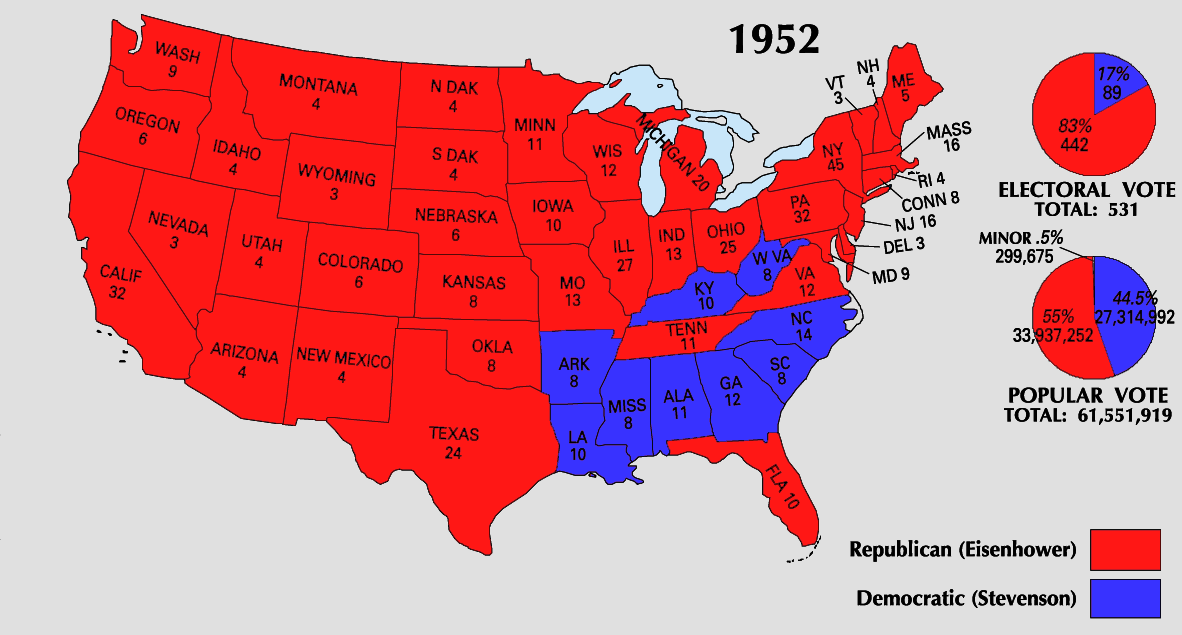
The map above shows the result of the 1952 US presidential election between Dwight D. Eisenhower and Adlai Stevenson II. Turnout for the election was 62.30%.
Here are the key details:
| Winner: | Runner-Up: | |
|---|---|---|
| Name: | Dwight D. Eisenhower | Adlai Stevenson II |
| Political Party: | Republican | Democratic |
| Home state: | New York | Illinois |
| VP Name: | Richard Nixon | John Sparkman |
| States: Won (Out of 48): | 39 | 9 |
| Electoral College Votes (out of 531): | 442 | 89 |
| Percentage of Popular Vote | 55.18% | 44.30% |
| Total Votes | 34,075,529 | 27,375,090 |
| Margin % | 10.85% | – |
| Margin (votes) | 6,700,439 | – |
| 3rd Place | 4th Place: | |
|---|---|---|
| Name: | Vincent Hallinan | Stuart Hamblen |
| Political Party | Progressive | Prohibition |
| Electoral College Votes | 0 | 0 |
| Number of Votes: | 140,746 | 73,412 |
| Percentage of Popular Vote: | 0.23% | 0.12% |
Key Issues in The 1952 Election
1. The Korean War
Issue: The Korean War had been ongoing since 1950, leading to a military stalemate and significant American casualties. The public was eager for a resolution.
Eisenhower’s Position:
- Promised to personally visit Korea to assess the situation.
- Pledged to find a way to end the war honorably.
- His military background gave credibility to his commitment.
Stevenson’s Position:
- Supported a negotiated peace but was less specific about his plans.
- Warned against making promises that might be difficult to fulfill.
- Emphasized the complexities of international conflict.
2. Communism and McCarthyism
Issue: Fear of communist infiltration was high, intensified by Senator Joseph McCarthy’s aggressive investigations.
Eisenhower’s Position:
- Opposed communism but avoided direct criticism of McCarthy to maintain party unity.
- Advocated for strong internal security measures.
- Focused on combating communism abroad and at home.
Stevenson’s Position:
- Criticized McCarthy’s tactics as undermining civil liberties.
- Called for a balanced approach to security that protected individual rights.
- Emphasized the importance of not sacrificing democratic principles.
3. Government Corruption
Issue: Allegations of corruption plagued the Truman administration, affecting public trust in the Democratic Party.
Eisenhower’s Position:
- Campaigned on restoring honesty and integrity to government.
- Promised to “clean up the mess in Washington.”
- Positioned himself as an outsider who could reform the system.
Stevenson’s Position:
- Acknowledged issues but defended the party’s overall record.
- Proposed reforms to increase transparency.
- Argued that experience, not just change, was necessary for effective governance.
4. Economic Concerns
Issue: Post-war inflation and fears of a recession were significant worries for voters.
Eisenhower’s Position:
- Advocated for fiscal conservatism, including reduced government spending.
- Supported tax cuts to stimulate economic growth.
- Emphasized free-market principles.
Stevenson’s Position:
- Supported continued federal investment in social programs.
- Argued for a balanced approach to budgeting.
- Believed in government’s role in stabilizing the economy.
5. Foreign Policy and the Cold War
Issue: The Soviet Union’s expanding influence raised concerns about national security and global leadership.
Eisenhower’s Position:
- Promoted a strong military defense and containment of communism.
- Supported alliances like NATO.
- Leveraged his international experience to assure voters.
Stevenson’s Position:
- Also supported containment but stressed diplomacy.
- Advocated for working closely with the United Nations.
- Emphasized moral leadership in foreign affairs.
6. Civil Rights
Issue: While not a dominant issue, civil rights were gaining attention, especially regarding segregation and voting rights.
Eisenhower’s Position:
- Took a moderate stance, supporting gradual progress.
- Believed states should lead on civil rights issues.
- Avoided taking strong public positions that might alienate Southern voters.
Stevenson’s Position:
- Expressed sympathy for civil rights but was cautious.
- Feared aggressive federal action might cause backlash.
- Focused on unity and incremental change.
7. Agricultural Policy
Issue: Farmers were concerned about declining crop prices and the need for federal support.
Eisenhower’s Position:
- Proposed flexible price supports tied to market conditions.
- Aimed to reduce government intervention over time.
- Emphasized efficiency and modernization in agriculture.
Stevenson’s Position:
- Supported high, fixed price supports to ensure farmers’ incomes.
- Advocated for robust federal assistance programs.
- Highlighted the importance of agriculture to the national economy.
Why did Eisenhower win?
1. Personal Popularity and Leadership Reputation
- War Hero Status: Eisenhower was a celebrated World War II general who served as the Supreme Commander of the Allied Expeditionary Forces in Europe. His leadership in planning and executing the D-Day invasion made him a national hero.
- Trust and Confidence: Voters believed in his ability to lead the nation, particularly in matters of national security and foreign policy.
- Non-Partisan Appeal: Prior to declaring his Republican affiliation, both major parties had sought him as a candidate, highlighting his broad appeal across the political spectrum.
2. Desire for Change After Democratic Dominance
- Democratic Fatigue: The Democratic Party had controlled the presidency for 20 years since Franklin D. Roosevelt’s election in 1932. Many voters felt it was time for a change.
- Truman’s Unpopularity: President Harry S. Truman’s approval ratings were low due to ongoing issues like the Korean War and allegations of corruption within his administration. Eisenhower capitalized on this dissatisfaction.
3. The Korean War
- Promise to End the War: Eisenhower pledged to go to Korea personally and seek an honorable end to the conflict, a message that resonated with war-weary Americans.
- Military Credibility: His background gave him authority on military matters, and voters trusted he could negotiate a resolution more effectively than a civilian leader.
4. Fear of Communism and Anti-Communist Sentiment
- Cold War Context: The early 1950s were marked by heightened fear of communist expansion and espionage.
- Strong Anti-Communist Stance: Eisenhower promised vigorous opposition to communism both abroad and at home, aligning with public sentiment.
- McCarthyism Influence: While Eisenhower was cautious not to fully endorse Senator Joseph McCarthy’s extreme tactics, he benefited from the general anti-communist mood without alienating moderate voters.
5. Government Corruption Issues
- Restoring Integrity: Eisenhower campaigned on a platform of cleaning up corruption associated with the Truman administration, appealing to voters’ desire for honest governance.
- Contrast with Democrats: By highlighting scandals involving Democratic officials, he positioned himself as the candidate of reform.
6. Effective Campaign Strategies
- Use of Media: Eisenhower’s campaign effectively utilized television advertising, a relatively new medium at the time. The “Eisenhower Answers America” ads connected with voters on a personal level.
- Memorable Slogans: The catchy slogan “I Like Ike” was simple and fostered a personal connection with voters.
- Dynamic Running Mate: Richard Nixon, his vice-presidential candidate, energized the campaign and appealed to younger voters. Nixon’s “Checkers Speech” defused a potential scandal and maintained public trust.
7. Economic Policies
- Fiscal Conservatism: Eisenhower advocated for reducing government spending and balancing the budget, which appealed to fiscally conservative voters.
- Tax Reduction: He supported tax cuts to stimulate economic growth, addressing concerns about post-war inflation and recession fears.
8. Appeal to Moderates and Independents
- Moderate Republicanism: Eisenhower’s centrist positions attracted moderate Republicans, independents, and even some Democrats disillusioned with their party.
- Avoidance of Extremism: He maintained a distance from the more extreme elements within his party, making him more palatable to a broader electorate.
9. Weaknesses of Adlai Stevenson’s Campaign
- Perceived Elitism: Stevenson’s intellectual demeanor and eloquent speeches sometimes came across as elitist, making it harder for him to connect with the average voter.
- Lack of Clear Positions: He was often criticized for not taking firm stances on key issues, which contrasted with Eisenhower’s decisive image.
- Association with Unpopular Policies: As the Democratic nominee, Stevenson was linked to the unpopular aspects of the Truman administration.
10. Regional and Demographic Shifts
- Breaking the “Solid South”: Eisenhower made significant inroads in Southern states that had traditionally voted Democratic, partly due to regional dissatisfaction with national Democratic policies.
- Urban and Suburban Appeal: His messages resonated with both urban workers and suburban families concerned about national security and economic stability.
1952 Election Results Map By County

1952 Map From The National Atlas of the United States (now sadly permanently offline)
Other US Presidential Election Maps: