
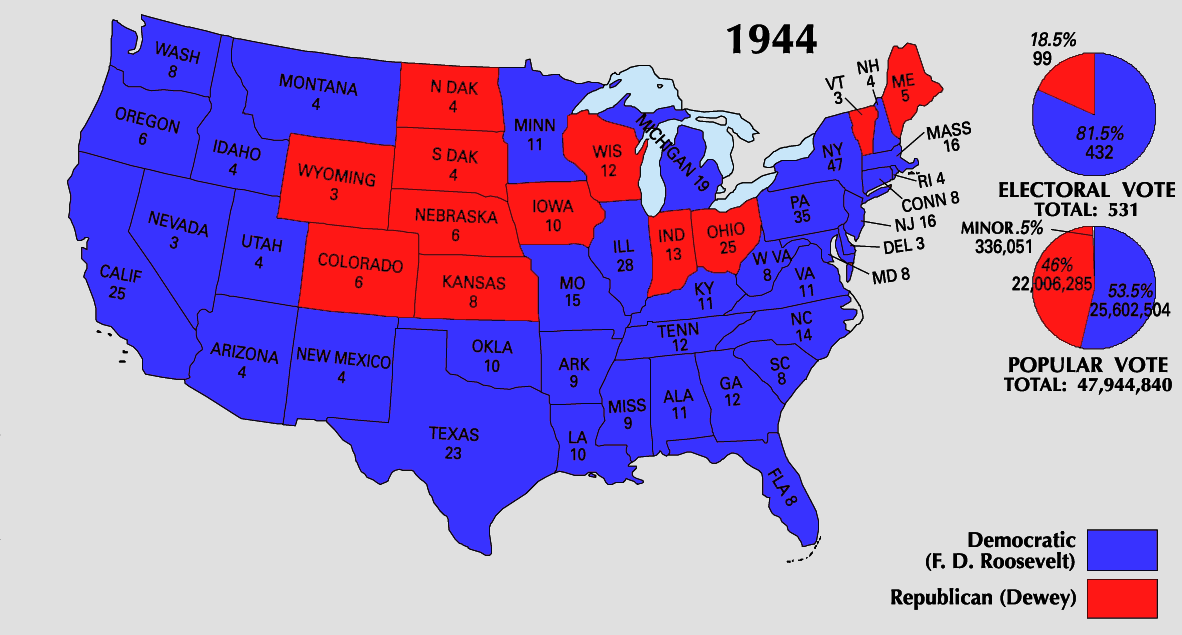
The map above shows the result of the 1944 US presidential election between Franklin D. Roosevelt and Thomas E. Dewey. Turnout for the election was 55.90%.
Here are the key details:
| Winner: | Runner-Up: | |
|---|---|---|
| Name: | Franklin D. Roosevelt | Thomas E. Dewey |
| Political Party: | Democratic | Republican |
| Home state: | New York | New York |
| VP Name: | Harry S. Truman | John W. Bricker |
| States: Won (Out of 48): | 36 | 12 |
| Electoral College Votes (out of 531): | 432 | 99 |
| Percentage of Popular Vote | 53.39% | 45.90% |
| Total Votes | 25,612,916 | 22,017,929 |
| Margin % | 7.50% | – |
| Margin (votes) | 3,594,987 | – |
| 3rd Place | 4th Place | |
|---|---|---|
| Name: | None | Norman Thomas |
| Political Party | Texas Regulars | Socialist |
| Electoral College Votes | 0 | 0 |
| Number of Votes: | 143,238 | 79,017 |
| Percentage of Popular Vote: | 0.30% | 0.16% |
Key Issues in The 1944 Election
The 1944 U.S. presidential election occurred during the final years of World War II and centered around several key issues, most of which related to the war and post-war planning. Here’s a breakdown of the major issues and where each candidate stood on them:
Candidates:
- Franklin D. Roosevelt (Democratic Party) – Incumbent President seeking an unprecedented fourth term.
- Thomas E. Dewey (Republican Party) – Governor of New York.
Key Issues:
1. World War II and Foreign Policy
- Franklin D. Roosevelt: As the sitting president during the war, Roosevelt was committed to seeing it through to victory. He emphasized the importance of continuing the fight alongside the Allies (Great Britain and the Soviet Union) until Nazi Germany and Imperial Japan were defeated. Roosevelt also highlighted his leadership experience in managing the war effort and planning for the post-war world, including the creation of the United Nations and international cooperation to prevent future conflicts.
- Thomas E. Dewey: Dewey supported the war effort but criticized Roosevelt’s management of it, particularly for what Republicans argued was excessive concentration of power in the executive branch. Dewey emphasized the need for post-war reform and suggested that Roosevelt had been in office too long. He focused more on domestic management after the war and questioned the administration’s handling of the post-war economy.
2. The Economy and Post-War Recovery
- Franklin D. Roosevelt: Roosevelt focused on continuing the policies of the New Deal and preparing for a smooth transition from a wartime to a peacetime economy. He assured voters that he would ensure a strong post-war economy by providing jobs for returning soldiers and maintaining support for labor rights. Roosevelt also proposed government intervention in maintaining employment and aiding veterans with benefits.
- Thomas E. Dewey: Dewey and the Republicans criticized the New Deal as being too large and bureaucratic. Dewey promised to reduce government intervention in the economy and advocated for policies that would encourage free enterprise, private industry, and a smaller federal government. He believed that the private sector would be better suited to ensure post-war prosperity and stability for returning veterans.
3. Fourth Term Controversy
- Franklin D. Roosevelt: Roosevelt was seeking an unprecedented fourth term, which was controversial in itself. Although Roosevelt argued that his experience and leadership were critical to winning the war and stabilizing the post-war world, some Americans were concerned about one man holding power for so long.
- Thomas E. Dewey: Dewey capitalized on this concern, arguing that no president should serve more than two terms and suggesting that Roosevelt had become too entrenched in Washington. He pushed for fresh leadership and framed the election as a choice between dictatorship and democracy, hinting that Roosevelt’s extended time in office was unhealthy for the country.
4. Labor and Social Welfare
- Franklin D. Roosevelt: Roosevelt’s policies were rooted in the New Deal, focusing on labor rights, social security, and social welfare programs. He promised to continue supporting workers’ rights, unions, and job programs for post-war America. His vision included expanding social security and other protections for the working class.
- Thomas E. Dewey: Dewey, while not outright opposing social welfare, advocated for a more business-friendly environment and less reliance on government programs. He proposed policies that he believed would spur private investment and reduce the need for government intervention in social welfare.
5. Government Size and Bureaucracy
- Franklin D. Roosevelt: Roosevelt defended the expansion of the federal government under his administration, arguing that it was necessary to fight the Great Depression and the war. He believed in a strong government role in shaping the economy and ensuring social protections.
- Thomas E. Dewey: Dewey criticized Roosevelt’s expansion of federal bureaucracy, arguing that it led to inefficiency and waste. He called for reducing the size of government and advocated for state and local governments to take on more responsibility, with the federal government playing a smaller role.
6. Health and Roosevelt’s Fitness for Office
- Franklin D. Roosevelt: Roosevelt’s health became a significant issue, as rumors circulated that he was gravely ill (he would die shortly after the election in April 1945). However, Roosevelt downplayed these concerns and focused on projecting strength and vitality in his public appearances.
- Thomas E. Dewey: Dewey did not directly attack Roosevelt’s health but made subtle allusions to the need for vigorous leadership, suggesting that a change in leadership was necessary to lead the country into the post-war period.
Why did Roosevelt win a 4th term?
Here are the main factors that contributed to his victory:
1. Ongoing World War II and Desire for Stability
Leadership During Wartime: The U.S. was still deeply involved in World War II in 1944, and Roosevelt was widely seen as an experienced wartime leader.
Having led the nation through both the Great Depression and the majority of World War II, many Americans believed Roosevelt’s leadership was crucial to seeing the war through to a successful conclusion.
His experience and steady hand in a time of global crisis made voters reluctant to change leadership during such a pivotal moment in history.
Trust in Roosevelt’s Foreign Policy: Roosevelt was viewed as key to maintaining strong alliances with the Allies, particularly Great Britain and the Soviet Union, which were critical to the war effort.
His role in shaping the post-war world order, including plans for the United Nations, made him an indispensable figure in the eyes of many voters.
2. Successful War Strategy and Recent Military Successes
Momentum in the War: By the time of the election, the tide of World War II had turned in favor of the Allies. The D-Day invasion of Normandy in June 1944, which marked a significant turning point in the war in Europe, had recently occurred.
The successful progress of the war, including victories in both Europe and the Pacific, helped to strengthen Roosevelt’s standing. Voters saw the military gains as a validation of his leadership.
Roosevelt as a Symbol of Victory: Many Americans associated Roosevelt with the victories that the U.S. military was achieving and felt confident that his continuation in office would lead to a successful conclusion of the war.
3. Weaknesses of Thomas Dewey’s Campaign
Lack of a Strong Alternative: Thomas E. Dewey, the Republican candidate, ran a competent campaign but struggled to convince voters that he could provide the same level of leadership during wartime.
While Dewey criticized Roosevelt’s policies and argued for the need for new leadership, he didn’t present a compelling case for how his administration would better handle the ongoing war effort. Many voters felt Dewey lacked the necessary experience to lead the country through such a critical period.
Focus on Domestic Issues: Dewey’s emphasis on domestic issues, such as criticizing the New Deal and calling for less government intervention in the economy, did not resonate as strongly with voters compared to Roosevelt’s focus on the war and post-war planning. In a time of global conflict, domestic policy was less of a priority for many voters.
4. Roosevelt’s Personal Popularity and Legacy
Longstanding Popularity: Roosevelt remained a beloved figure among many Americans, particularly those who had supported him through his New Deal policies during the Great Depression.
His New Deal programs had significantly expanded the role of government in providing economic relief, jobs, and social security, earning him deep loyalty from working-class voters, labor unions, and many minority groups, especially African Americans, who had shifted towards the Democratic Party under his leadership.
Symbol of Hope: Roosevelt’s personal charisma and ability to connect with the public, particularly through his famous “fireside chats,” helped him maintain a strong emotional connection with voters. He projected a sense of optimism and hope, which was appealing during times of crisis.
5. Coalition of Voters Supporting Roosevelt
Broad Coalition: Roosevelt had built a large and diverse political coalition, often referred to as the “New Deal Coalition,” which included labor unions, working-class Americans, African Americans, farmers, ethnic minorities, and urban dwellers.
This coalition remained loyal to Roosevelt in 1944, and their support played a critical role in his electoral success.
Labor Support: Labor unions and working-class voters remained loyal to Roosevelt because of his pro-labor policies and the expansion of workers’ rights under the New Deal.
Roosevelt’s administration had supported labor through initiatives like the National Labor Relations Act, which gave workers the right to organize and collectively bargain.
6. Post-War Planning and Roosevelt’s Vision
Vision for Post-War World: Roosevelt had laid out plans for a strong post-war international order, including the establishment of the United Nations to prevent future conflicts.
His vision of global cooperation and leadership on the world stage appealed to voters who wanted to avoid another world war and believed Roosevelt was uniquely positioned to lead in the post-war era.
Economic Transition to Peacetime: Roosevelt reassured voters that he had a plan for transitioning the economy from wartime production to peacetime prosperity.
His experience with the New Deal and managing the economy during the Depression gave voters confidence that he could handle the challenges of demobilization and reintegrating soldiers into civilian life.
7. Managing Concerns Over Roosevelt’s Health
Downplaying Health Issues: While Roosevelt’s declining health was a concern (he had been diagnosed with heart disease and other ailments), his campaign worked to downplay these worries.
Roosevelt made several public appearances during the campaign to show his vitality, and his strong performance in these appearances helped alleviate concerns for some voters. Additionally, the gravity of the war overshadowed concerns about his physical health.
8. Institutional and Media Support
Support from Key Media Outlets: Roosevelt had the backing of much of the media, which largely portrayed him favorably. Additionally, the government’s ability to control messaging during wartime, coupled with Roosevelt’s mastery of radio as a medium, allowed him to effectively communicate his leadership and war goals to the public.
1944 Election Results Map By County

1944 Map From The National Atlas of the United States (now sadly permanently offline)
Other US Presidential Election Maps: