
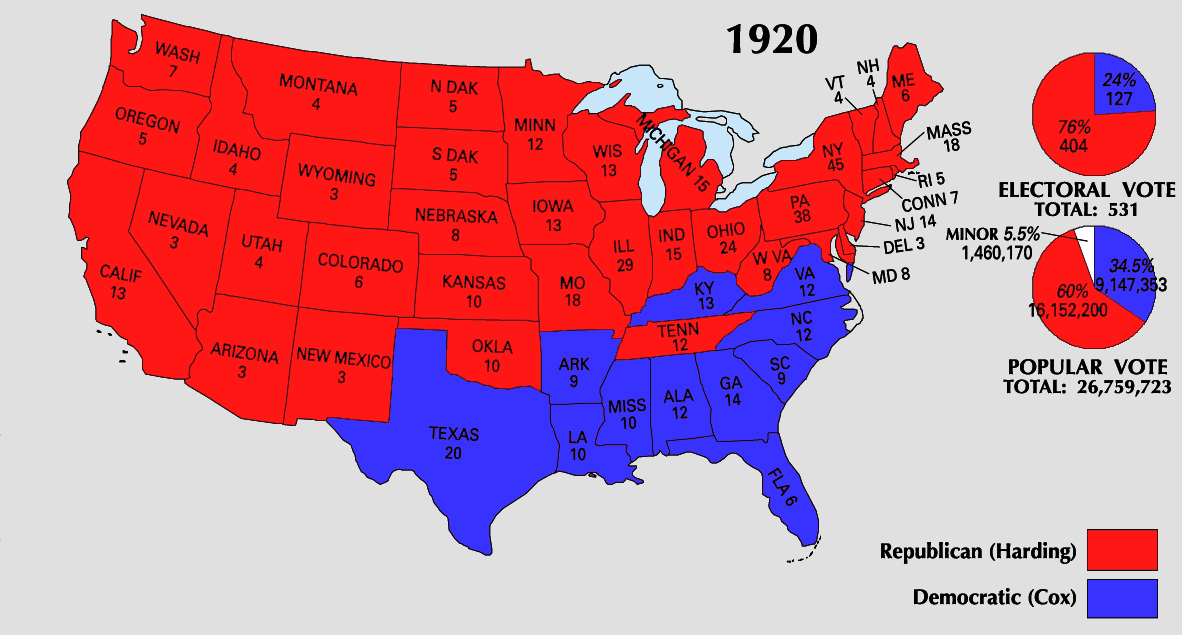
The map above shows the result of the 1920 US presidential election between Warren G. Harding and James M. Cox. Turnout for the election was 49.20%.
Here are the key details:
| Winner: | Runner-Up: | |
|---|---|---|
| Name: | Warren G. Harding | James M. Cox |
| Political Party: | Republican | Democratic |
| Home state: | Ohio | Ohio |
| VP Name: | Calvin Coolidge | Franklin D. Roosevelt |
| States: Won (Out of 48): | 37 | 11 |
| Electoral College Votes (out of 531): | 404 | 127 |
| Percentage of Popular Vote | 60.32% | 34.20% |
| Total Votes | 16,144,093 | 9,139,661 |
| Margin % | 26.17% | – |
| Margin (votes) | 7,004,432 | – |
| 3rd Place | 4th Place: | |
|---|---|---|
| Name: | Eugene V. Debs | Parley P. Christensen |
| Political Party | Socialist | Farmer-Labor |
| Electoral College Votes | 0 | 0 |
| Number of Votes: | 914,191 | 265,395 |
| Percentage of Popular Vote: | 3.41% | 0.99% |
Key Issues in the 1920 Election:
Here is an overview of where the candidates stood on the key issues of the time:
1. League of Nations and Foreign Policy
Warren G. Harding (Republican): Harding opposed the United States joining the League of Nations, an international organization proposed by President Woodrow Wilson as part of his post-World War I vision for global peace. Harding, reflecting isolationist sentiment, argued that the U.S. should not entangle itself in foreign alliances that could drag the country into more wars.
James M. Cox (Democrat): Cox supported the League of Nations, in line with the Democratic Party’s platform and Woodrow Wilson’s vision. Cox’s position was that the U.S. needed to take an active role in international diplomacy to secure lasting peace and prevent future conflicts.
2. Economic Recovery and Postwar Issues
Harding: His campaign called for a “return to normalcy,” which appealed to Americans weary of the upheaval from the war and domestic changes like labor strikes and inflation. Harding promised to focus on economic recovery through reduced government intervention and lower taxes, emphasizing pro-business policies and reduced regulations.
Cox: Cox sought to continue the progressive reforms of the Wilson administration and favored more government intervention in the economy to help stabilize postwar conditions. He advocated for measures to help labor, including pro-labor laws and addressing issues of unemployment.
3. Prohibition
Harding: Harding was not an ardent supporter of Prohibition (which had been implemented nationwide in 1920), but he accepted it as the law of the land. He did not make it a major issue in his campaign but promised to enforce it while privately maintaining more lenient views.
Cox: Cox also supported the enforcement of Prohibition, but like Harding, he was not an enthusiastic supporter of the policy. He also did not emphasize the issue heavily in his campaign, understanding the deep divisions it created in American society.
4. Women’s Suffrage
Harding: Harding was a supporter of women’s suffrage and the passage of the 19th Amendment, which had been ratified in August 1920, just before the election. Harding courted the new female vote, encouraging women to participate in politics and emphasizing their role in postwar recovery.
Cox: Cox also supported women’s suffrage and celebrated the 19th Amendment as a major step forward in American democracy. Both candidates recognized the importance of women voters and included them in their campaign strategies.
5. Labor and Progressive Reforms
Harding: Harding was critical of some progressive labor reforms and argued that the country needed less government involvement in business. He leaned toward policies that would reduce the influence of labor unions and relax regulatory measures put in place during the Wilson administration.
Cox: Cox, in contrast, supported many progressive reforms, including labor rights, minimum wage laws, and continued regulation of business practices. He saw government intervention as essential to protect workers and maintain fair economic practices in the postwar economy.
6. Civil Rights
Harding: While Harding spoke in favor of some civil rights for African Americans, his support was limited, and he did not push for major reforms. He was more focused on keeping the Republican Party’s broad coalition intact, which included Southern whites who were resistant to civil rights progress.
Cox: Cox, like many Democrats at the time, did not prioritize civil rights for African Americans. The Democratic Party was largely influenced by its southern base, which supported segregation and disenfranchisement of Black Americans.
7. Campaign and Rhetoric
Harding: His campaign theme of a “return to normalcy” resonated deeply with a public exhausted by war, inflation, and social changes. Harding’s rhetoric was focused on calm, stability, and moving away from the activism of the Wilson years.
Cox: Cox ran a more energetic campaign, arguing that America needed to embrace the challenges of the postwar world, maintain its progressive spirit, and stay involved internationally, especially through the League of Nations.
Why did Harding win?
Here’s an analysis of why and how Harding won:
1. Desire for a “Return to Normalcy”
Public Fatigue: After the turmoil of World War I, the flu pandemic of 1918, labor strikes, racial tensions, and the perceived overreach of the Wilson administration’s progressive reforms, Americans were eager for stability and peace.
Harding’s campaign slogan, “Return to Normalcy,” encapsulated this widespread desire for a return to prewar conditions, offering voters a reassuring message of calm and conservative governance.
Contrast with Wilson’s Idealism: The Democratic Party, led by President Woodrow Wilson, had pushed for international engagement and progressive reform during and after the war.
Wilson’s championing of the League of Nations and his progressive domestic agenda were seen as too idealistic and interventionist by a growing portion of the electorate. Harding’s call for a more hands-off approach, both domestically and internationally, resonated strongly with voters who were tired of these upheavals.
2. Discontent with the Democratic Party
The Wilson Legacy: By 1920, President Wilson had become an unpopular figure. His administration’s handling of the Treaty of Versailles, the League of Nations, and the domestic economy had eroded support for the Democratic Party.
Wilson’s refusal to compromise on the League of Nations and his physical incapacitation due to a stroke in 1919 left the party divided and weakened.
Economic Troubles: Postwar economic problems, such as high inflation, unemployment, and labor unrest, hurt the Democrats’ standing. Many Americans blamed Wilson and the Democrats for these difficulties, creating a political environment favorable to the opposition party.
The strikes and social unrest, combined with government intervention in the economy during the war, led many voters to seek a more business-friendly, less interventionist government.
3. Harding’s Campaign Strategy
“Front Porch” Campaign: Harding conducted a “front porch” campaign, where he made speeches from his home in Marion, Ohio, rather than traveling extensively.
This low-key approach was in stark contrast to Cox’s more active, traditional campaign and gave Harding the image of a calm, steady leader. His speeches were deliberately vague and soothing, designed to appeal to a broad cross-section of Americans without alienating specific groups.
Broad Appeal and Avoidance of Controversy: Harding’s vague policy promises and conservative rhetoric appealed to various voter blocs, including traditional Republicans, war-weary voters, and those seeking stability.
By avoiding controversial issues and focusing on general themes of peace and prosperity, he united the Republican Party and attracted independent voters. He did not push for major reforms or radical change, which was a relief to many voters anxious about the rapid shifts of the previous decade.
4. Isolationism and the League of Nations
Opposition to the League of Nations: One of the most important issues in the 1920 election was the U.S. involvement in the League of Nations. Harding opposed the League, arguing that it would entangle the U.S. in unnecessary foreign conflicts.
This position resonated with the growing isolationist sentiment among Americans, who were increasingly wary of international commitments after the trauma of World War I.
Cox’s Support for the League: James Cox, the Democratic candidate, supported the League of Nations, following the vision of Wilson. However, many Americans viewed the League as a costly, idealistic endeavor that would drag the country into future wars.
Harding’s opposition to the League provided a clear contrast to Cox and aligned with the public’s desire for disengagement from international politics.
5. Media and Public Image
Harding’s “Presidential” Image: Harding was a charismatic candidate with a look and demeanor that fit the public’s image of a president. His campaign emphasized his small-town roots, portraying him as a man of the people and contrasting this with the intellectualism and elitism often associated with Wilson and his policies.
His straightforward, reassuring persona made him an appealing alternative to the perceived complexity and divisiveness of Wilson’s administration.
Media Support: Harding received strong support from newspapers and media outlets, which played a significant role in shaping public opinion. His campaign also made effective use of advertising and radio to spread his message of stability and traditional American values.
6. Women’s Suffrage
The 19th Amendment: The election of 1920 was the first U.S. presidential election in which women had the right to vote nationwide, following the ratification of the 19th Amendment.
Harding and the Republican Party actively courted the women’s vote, and Harding’s message of stability, domestic focus, and moral conservatism appealed to many new female voters, who were thought to be more conservative than their male counterparts.
7. Political and Social Conservatism
Support from Business Interests: Harding and the Republicans were favored by big business, which was eager for a rollback of wartime regulations and restrictions. Harding promised pro-business policies, lower taxes, and less government intervention in the economy, which reassured the business community and won their financial and electoral support.
Conservative Backlash: Harding’s victory also represented a conservative backlash against the progressivism of the Wilson era. The U.S. had undergone significant social and political changes in the early 20th century, including labor rights, women’s suffrage, and Prohibition.
Many voters, particularly in rural and conservative areas, felt uncomfortable with these rapid changes and supported Harding’s more traditional, less activist approach to governance.
8. Republican Party Strength
Republican Unity: The Republican Party was united behind Harding and ran a disciplined, well-financed campaign. The Democratic Party, on the other hand, was divided internally over the League of Nations, progressive reforms, and Wilson’s legacy. This division weakened Cox’s ability to mount an effective challenge to the Republicans.
Support in Key States: Harding won crucial battleground states, including those in the Midwest and the Northeast, which were essential for an electoral college victory.
His campaign’s broad appeal and support from business, rural voters, and newly enfranchised women allowed him to win 37 out of 48 states, dominating both the popular and electoral votes.
1920 Election Results Map By County

1920 Map From The National Atlas of the United States (now sadly permanently offline)
Other US Presidential Election Maps: