
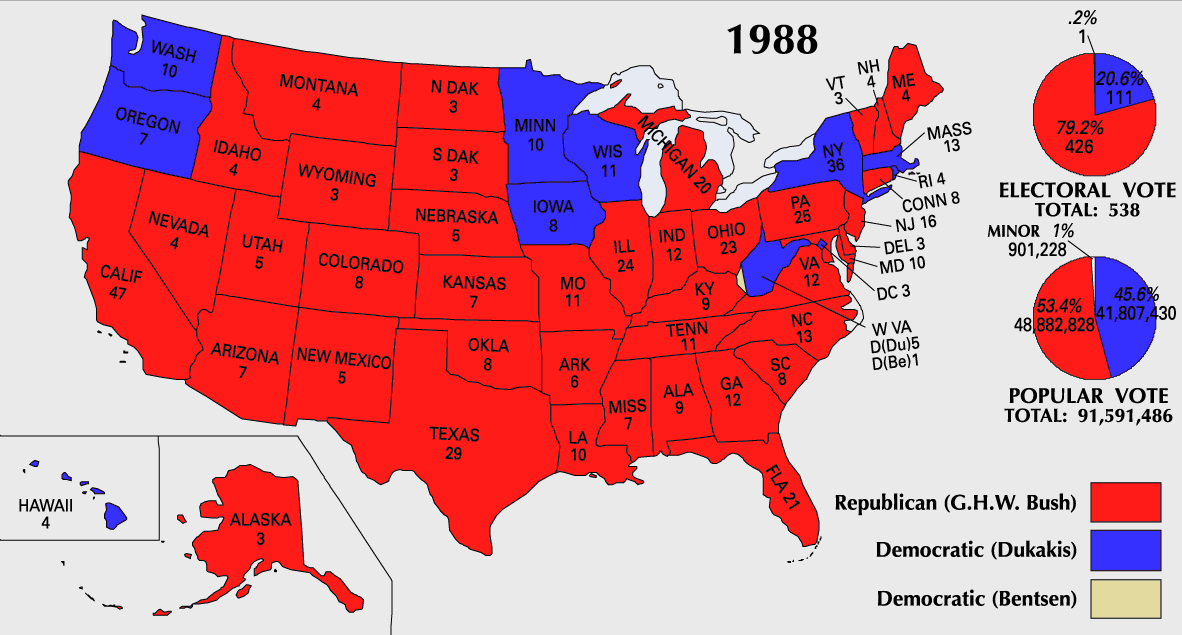
The map above shows the result of the 1988 US presidential election between George H. W. Bush and Michael Dukakis. Turnout for the election was 52.80%.
Here are the key details:
| Winner: | Runner-Up: | |
|---|---|---|
| Name: | George H. W. Bush | Michael Dukakis |
| Political Party: | Republican | Democratic |
| Home state: | Texas | Massachusetts |
| VP Name: | Dan Quayle | Lloyd Bentsen |
| States: Won (Out of 51): | 40 | 10 |
| Electoral College Votes (out of 538): | 426 | 111 |
| Percentage of Popular Vote | 53.37% | 45.60% |
| Total Votes | 48,886,597 | 41,809,476 |
| Margin % | 7.72% | – |
| Margin (votes) | 7,077,121 | – |
Other Parties
| 3rd Place | 4th Place | |
|---|---|---|
| Name: | Ron Paul | Lenora Fulani |
| Political Party | Libertarian | New Alliance |
| Electoral College Votes | 0 | 0 |
| Number of Votes: | 431,750 | 217,221 |
| Percentage of Popular Vote: | 0.47% | 0.24% |
Key Issues of The 1988 Election
The 1988 U.S. presidential election featured a contest between Republican candidate George H.W. Bush and Democratic candidate Michael Dukakis.
The election focused on several key issues, with the candidates taking distinct positions that reflected their party platforms and personal political philosophies.
1. Economic Policy
- George H.W. Bush: Bush campaigned on continuing the economic policies of the Reagan administration, which included tax cuts, deregulation, and a strong defense budget. He famously pledged “no new taxes,” a statement that would later come back to haunt him during his presidency.
- Michael Dukakis: Dukakis advocated for a more active role of government in addressing economic issues, including investments in education, infrastructure, and health care. He supported raising taxes on the wealthy to fund these programs and reduce the deficit.
2. Crime and Punishment
- George H.W. Bush: Bush took a tough stance on crime, emphasizing the need for stronger law enforcement and harsher penalties for offenders. The “Willie Horton” ad, which highlighted a crime committed by a felon released on furlough under a program in Massachusetts, became a central (and controversial) part of Bush’s campaign, framing Dukakis as soft on crime.
- Michael Dukakis: While Dukakis also supported law enforcement, he advocated for criminal justice reform and was known for a more rehabilitative approach. His support for the Massachusetts furlough program, which allowed prisoners temporary leave, became a major liability after the Willie Horton incident.
3. National Defense and Foreign Policy
- George H.W. Bush: Bush emphasized his experience in foreign policy, having served as Vice President, CIA Director, and Ambassador to the United Nations. He supported maintaining a strong defense and continuing the Cold War policies of the Reagan administration, including the Strategic Defense Initiative (SDI) or “Star Wars.”
- Michael Dukakis: Dukakis advocated for a reduction in defense spending and was critical of the SDI, arguing that the funds could be better used domestically. He also supported arms control agreements with the Soviet Union and a more diplomatic approach to foreign relations.
4. Social Issues
- George H.W. Bush: Bush generally supported conservative positions on social issues, including opposition to abortion and support for traditional family values. He also favored limited government intervention in social programs.
- Michael Dukakis: Dukakis was more liberal on social issues, supporting abortion rights, environmental protection, and government programs to aid the poor and disadvantaged. He also emphasized civil rights and was critical of the Reagan administration’s record on these issues.
5. Environmental Policy
- George H.W. Bush: Bush did not emphasize environmental issues during his campaign, though he did promise to be an “environmental president.” However, his campaign was more focused on economic growth and national defense.
- Michael Dukakis: Dukakis made the environment a significant part of his platform, advocating for stronger regulations on pollution and greater investment in renewable energy. He criticized the Reagan administration for rolling back environmental protections.
6. Leadership and Experience
- George H.W. Bush: Bush capitalized on his extensive experience in government, presenting himself as a steady and experienced leader capable of continuing the successes of the Reagan era.
- Michael Dukakis: Dukakis, as governor of Massachusetts, portrayed himself as a competent and effective manager, pointing to his state’s economic performance under his leadership. However, he struggled to counter the perception that he lacked foreign policy experience compared to Bush.
Why Did Bush Win?
George H.W. Bush won the 1988 U.S. presidential election for several key reasons:
1. Association with Ronald Reagan’s Popularity
- Reagan’s Legacy: Bush was Ronald Reagan’s vice president, and he successfully tied his campaign to Reagan’s popular presidency. The 1980s had seen significant economic growth, a strong stance against the Soviet Union, and a sense of American renewal under Reagan. Bush promised to continue Reagan’s policies, appealing to voters who were satisfied with the status quo. His campaign slogan, “A Kinder, Gentler Nation,” suggested continuity with Reagan’s achievements while also promising a more compassionate approach.
2. Effective Negative Campaigning
- The “Willie Horton” Ad: Bush’s campaign effectively used negative ads to undermine Michael Dukakis. The most notorious was the “Willie Horton” ad, which highlighted the case of a convicted murderer who committed further crimes while on a weekend furlough program in Massachusetts, where Dukakis was governor. This ad played into fears about crime and portrayed Dukakis as weak on law and order.
- Portraying Dukakis as Out of Touch: Bush’s campaign also succeeded in framing Dukakis as an out-of-touch liberal, emphasizing his opposition to mandatory recitation of the Pledge of Allegiance in schools and his perceived lack of patriotism (exemplified by his awkward response to a question about the hypothetical use of the death penalty if his wife were raped and murdered).
3. Perceived Weaknesses of Michael Dukakis
- Lack of Charisma and Connection with Voters: Dukakis struggled to connect with voters on a personal level. He was often seen as technocratic and cold, and he failed to inspire enthusiasm among the electorate. His campaign was also criticized for being overly cautious and failing to respond effectively to Bush’s attacks.
- Foreign Policy Inexperience: Dukakis’s limited experience in foreign policy was a significant disadvantage compared to Bush, who had served as Vice President, CIA Director, and U.N. Ambassador. In the final presidential debate, when asked about his temperament in a crisis, Dukakis’s calm and detached response was perceived as insufficiently passionate, reinforcing doubts about his leadership abilities.
4. Strong Economy and International Standing
- Economic Stability: The U.S. economy was strong in the late 1980s, with low unemployment and inflation. Voters were generally satisfied with their economic situation, and Bush’s association with the Reagan administration’s economic policies worked in his favor.
- End of the Cold War: The late 1980s also saw significant developments in the Cold War, including the beginnings of reforms in the Soviet Union under Mikhail Gorbachev. Bush’s experience in foreign policy gave voters confidence that he could effectively manage these changes and maintain America’s global standing.
5. Strategic Campaigning
- Targeting Swing States: Bush’s campaign effectively targeted key swing states and used resources to win over voters in these areas. He was able to carry several traditionally Democratic states, such as New Jersey, Illinois, and Maryland, by appealing to moderate and conservative voters.
- Successful Framing of Issues: Bush’s campaign successfully framed the election around issues where Dukakis was perceived as vulnerable, such as crime and national defense, rather than allowing the campaign to focus on areas where Dukakis might have had an advantage, like health care or education.
6. Dukakis’s Campaign Mistakes
- Failure to Respond to Attacks: Dukakis’s campaign was criticized for not responding aggressively enough to Bush’s negative ads. This allowed the Bush campaign to define Dukakis in the public’s mind without significant pushback.
- Underestimating the Importance of Image: Dukakis’s campaign underestimated the importance of emotional appeal and image. His reserved and analytical style was less effective in a campaign environment increasingly dominated by television and media imagery.
1988 Election Results Map By County

1988 Map From The National Atlas of the United States (now sadly permanently offline)
Other US Presidential Election Maps: