
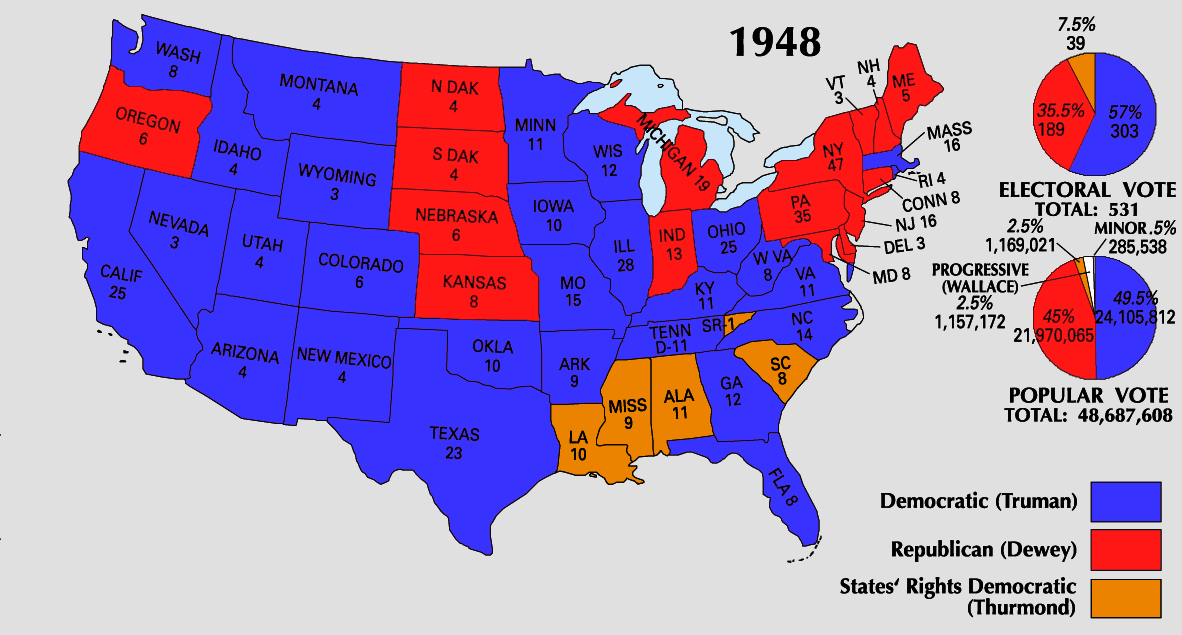
The map above shows the result of the 1948 US presidential election between Harry S. Truman and Thomas E. Dewey. Turnout for the election was 52.20%.
Here are the key details:
| Winner | Runner-Up: | |
|---|---|---|
| Name: | Harry S. Truman | Thomas E. Dewey |
| Political Party: | Democratic | Republican |
| Home state: | Missouri | New York |
| VP Name: | Alben W. Barkley | Earl Warren |
| States: Won (Out of 48): | 28 | 16 |
| Electoral College Votes (out of 531): | 303 | 189 |
| Percentage of Popular Vote | 49.55% | 45.10% |
| Total Votes | 24,179,347 | 21,991,292 |
| Margin % | 4.48% | – |
| Margin (votes) | 2,188,055 | – |
| 3rd Place | 4th Place | |
|---|---|---|
| Name: | Strom Thurmond | Henry A. Wallace |
| Political Party | States’ Rights Democratic | Progressive/American Labor |
| Electoral College Votes | 39 | 0 |
| Number of Votes: | 1,176,023 | 1,157,328 |
| Percentage of Popular Vote: | 2.40% | 2.37% |
Key Issues in The 1948 Election
The 1948 U.S. presidential election was one of the most dramatic and pivotal elections in American history, known for its upset result in which President Harry S. Truman defeated the heavily favored Republican candidate Thomas E. Dewey.
There were three major candidates and an important third-party contender in the election, each representing different issues and political perspectives:
1. Harry S. Truman (Democrat)
- Civil Rights: Truman made civil rights a central issue, marking a turning point in Democratic politics. In 1948, he issued executive orders to desegregate the military and end racial discrimination in federal hiring. He supported stronger civil rights legislation, which split his party.
- Economy: Truman championed the continuation of the New Deal programs and sought to expand social welfare policies, including national health insurance, price controls, and aid to farmers. He promoted a “Fair Deal” program, which included expanding Social Security, raising the minimum wage, and providing public housing.
- Foreign Policy: Truman’s administration was deeply involved in the early stages of the Cold War. He supported the Marshall Plan to rebuild Europe and the Truman Doctrine to contain communism. Truman’s foreign policy also included creating the North Atlantic Treaty Organization (NATO).
- Labor: After labor unrest and strikes post-WWII, Truman vetoed the Taft-Hartley Act, a law that limited the power of unions. His pro-labor stance helped him with the working-class vote.
2. Thomas E. Dewey (Republican)
- Economy: Dewey was a moderate Republican who criticized Truman’s handling of inflation and post-war economic recovery. He argued for reducing government spending and balancing the budget but avoided calling for a repeal of New Deal programs like Social Security, knowing their popularity.
- Civil Rights: Dewey had a reputation for being relatively progressive on civil rights issues, supporting anti-discrimination measures and racial equality. However, his campaign did not make civil rights a central focus.
- Foreign Policy: Like Truman, Dewey supported containing communism and endorsed the Marshall Plan. However, he criticized the administration’s handling of the early Cold War, suggesting it was too reactive.
- Labor: Dewey was less supportive of unions compared to Truman, endorsing the Taft-Hartley Act, which was designed to curb union power.
3. Strom Thurmond (Dixiecrat / States’ Rights Democratic Party)
- Civil Rights: Thurmond’s candidacy was a reaction to Truman’s civil rights policies. Thurmond and the Dixiecrats represented Southern Democrats who were deeply opposed to federal civil rights legislation and integration. They promoted racial segregation and states’ rights, opposing any federal intervention on the issue of race.
- States’ Rights: The Dixiecrat campaign centered around states’ rights, arguing that states should have the authority to govern themselves without federal interference, particularly on matters like segregation and civil rights.
- Economy & Labor: Thurmond and the Dixiecrats did not offer substantial policy differences from mainstream Democrats on issues like the economy or labor, focusing primarily on defending segregation.
Fourth Party Contender: Henry A. Wallace (Progressive Party)
- Foreign Policy: Wallace broke from the Democrats over Truman’s hardline anti-communist policies. He advocated for a more conciliatory approach to the Soviet Union and opposed the Cold War framework that both Truman and Dewey supported.
- Civil Rights & Economy: Wallace was more progressive than Truman on domestic policies, supporting stronger civil rights protections, desegregation, and expanded social welfare programs. He also pushed for more aggressive labor rights.
- Economic Policy: Wallace favored expanding the New Deal programs, government control of key industries, and national health insurance.
Why did Truman win?
Several key factors contributed to Truman’s unexpected victory:
1. Truman’s Effective Campaign Style
The “Whistle-Stop” Tour: Truman traveled over 31,000 miles across the country by train, stopping in small towns and rural areas, often making five or six speeches a day.
These “whistle-stop” speeches allowed him to connect directly with voters, presenting himself as a man of the people and energizing his base. He made passionate attacks on the Republican-controlled 80th Congress, labeling it the “Do-Nothing Congress” and blaming it for failing to pass progressive legislation.
Appealing to the Common Voter: Truman’s campaign focused on populist themes, such as advocating for the working class, defending labor rights, and pushing for social programs like healthcare and education. He effectively painted himself as the defender of the “little guy” and as the protector of New Deal policies.
2. Truman’s Position on Civil Rights
Courage on Civil Rights: Truman’s support for civil rights, while alienating Southern Democrats, helped him secure the African American vote, particularly in key Northern cities.
His executive orders desegregating the military and prohibiting discrimination in federal hiring earned him the support of progressive voters and Black Americans.
Splitting the Opposition: While his civil rights stance lost him some Southern support (leading to the Dixiecrat candidacy of Strom Thurmond), it also helped split his opposition. This division allowed him to win key states in the South, despite the Dixiecrat challenge.
3. Republican Overconfidence and a Lackluster Campaign by Dewey
Overconfidence: The Republican candidate, Thomas E. Dewey, and much of the media were so confident of a Dewey victory that Dewey ran a cautious, almost passive campaign.
His speeches were vague and non-controversial, avoiding strong policy stances in the belief that a general, non-offensive approach would secure his victory. This strategy, while minimizing risk, made Dewey seem out of touch and less energetic compared to Truman’s dynamic campaign.
Failure to Engage with Key Issues: Dewey failed to engage directly with the specific concerns of postwar America. His failure to directly address issues such as the labor unrest, inflation, and the housing crisis made him seem indifferent to the challenges ordinary Americans were facing.
4. Truman’s Attack on the “Do-Nothing Congress”
Blaming Congress: Truman effectively shifted much of the blame for the nation’s problems onto the Republican-controlled 80th Congress, accusing it of obstructing legislation that would have helped average Americans.
He argued that Republicans in Congress, including Dewey, were more interested in serving wealthy business interests than the public. This message resonated with working-class voters, who felt that the Republicans had done little to improve their lives post-WWII.
5. The Labor Vote
Union Support: Truman received strong support from organized labor, especially after vetoing the Taft-Hartley Act, which aimed to curb union power. His defense of unions and workers’ rights solidified his base among laborers, particularly in industrial states.
Labor Mobilization: Unions worked hard to mobilize voters for Truman, helping to turn out a strong vote in key industrial states like Ohio, Michigan, and Pennsylvania, which were crucial to his victory.
6. Third-Party Candidates and a Fragmented Opposition
Divided Democratic Opposition: While Strom Thurmond’s Dixiecrat candidacy did take away some votes in the South, it also split the anti-Truman vote, making it harder for Dewey to consolidate opposition.
Thurmond only won four Southern states, and Truman managed to retain enough Southern support to prevent Dewey from winning those states.
Progressive Party: Henry Wallace’s Progressive Party candidacy, while an issue for Truman in some Northern liberal circles, did not attract a large enough voter base to seriously damage Truman’s chances.
Wallace’s appeal to left-wing voters on issues like civil rights and foreign policy was overshadowed by Truman’s more moderate but still progressive stance.
7. Cold War Foreign Policy
Support for Truman’s Leadership: Truman’s tough stance against the Soviet Union, including the Truman Doctrine and Marshall Plan, resonated with voters who were concerned about the spread of communism.
While Henry Wallace criticized these policies as too aggressive, the majority of Americans supported Truman’s leadership in the early stages of the Cold War. His foreign policy experience also contrasted with Dewey’s lack of expertise in this area.
8. Polls Misled the Public
Faulty Polling: Early polling showed Dewey leading Truman by a wide margin, and many newspapers predicted a Dewey victory. Some polls stopped gathering data weeks before the election, missing a late surge of support for Truman. This overconfidence affected public perception and contributed to Dewey’s cautious campaign.
Underdog Status: The perception that Truman was going to lose might have actually worked to his advantage, motivating his supporters to turn out to vote. The lack of urgency on the Republican side, in contrast, may have depressed turnout for Dewey.
1948 Election Results Map By County

1948 Map From The National Atlas of the United States (now sadly permanently offline)
Other US Presidential Election Maps: