
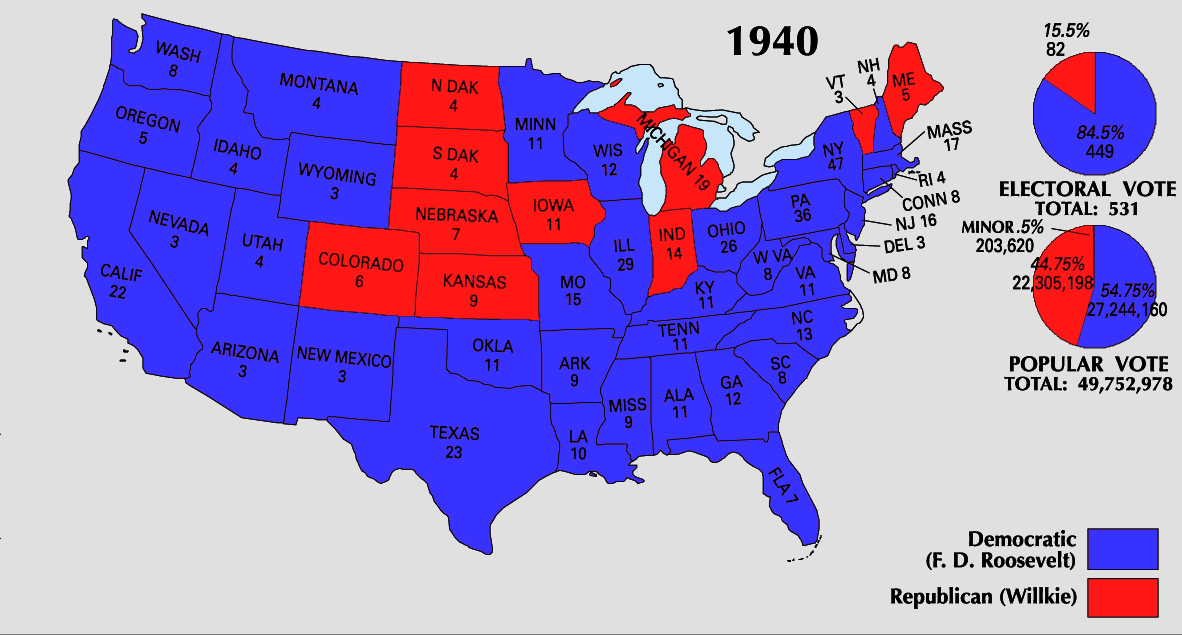
The map above shows the result of the 1940 US presidential election between Franklin D. Roosevelt and Wendell Willkie. Turnout for the election was 62.40%.
Here are the key details:
| Winner: | Runner-Up: | |
|---|---|---|
| Name: | Franklin D. Roosevelt | Wendell Willkie |
| Political Party: | Democratic | Republican |
| Home state: | New York | New York |
| VP Name: | Henry A. Wallace | Charles L. McNary |
| States: Won (Out of 48): | 38 | 10 |
| Electoral College Votes (out of 531): | 449 | 82 |
| Percentage of Popular Vote | 54.74% | 44.80% |
| Total Votes | 27,313,945 | 22,347,744 |
| Margin % | 9.96% | – |
| Margin (votes) | 4,966,201 | – |
| 3rd Place | 4th Place: | |
|---|---|---|
| Name: | Norman Thomas | Roger Babson |
| Political Party | Socialist | Prohibition |
| Electoral College Votes | 0 | 0 |
| Number of Votes: | 116,599 | 57,903 |
| Percentage of Popular Vote: | 0.23% | 0.12% |
Key Issues In the 1940 Election
The 1940 U.S. Presidential Election took place during a critical time in world history, as World War II was raging in Europe, and the U.S. was grappling with how to respond.
This election marked President Franklin D. Roosevelt’s unprecedented run for a third term, and he faced Republican candidate Wendell Willkie.
Several key issues shaped the election, with the most important being:
1. World War II and Foreign Policy
- Franklin D. Roosevelt (Democrat):
- Roosevelt was cautious about direct U.S. involvement in World War II but strongly believed in aiding the Allies (particularly Britain) in their fight against Nazi Germany.
- He supported policies like the Lend-Lease Act, which provided military aid to countries whose defense he considered vital to the security of the U.S. This act was a way to support the Allies without direct involvement in the war.
- FDR’s position was not one of isolationism, but rather interventionist in terms of providing aid, while still keeping the U.S. out of active combat.
- Wendell Willkie (Republican):
- Willkie, though a Republican, held a surprisingly similar stance on foreign policy. He also supported aiding Britain, arguing that the U.S. could not afford to ignore the threat of Nazi Germany.
- However, Willkie’s key criticism of Roosevelt was that the president’s leadership was too autocratic and could lead to U.S. involvement in the war without proper congressional approval. Willkie painted Roosevelt as someone who might drag the U.S. into war.
- Both candidates, therefore, argued against direct U.S. involvement, but Willkie claimed he would handle the situation more constitutionally and transparently.
2. New Deal and Economic Recovery
- Franklin D. Roosevelt:
- FDR was running on the legacy of his New Deal, which had been a series of programs aimed at economic recovery during the Great Depression. While the New Deal programs were popular with many Americans, especially workers and farmers, there were some criticisms that they expanded government power too much.
- He argued that his policies were essential to pulling the country out of the Depression and providing long-term economic stability.
- Roosevelt aimed to continue and expand some of the New Deal programs, though by 1940, the economy had started to recover more significantly, reducing the immediate need for further expansion.
- Wendell Willkie:
- Willkie, though a political outsider and former business executive, criticized the New Deal’s governmental overreach. He argued that the New Deal created too much federal control over the economy, which was stifling private enterprise and leading toward unnecessary bureaucracy.
- He called for a rollback of New Deal programs, arguing for less regulation, a more business-friendly environment, and reducing the deficit created by New Deal spending.
3. Roosevelt’s Third Term
- Franklin D. Roosevelt:
- FDR’s decision to run for a third term was unprecedented and became a major issue in the election. Critics argued that this broke a longstanding tradition of presidents only serving two terms, as set by George Washington.
- Roosevelt defended his decision, arguing that the world was in a precarious situation and that his experience as a wartime leader was crucial to navigating the U.S. through this turbulent period.
- His campaign slogan, “Don’t change horses in midstream,” suggested that changing leadership during a crisis could endanger the country’s safety and stability.
- Wendell Willkie:
- Willkie attacked Roosevelt’s third-term bid as an attempt to consolidate power and set a dangerous precedent for future presidents. He argued that no leader should be in power for so long, as it was a step toward authoritarianism.
- He positioned himself as the candidate of change and reform, arguing that fresh leadership was necessary to restore balance and ensure that the presidency did not become too powerful.
4. National Defense
- Franklin D. Roosevelt:
- Roosevelt had initiated steps to strengthen national defense in light of growing threats from Nazi Germany and Japan. He had supported expanding the military and initiated the first peacetime draft (Selective Training and Service Act of 1940).
- He balanced defense preparedness with his goal of keeping the U.S. out of direct involvement in the war.
- Wendell Willkie:
- Willkie supported military preparedness and the draft as well, but criticized Roosevelt for not acting more quickly. He argued that the U.S. was unprepared for potential conflict and that Roosevelt had been slow in responding to growing threats.
- Like Roosevelt, Willkie stressed defense without immediate involvement in the war.
5. Labor and Industrial Relations
- Franklin D. Roosevelt:
- Roosevelt had strong backing from labor unions and positioned himself as the champion of workers’ rights. His policies included efforts to protect workers’ rights to unionize and improve working conditions.
- Wendell Willkie:
- Willkie was more aligned with business interests and criticized Roosevelt for being too close to labor unions. He called for a better balance between labor and management, arguing that the administration’s pro-labor stance was hurting businesses and slowing economic growth.
Why did Roosevelt win?
Here are the main reasons why Roosevelt won:
1. Leadership During Crisis and War
- Experience in Foreign Policy: With World War II escalating in Europe and much of the world already in turmoil, many Americans valued Roosevelt’s experience on the global stage. FDR had been navigating the complex international situation, maintaining U.S. neutrality while supporting the Allies through measures like the Lend-Lease Act.
- Don’t Change Horses in Midstream: Roosevelt’s campaign emphasized continuity of leadership during a time of crisis. The slogan “Don’t change horses in midstream” resonated with voters, who were anxious about the instability abroad and feared that a change in leadership could jeopardize the nation’s security.
- National Defense: Roosevelt had already taken steps to strengthen the U.S. military, including the first peacetime draft. Many voters trusted him to continue preparing the nation for defense without rushing into war. Although Wendell Willkie also supported preparedness, Roosevelt was seen as more seasoned to lead the country through these dangerous times.
2. Popularity of the New Deal
- Economic Recovery: By 1940, the U.S. economy had improved significantly from the depths of the Great Depression. Roosevelt’s New Deal programs, while controversial to some, were seen by many Americans as having played a critical role in reviving the economy and providing jobs, financial security, and social welfare.
- Support from Labor Unions and Working Class: Roosevelt enjoyed widespread support from labor unions, which had benefited from pro-labor policies under his administration, such as the Wagner Act that protected workers’ rights to unionize. This solidified his base among working-class Americans, who feared that Willkie’s pro-business stance would reverse these gains.
3. Public Fear of Willkie’s Inexperience
- Political Outsider: Wendell Willkie was a political outsider with no prior experience in public office, which was a significant disadvantage at a time when foreign policy experience was seen as critical. While Willkie’s business background appealed to some voters, many were skeptical about whether he could effectively manage the complex foreign and domestic issues the U.S. was facing.
- Lack of Clear Policy Differences on Foreign Policy: Although Willkie criticized Roosevelt for being autocratic and potentially pulling the U.S. into war, he did not offer a dramatically different approach to foreign policy. Both candidates supported aiding the Allies and preparing for national defense. With little clear distinction on this critical issue, Roosevelt’s experience gave him an advantage.
4. The Appeal of Stability and Continuity
- The Third Term Question: While there was controversy over Roosevelt running for an unprecedented third term, many voters were more concerned about the ongoing global crisis than the constitutional tradition of a two-term limit. Roosevelt’s argument that his leadership was necessary to guide the U.S. through this dangerous period outweighed fears of potential authoritarianism. Voters were more comfortable with continuity rather than risk a new, untested leader.
- Trust in Roosevelt’s Judgment: Roosevelt had built up a significant reservoir of public trust through his radio Fireside Chats and personal connection with the American people. He was seen as a reassuring figure who could be trusted to keep the U.S. safe and prosperous.
5. Political Coalition
- Broad Electoral Coalition: Roosevelt maintained strong support from a broad coalition of voters, including urban working-class Americans, African Americans (who had begun shifting from the Republican Party to the Democratic Party during Roosevelt’s presidency), farmers, and the South. This wide base of support was difficult for Willkie to counteract.
- Support from Minority Groups: Roosevelt’s New Deal programs had earned him support from African Americans, a critical shift in voting patterns. While the Democratic Party had traditionally been the party of the South, and African Americans had been Republican since Lincoln’s time, the New Deal provided jobs and relief to many African Americans, making them loyal to Roosevelt.
6. Willkie’s Campaign Struggles
- Internal Divisions within the Republican Party: Willkie faced challenges in uniting the Republican Party, which was divided between its isolationist and interventionist wings. Although Willkie himself supported aid to Britain, he had to balance these internal divisions, weakening his campaign’s message.
- Roosevelt’s Strategic Campaigning: Roosevelt’s campaign was highly effective at emphasizing the risks of change. Willkie struggled to break through this narrative and often found himself on the defensive.
7. Roosevelt’s Personal Popularity
- Charismatic Leadership: Roosevelt was personally popular with many Americans. His ability to communicate effectively with the public, especially through his Fireside Chats, made him a reassuring and trusted figure in the midst of uncertainty.
- Voter Confidence in His Vision: Many voters believed in Roosevelt’s vision for the country, particularly his balanced approach to foreign policy. They were confident that Roosevelt’s steady hand would guide the U.S. through both the ongoing economic recovery and the rising global threat of war.
1940 Election Results Map By County

1940 Map From The National Atlas of the United States (now sadly permanently offline)
Other US Presidential Election Maps: