
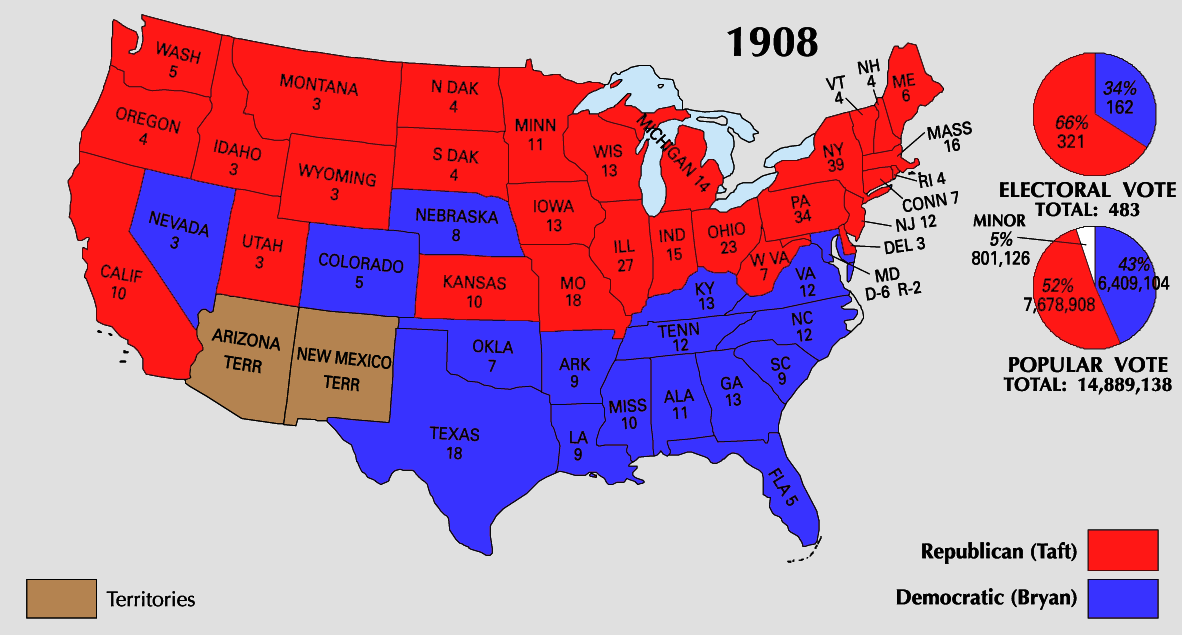
The map above shows the result of the 1908 US presidential election between William Howard Taft and William Jennings Bryan. Turnout for the election was 65.70%.
Here are the key details:
| Winner: | Runner-Up: | |
|---|---|---|
| Name: | William Howard Taft | William Jennings Bryan |
| Political Party: | Republican | Democratic |
| Home state: | Ohio | Nebraska |
| VP Name: | James S. Sherman | John W. Kern |
| States: Won (Out of 46): | 29 | 17 |
| Electoral College Votes (out of 483): | 321 | 162 |
| Percentage of Popular Vote | 51.57% | 43.00% |
| Total Votes | 7,678,335 | 6,408,979 |
| Margin % | 8.53% | – |
| Margin (votes) | 1,269,356 | – |
| 3rd Place | 4th Place: | |
|---|---|---|
| Name: | Eugene V. Debs | Eugene W. Chafin |
| Political Party | Socialist | Prohibition |
| Electoral College Votes | 0 | 0 |
| Number of Votes: | 420,852 | 254,087 |
| Percentage of Popular Vote: | 2.83% | 1.71% |
Key Issues of The 1908 Election
The 1908 U.S. presidential election primarily revolved around issues such as economic reform, labor rights, and the continuation of President Theodore Roosevelt’s progressive policies.
Here’s an overview of the key issues and where each major candidate stood on them:
1. Economic Reform and Regulation of Big Business
- William Howard Taft (Republican): As Roosevelt’s chosen successor, Taft pledged to continue his “Square Deal” policies, which aimed to regulate big business and protect consumers. However, he took a more conservative approach, favoring a gradual, judicially oriented method of regulating monopolies.
- William Jennings Bryan (Democrat): Bryan advocated for stronger anti-trust laws, pushing for the federal government to break up monopolies and protect small businesses more aggressively. He believed the Republican policies favored corporate interests over those of the common people.
2. Labor Rights and Welfare
- Taft: While supporting fair treatment for labor, Taft was less aggressive in advocating for sweeping labor reforms compared to Roosevelt. He endorsed a modest expansion of worker protections, emphasizing the need for legal stability rather than radical change.
- Bryan: Bryan, a populist, was more vocal in supporting labor rights, including laws to improve working conditions and prevent exploitation. He also supported initiatives like a federal income tax, which he saw as a way to alleviate the tax burden on working-class citizens.
3. Tariff Reform
- Taft: The Republican platform called for a revision of tariffs to protect American industries while ensuring fair competition. Taft advocated a more conservative approach to tariff reduction, keeping protectionism as a key element of the economy.
- Bryan: Bryan argued for substantial tariff reductions, claiming that high tariffs benefited wealthy industrialists at the expense of working Americans. He aimed to lower tariffs to reduce the cost of goods and make American products more competitive globally.
4. Currency Reform and Monetary Policy
- Taft: Taft and the Republicans were committed to maintaining the gold standard, a system Roosevelt supported to stabilize the economy and promote industrial growth.
- Bryan: Bryan was historically known for his “Free Silver” stance, advocating for bimetallism (both gold and silver backing currency) to increase the money supply and aid indebted farmers and laborers. By 1908, however, he downplayed this issue but continued to argue for reforms that would benefit the broader population economically.
5. Continuation of Progressive Reforms
- Taft: Taft pledged to continue Roosevelt’s progressive reforms but in a way that aligned with his more conservative principles. He supported initiatives to curb corporate abuses but sought judicial means rather than direct intervention.
- Bryan: Bryan positioned himself as the true champion of progressive reform, arguing that Taft would not genuinely address corruption or support the needs of working Americans. He advocated for more direct government intervention to support average citizens.
Why Did Taft Win?
Here’s a breakdown of why and how Taft secured his victory:
1. Roosevelt’s Endorsement and Popularity
- Theodore Roosevelt, a highly popular president, had served nearly eight years in office and enjoyed strong public support for his progressive policies, including trust-busting, conservation efforts, and consumer protection.
- Roosevelt personally selected Taft as his successor and endorsed him, positioning Taft as the candidate who would continue the “Square Deal” reforms. This endorsement reassured voters who wanted Roosevelt’s progressive policies to continue.
- Taft successfully presented himself as the “safe” choice who would maintain stability and gradual progress, whereas Bryan’s positions were seen as potentially radical and divisive.
2. Republican Party Unity and Strength
- The Republican Party was strong and united behind Taft, with minimal internal conflicts. This unity allowed for a smooth campaign and a clear message focused on continuity and stability.
- Republicans held a dominant position in the country’s political landscape at the time, especially among industrial and business interests who feared Bryan’s populist rhetoric and preference for extensive government intervention.
- The economic prosperity of the era also benefited Taft, as many voters associated the Republican Party with strong economic leadership.
3. Democratic Weakness and Bryan’s Populist Stance
- William Jennings Bryan had already lost two presidential elections (1896 and 1900), which contributed to “Bryan fatigue” among the electorate. Some viewed his populist ideas as outdated, especially his former advocacy for “Free Silver.”
- By 1908, Bryan’s progressive, populist positions had lost some of their appeal, particularly to moderate voters. Many viewed him as too extreme compared to Taft’s more conservative, steady approach.
- Additionally, Bryan’s emphasis on anti-corporate and anti-trust rhetoric didn’t resonate as strongly with the broader population, who had seen some progress under Roosevelt’s policies and wanted a smoother transition rather than radical reforms.
4. Campaign Strategy and Image
- Taft’s campaign positioned him as a steady, capable administrator who would work within the system to achieve gradual progress. He ran a more low-key campaign, presenting himself as a calm, moderate, and dependable leader.
- Bryan’s campaign was energetic and passionate, but it lacked the new ideas or widespread appeal needed to attract undecided voters. His past losses and association with populist causes from earlier in his career alienated some middle- and upper-class voters who preferred stability.
5. The Economic Context
- The economy in 1908 was relatively stable, and many voters felt comfortable with a continuation of the Republican Party’s approach to business and economic policy. The memory of the economic panics in the 1890s, which had weakened Bryan’s earlier campaigns, still lingered.
- Voters associated Republican policies with economic growth and stability, which favored Taft over Bryan’s more populist platform.
1908 Election Results Map By County

1908 Map From The National Atlas of the United States (now sadly permanently offline)
Other US Presidential Election Maps: