
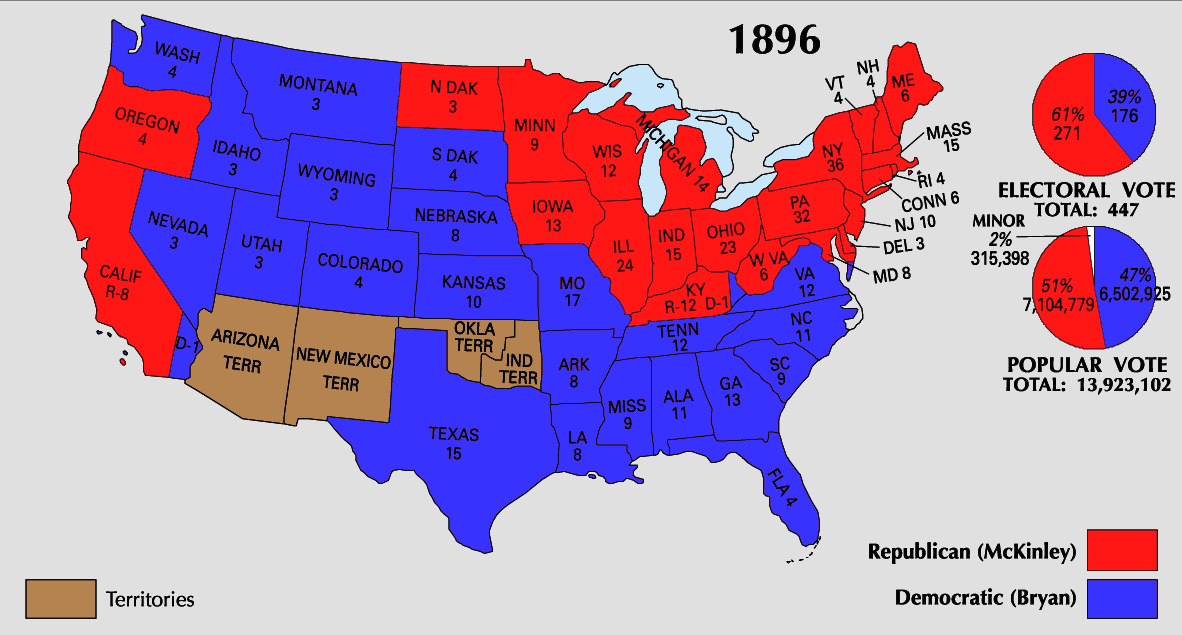
The map above shows the result of the 1896 US presidential election between William McKinley and William Jennings Bryan. Turnout for the election was 79.60%.
Here are the key details:
| Winner: | Runner-Up: | |
|---|---|---|
| Name: | William McKinley | William Jennings Bryan |
| Political Party: | Republican | Democratic |
| Home state: | Ohio | Nebraska |
| VP Name: | Garret Hobart | Arthur Sewall |
| States: Won (Out of 45): | 23 | 22 |
| Electoral College Votes (out of 447): | 271 | 176 |
| Percentage of Popular Vote | 51.02% | 46.70% |
| Total Votes | 7,112,138 | 6,509,052 |
| Margin % | 4.31% | – |
| Margin (votes) | 601,331 | – |
| 3rd Place | 4th Place | |
|---|---|---|
| Name: | John M. Palmer | Joshua Levering |
| Political Party | National Democratic | Prohibition |
| Electoral College Votes | 0 | 0 |
| Number of Votes: | 134,645 | 131,312 |
| Percentage of Popular Vote: | 0.97% | 0.94% |
What were the key issues in the 1896 election?
Here are the key issues and where each candidate stood on them:
1. The Gold Standard vs. Free Silver
Issue: The U.S. was on the gold standard, but many farmers and working-class Americans wanted the country to adopt a bimetallic standard using both gold and silver to back currency. They believed this would increase the money supply, leading to inflation, higher crop prices, and relief from debt.
- William Jennings Bryan (Democratic/Populist Candidate): Bryan was a strong advocate for “free silver” — the unlimited coinage of silver at a fixed ratio to gold (16:1). He argued that this policy would help the common people by reducing debts and raising prices for goods. His famous “Cross of Gold” speech expressed this stance, warning that the gold standard would crucify Americans “upon a cross of gold.”
- William McKinley (Republican Candidate): McKinley supported the gold standard, believing it would lead to economic stability and attract foreign investment. His campaign emphasized “sound money,” appealing to bankers, businesses, and the industrial sector who feared that inflation from free silver could hurt the economy.
2. Tariffs
Issue: Tariffs had long been a contentious issue in U.S. politics. Higher tariffs protected American industries from foreign competition but raised costs for consumers. Lower tariffs, conversely, made goods cheaper but exposed American businesses to global competition.
- McKinley: As a proponent of protective tariffs, McKinley argued that high tariffs would protect American jobs and industries, particularly benefiting northern industrialists and workers. He saw tariffs as a way to encourage economic growth and domestic manufacturing.
- Bryan: While Bryan’s focus was on currency, he generally supported lower tariffs. His position was more favorable to Southern and Western farmers who believed high tariffs raised their costs and reduced access to affordable goods.
3. Labor and Economic Inequality
Issue: Rapid industrialization had led to the rise of powerful corporations and widespread economic inequality. Laborers were increasingly demanding fair wages, better working conditions, and greater economic opportunity.
- Bryan: Bryan’s populist platform aligned him with farmers, small business owners, and workers who were concerned about the influence of “big money” in politics. He called for economic reform to reduce the power of corporations and ease the burden on the working class.
- McKinley: Though supportive of industrial growth, McKinley did not advocate major changes to address economic inequality. His policies prioritized economic stability and growth under the existing capitalist system, appealing to business interests and urban workers who feared the uncertainty that might come with Bryan’s proposals.
4. Government’s Role in the Economy
Issue: There was a divide between those who favored a more active government role to protect the interests of ordinary Americans and those who favored limited government intervention.
- Bryan: He and the Populists called for a more interventionist government to address economic imbalances, regulate big business, and protect workers and farmers.
- McKinley: McKinley’s vision was more limited government intervention. He believed that policies encouraging industry and business growth would naturally lead to economic improvement for all Americans.
Why did McKinley win?
Here’s a closer look at how and why McKinley won:
1. Strategic Campaign Management by Mark Hanna
- McKinley’s campaign was orchestrated by his manager, Mark Hanna, a wealthy industrialist with strong connections in the business community. Hanna believed that McKinley needed significant financial support and careful image management to counter Bryan’s populist appeal.
- Under Hanna’s guidance, McKinley ran a “front porch campaign,” where he stayed in Canton, Ohio, and delivered speeches to visitors who came to see him. This allowed him to project a calm, stable, and presidential image, contrasting with Bryan’s intense, nationwide campaigning.
- Hanna also directed a highly organized, well-funded campaign that involved distributing millions of pamphlets, organizing rallies, and carefully targeting messages to different regions.
2. Financial Support from Big Business
- McKinley received unprecedented financial backing from the business community, especially bankers, industrialists, and corporate interests. These groups feared that Bryan’s call for free silver would lead to inflation and destabilize the economy, harming their interests.
- With this financial support, the McKinley campaign could outspend Bryan significantly, producing a massive volume of pro-McKinley literature and organizing extensive outreach efforts. This financial advantage helped McKinley dominate in terms of publicity and visibility.
3. Emphasis on “Sound Money” and Economic Stability
- McKinley’s central message was one of “sound money” and economic stability, appealing to voters who were wary of the potential economic disruptions that free silver could bring. Many Americans, particularly urban and industrial workers, feared that Bryan’s inflationary policies would erode their savings and lead to economic instability.
- By positioning himself as the candidate of financial responsibility and growth, McKinley gained the support of voters who associated the gold standard with stability and who were apprehensive about populist economic reforms.
4. Support from Urban and Industrial Workers
- Although Bryan’s populist message resonated strongly with farmers and rural communities in the South and West, McKinley successfully courted urban and industrial workers in the Northeast and Midwest. McKinley’s stance on protective tariffs was especially appealing to industrial workers, as it suggested he would protect their jobs from foreign competition.
- In contrast, Bryan’s call for free silver and inflation was less appealing to wage earners, who feared that inflation would reduce their real wages.
5. Public Perception and Fear of Radical Change
- Many Americans viewed Bryan’s populism and intense oratory as radical, while McKinley’s calm demeanor and front-porch campaign presented him as a safer, more traditional choice. This perception helped McKinley gain support from conservative voters and those uneasy about rapid economic change.
- Bryan’s aggressive campaign style and reform-oriented policies were seen by some as too extreme, leading more moderate voters to favor McKinley’s incremental approach.
6. Regional and Demographic Support
- McKinley’s support was strong in the populous urban centers of the Northeast and Midwest, where industry and commerce were dominant. These areas had high voter turnout, giving him a strategic advantage in the electoral college.
- Bryan won most of the rural South and West, but these regions were less densely populated, limiting his ability to compete with McKinley’s urban and industrial strongholds.
1896 Election Results Map By County

1896 Map From The National Atlas of the United States (now sadly permanently offline)
Other US Presidential Election Maps: