
The map above shows the result of the 1860 US presidential election between Abraham Lincoln and John C. Breckinridge. Turnout for the election was 81.80%.
Here are the key details:
| Winner: | Runner-Up: | |
|---|---|---|
| Name: | Abraham Lincoln | John C. Breckinridge |
| Political Party: | Republican | Southern Democratic |
| Home state: | Illinois | Kentucky |
| VP Name: | Hannibal Hamlin | Joseph Lane |
| States: Won (Out of 33): | 18 | 11 |
| Electoral College Votes (out of 303): | 180 | 72 |
| Percentage of Popular Vote | 39.7% | 14.4% |
| Total Votes | 1,855,276 | 672,601 |
| Margin % | 10.13% | – |
| Margin (votes) | 474,049 | – |
| 3rd Place | 4th Place | |
|---|---|---|
| Name: | Stephen A. Douglas | John Bell |
| Political Party | Democratic | Constitutional Union |
| Electoral College Votes | 12 | 39 |
| Number of Votes: | 1,004,042 | 590,980 |
| Percentage of Popular Vote: | 21.5% | 12.6% |
What were the key issues of the 1860 us presidential election?
The 1860 U.S. presidential election was held during a period of intense division in the country over slavery, states’ rights, and the expansion of slavery into new territories.
These issues were at the forefront of national debate, leading to the candidacies of four main figures, each representing distinct political perspectives and regions.
Here’s an overview of the key issues and where each candidate stood on them:
1. The Expansion of Slavery
The central issue was whether slavery should be allowed to expand into the western territories. This issue highlighted the moral, economic, and political divides between the North and South.
- Abraham Lincoln (Republican Party): Lincoln opposed the expansion of slavery into new territories, although he did not call for the immediate abolition of slavery where it already existed. He believed that stopping the spread of slavery would put it on the path to gradual extinction.
- Stephen A. Douglas (Northern Democratic Party): Douglas supported “popular sovereignty,” meaning that each territory should decide for itself whether to allow slavery. He hoped this would ease tensions between North and South but saw it as a compromise that allowed for the possibility of slavery in new areas.
- John C. Breckinridge (Southern Democratic Party): Breckinridge supported the protection of slavery in all territories. He argued that slaveholders had the right to bring slaves into any U.S. territory and that the federal government should protect this right. This stance was in direct opposition to the Republicans and aligned with the interests of Southern slaveholders.
- John Bell (Constitutional Union Party): Bell tried to take a neutral stance by ignoring the issue of slavery as much as possible. His platform was primarily about preserving the Union and the Constitution without taking a firm stand on slavery, hoping to appeal to moderates and avoid sectional conflict.
2. States’ Rights and Federal Authority
Debates over how much power individual states should have versus the federal government were closely tied to the slavery issue, especially around whether states could secede from the Union.
- Lincoln: Although he believed in limited government intervention in state affairs, he argued that the federal government had the authority to restrict slavery in territories and rejected the idea of secession. Lincoln’s goal was to maintain the Union.
- Douglas: Douglas believed in states’ rights but thought that the Union had to remain intact. He supported the idea of popular sovereignty, balancing state decision-making with federal unionism.
- Breckinridge: Supported states’ rights to the extent that he endorsed the idea of secession if Southern states felt their rights were threatened. He felt that Southern states should have the ultimate say on slavery and their own interests.
- Bell: Sought to avoid the issue of states’ rights in relation to slavery altogether, instead promoting compromise and adherence to the Constitution as a way to preserve the Union.
3. Preservation of the Union
The potential for Southern secession loomed large, especially if a Republican like Lincoln won the presidency.
- Lincoln: Lincoln made it clear that he was dedicated to preserving the Union and would not accept secession, even if that meant going to war. While he sought to restrict slavery’s spread, he believed a united country was essential.
- Douglas: Supported the Union but believed in a compromise approach to reduce tensions. He argued that popular sovereignty could defuse sectional conflict by respecting each territory’s choice.
- Breckinridge: While he preferred to maintain the Union, he was ultimately willing to support Southern secession if necessary to protect Southern rights, especially concerning slavery.
- Bell: His main focus was the preservation of the Union. He aimed to bring together moderates from both sides to avoid secession, with a platform that bypassed direct mention of slavery in favor of loyalty to the Constitution.
4. Party Platforms and Regional Divides
Each candidate’s stance was aligned with the regional interests they represented, further deepening sectional divides.
- Lincoln: His Republican platform appealed to Northern industrial and anti-slavery interests. He garnered almost no support in the South but was popular in the North, where opposition to slavery’s expansion was strong.
- Douglas: Although a Northern Democrat, Douglas tried to bridge North-South divisions, but his stance on popular sovereignty was unpopular in both the North (which opposed slavery) and the South (which wanted guaranteed protections for slavery).
- Breckinridge: Representing the Southern Democrats, Breckinridge’s pro-slavery, states’ rights position was highly popular in the South but alienated Northern voters.
- Bell: His Constitutional Union Party was mainly popular in the border states, where people wanted to avoid the coming conflict and were wary of taking a hard stance on slavery.
Why did Lincoln win and what was the impact?
Abraham Lincoln’s victory in the 1860 election resulted from a combination of political fragmentation, strategic positioning by the Republican Party, and shifting national attitudes toward slavery and the Union.
Here’s a breakdown of how Lincoln won, why his election was so significant, and its profound impact on the United States.
How Lincoln Won
- Fragmentation of the Democratic Party
- The Democratic Party split into two factions: Northern Democrats, who nominated Stephen A. Douglas, and Southern Democrats, who nominated John C. Breckinridge. The division within the Democratic Party split the pro-slavery vote, severely weakening its electoral strength, especially in states where support for slavery was divided.
- This split allowed Lincoln to win key Northern states with large populations and electoral votes, where the Republican platform had a solid base.
- Republican Appeal in the North
- The Republican Party’s platform was strategically designed to appeal to Northern voters by focusing on halting the expansion of slavery (without outright abolishing it) and promoting economic policies favorable to the industrial and agricultural interests in the North.
- Lincoln campaigned on the idea of preventing the spread of slavery rather than direct abolition, which reassured some moderate Northern voters who were concerned about secession but opposed slavery’s expansion.
- Electoral Strategy and Geographic Advantage
- The Electoral College system benefited Lincoln because his support was highly concentrated in populous Northern states. He didn’t need votes from the South to secure a majority of electoral votes.
- Lincoln won almost all the Northern states, giving him a majority in the Electoral College, even though he received less than 40% of the popular vote. This meant he could win the presidency without a single Southern electoral vote, which only heightened the South’s alarm.
- Weakness of Third-Party Candidates
- The Constitutional Union Party, represented by John Bell, tried to appeal to moderates who prioritized preserving the Union but did not take a strong stance on slavery. However, this party lacked a clear position and strong support outside of the border states.
- Bell’s and Douglas’s inability to galvanize national support further cleared the way for Lincoln’s victory.
Why Lincoln’s Election Was So Significant
- Symbolic Challenge to Slavery
- While Lincoln’s platform only sought to prevent slavery’s expansion, his election was seen by the South as a direct threat to the institution of slavery. Many Southerners feared that Republican control of the federal government would eventually lead to slavery’s abolition.
- Lincoln’s victory as a Northern, anti-slavery candidate underscored the deep sectional divide, heightening fears that the North would dominate the South politically and economically.
- A Catalyst for Secession
- Lincoln’s election led to an immediate and strong reaction from the Southern states, starting with South Carolina. In December 1860, South Carolina voted to secede from the Union, claiming that Lincoln’s presidency posed an existential threat to their way of life and state sovereignty.
- Other Southern states quickly followed, forming the Confederate States of America in early 1861, setting the stage for a direct confrontation with the Union.
- Shift in Political Power
- Lincoln’s win marked a shift in political power toward the North and the anti-slavery movement, breaking the long-standing influence of Southern slaveholding interests in federal government.
- This shift alarmed Southern leaders, who believed their political power was declining, fueling fears that their voices would no longer be represented in national policy.
The Impact on the United States
- The Civil War (1861–1865)
- Lincoln’s election was the immediate trigger for the Civil War, as Southern states began seceding within months, leading to a clash over the future of the Union.
- The conflict that followed, one of the deadliest in American history, was fought primarily over the preservation of the Union and the fate of slavery in America. Over 600,000 Americans lost their lives, and the country was left deeply scarred.
- Abolition of Slavery
- The Civil War eventually led to the Emancipation Proclamation in 1863, where Lincoln declared freedom for slaves in Confederate-held territories. This shifted the war aims from merely preserving the Union to a fight for freedom and equality.
- Following the Union victory in 1865, the 13th Amendment was ratified, permanently abolishing slavery throughout the United States.
- Reconstruction and Long-Term Consequences
- The war’s end marked the beginning of the Reconstruction era, a challenging period aimed at rebuilding the South and integrating freed African Americans into American society.
- The struggle for civil rights continued well beyond Lincoln’s time, as the end of slavery didn’t translate to immediate equality. Segregation, discrimination, and violence against African Americans persisted, influencing U.S. society and politics for generations.
- Transformation of Federal and State Powers
- The Civil War led to a strengthened federal government, as Lincoln and Congress expanded federal power to preserve the Union. This shift set a precedent for federal authority over states, particularly on civil rights and issues impacting the nation as a whole.
- This evolution of power dynamics reshaped the American political landscape, cementing the concept of a unified nation rather than a collection of loosely connected states.
In sum, Lincoln’s election was a pivotal moment in U.S. history that led to a violent confrontation over slavery and state rights, ultimately reshaping the nation.
It resulted in the abolition of slavery, increased federal power, and a prolonged struggle for racial equality that would continue into the 20th century and beyond.
1860 Election Results Map By County
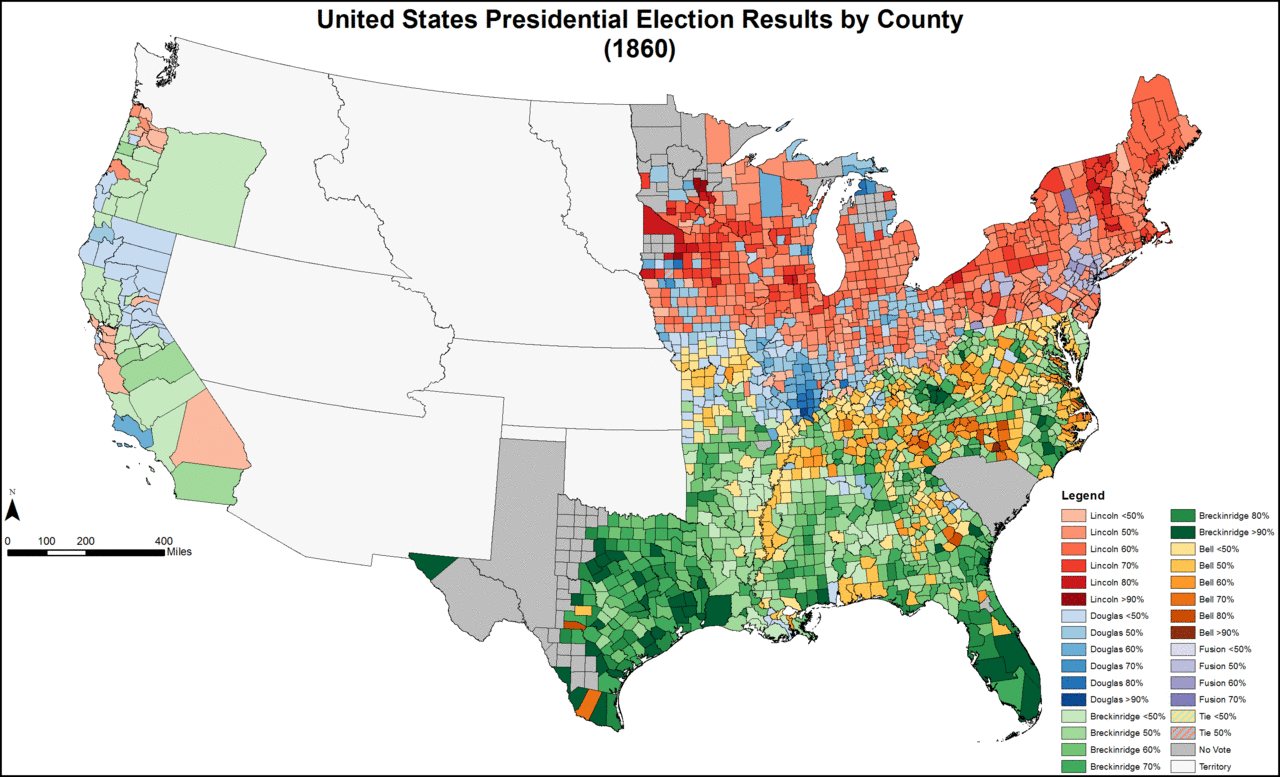
1860 Map From The National Atlas of the United States (now sadly permanently offline)
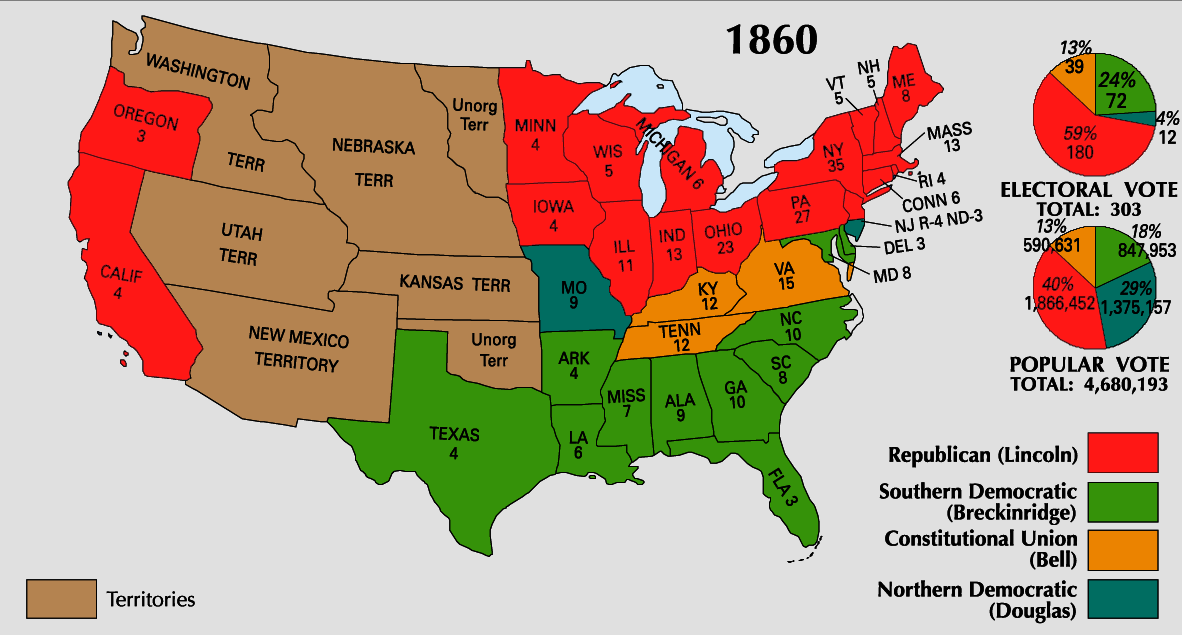
Other US Presidential Election Maps: