
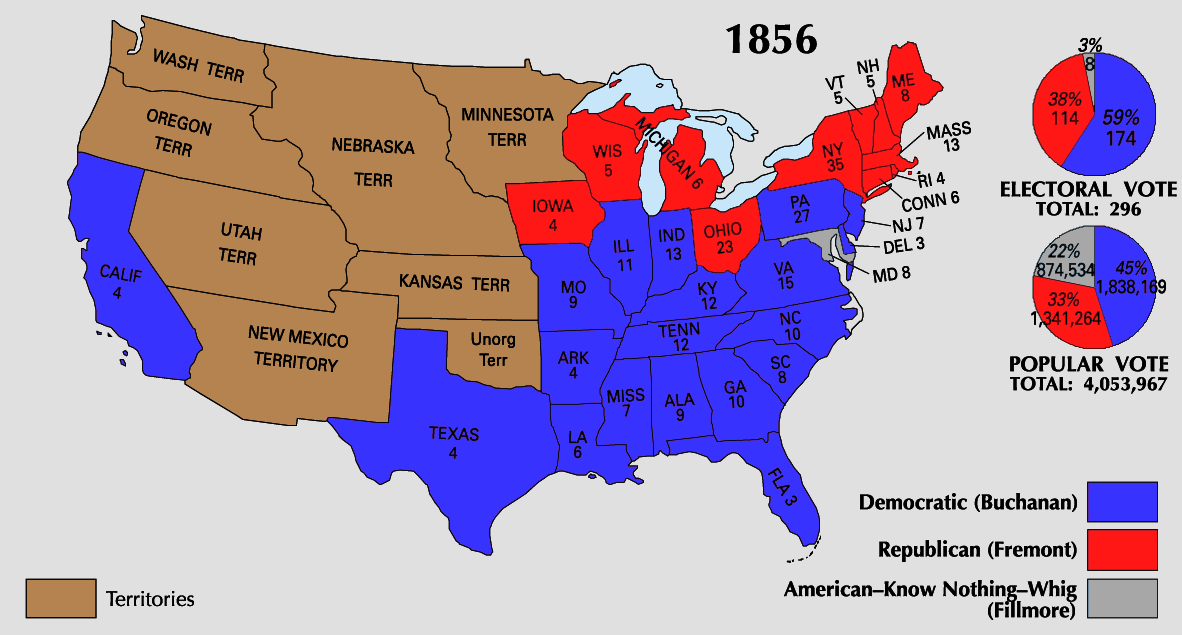
The map above shows the result of the 1856 US presidential election between James Buchanan, John C. Frémont and Millard Fillmore. Turnout for the election was 79.40%.
Here are the key details:
| Winner | Runner-Up | |
|---|---|---|
| Name: | James Buchanan | John C. Frémont |
| Political Party: | Democratic | Republican |
| Home state: | Pennsylvania | California |
| VP Name: | John C. Breckinridge | William L. Dayton |
| States: Won (Out of 31): | 19 | 11 |
| Electoral College Votes (out of 296): | 174 | 114 |
| Percentage of Popular Vote | 45.29% | 33.10% |
| Total Votes | 1,835,140 | 1,342,345 |
| Margin % | 12.20% | – |
| Margin (votes) | 494,472 | – |
| 3rd Place | 4th Place: | |
|---|---|---|
| Name: | Millard Fillmore | NA |
| Political Party | American | NA |
| Electoral College Votes | 8 | NA |
| Number of Votes: | 873,053 | NA |
| Percentage of Popular Vote: | 21.60% | NA |
What were the key issues of the 1856 election?
The 1856 U.S. presidential election was a critical point in American history, as it highlighted deepening sectional tensions over slavery.
It featured three major candidates: James Buchanan (Democratic Party), John C. Frémont (Republican Party), and Millard Fillmore (Know-Nothing Party/American Party).
The primary issues revolved around the expansion of slavery into new territories, states’ rights, and concerns about immigration.
Key Issues and Candidates’ Positions
- Slavery and Its Expansion
- The Kansas-Nebraska Act of 1854 had allowed territories to decide for themselves whether to allow slavery, leading to violent conflicts in Kansas (“Bleeding Kansas”). This made the expansion of slavery the most pressing issue.
- James Buchanan (Democratic Party): Buchanan advocated for popular sovereignty, meaning each territory could decide on slavery through a local vote. He supported the Kansas-Nebraska Act, hoping to keep the Democratic Party united across the North and South by not explicitly opposing slavery. He argued this would preserve the Union and avoid sectional conflict.
- John C. Frémont (Republican Party): The newly formed Republican Party was founded on an anti-slavery platform, particularly against the expansion of slavery into the western territories. Frémont opposed the Kansas-Nebraska Act and promoted “Free Soil” principles, meaning he wanted new territories to remain free states. His slogan, “Free Soil, Free Men, and Frémont,” encapsulated the party’s stance.
- Millard Fillmore (Know-Nothing Party/American Party): Fillmore took a more moderate stance, arguing for compromise and against sectional agitation. Although he did not advocate for the expansion of slavery, he believed that anti-slavery agitation threatened the Union and pushed for enforcement of the Fugitive Slave Act. He opposed the Republican Party’s anti-slavery expansion stance, fearing it would lead to disunion.
- Immigration and Nativism
- The 1850s saw a rise in immigration, especially from Ireland and Germany, leading to tensions over jobs, religion, and cultural assimilation.
- James Buchanan: While his campaign did not focus heavily on immigration, Buchanan avoided overtly nativist rhetoric, aiming to appeal to a broader base.
- John C. Frémont: The Republican Party attracted some anti-immigrant voters due to its emphasis on Northern, Protestant values, though it was not explicitly anti-immigrant.
- Millard Fillmore: Running with the Know-Nothing Party, Fillmore’s platform was strongly nativist, advocating restrictions on immigration and naturalization. His party appealed to voters who felt threatened by the growing Catholic immigrant population and sought to “Americanize” the country.
- Preservation of the Union
- The underlying fear of the election was that increasing tensions over slavery could lead to disunion.
- James Buchanan: He positioned himself as the “Union candidate” and appealed to both Northern and Southern voters as someone who could maintain balance and keep the Union together.
- John C. Frémont: Although committed to preventing the expansion of slavery, Frémont and the Republicans were seen by some as promoting policies that could threaten the South’s place in the Union.
- Millard Fillmore: He cast himself as a candidate for moderation, claiming that both Buchanan’s and Frémont’s platforms would deepen sectional divisions. He argued that only his approach would prevent the Union from breaking apart.
Why did Buchanan win?
His victory was not necessarily because of widespread popularity but rather due to specific strategic advantages and circumstances that favored his candidacy.
Key Reasons for Buchanan’s Victory
- Sectional Divisions and the Fragmentation of Opposition
- The issue of slavery had divided the nation deeply along sectional lines (North vs. South), and Buchanan’s Democratic Party was the only major party with substantial support in both the North and the South. Buchanan’s position on popular sovereignty—allowing territories to decide for themselves on slavery—allowed him to avoid directly opposing slavery, which kept Southern Democrats on his side, while appealing to Northern voters who feared disunion.
- The Republican Party, led by John C. Frémont, was a newly formed coalition primarily focused on anti-slavery expansion. It had strong support in the North but was largely absent in the South. Frémont’s candidacy illustrated the sectional divide, as he was unable to gain any Southern support, limiting his overall appeal.
- Millard Fillmore, running as the Know-Nothing candidate, split the anti-Democratic vote. Although Fillmore’s campaign did not center on slavery as much as on nativism, his presence drew votes from some Northern and border-state voters who were reluctant to support either Buchanan or Frémont, further weakening the opposition.
- Perception of Buchanan as a “Compromise Candidate”
- Buchanan had been out of the country as the U.S. ambassador to the United Kingdom during the highly controversial Kansas-Nebraska Act debates. This distance allowed him to avoid association with the violence in Kansas and other recent political strife. He presented himself as a stable, experienced candidate who could bridge divides and preserve the Union.
- Buchanan’s neutrality, or at least his perceived impartiality, on the Kansas-Nebraska issue helped him appeal to moderate Northerners and Southerners who wanted to avoid further sectional tension.
- Democratic Party’s Strength and Organization
- The Democratic Party had a well-established political machine and strong organization across the country. Democrats had successfully maintained power in previous administrations and were experienced at rallying voters. Their organizational edge helped them mobilize voters effectively, especially in the South and the border states.
- The Democratic Party also framed Buchanan’s candidacy as a vote for unity and stability, contrasting him with Frémont, whom they accused of representing a “sectional party” that would endanger the Union.
- Fear of Disunion and Radicalism
- Many voters, especially in the North, were concerned that the election of a Republican candidate like Frémont, who opposed the expansion of slavery, might provoke the Southern states to secede. Buchanan’s supporters painted Frémont as a dangerous radical whose policies could lead to disunion or even civil war.
- Buchanan positioned himself as the safer, less divisive choice, and many voters opted for him as a way to avoid exacerbating sectional tensions. This appeal to stability and Union preservation resonated with voters who were worried about the potential for national conflict.
- The Appeal of Nativism (Benefiting Buchanan Indirectly)
- Although Fillmore’s Know-Nothing Party focused on nativism and anti-immigrant sentiments, which did not directly help Buchanan, it divided the anti-Democratic vote. Many nativists and former Whigs, especially in the South and in border states, preferred Buchanan to Frémont because Buchanan did not explicitly align himself with either the anti-slavery or pro-slavery factions.
- Buchanan’s more moderate stance on slavery allowed him to draw votes from voters who were not fully aligned with the Know-Nothings or Republicans but feared the consequences of a Frémont administration.
1856 Election Results Map By County

1856 Map From The National Atlas of the United States (now sadly permanently offline)
Other US Presidential Election Maps: