
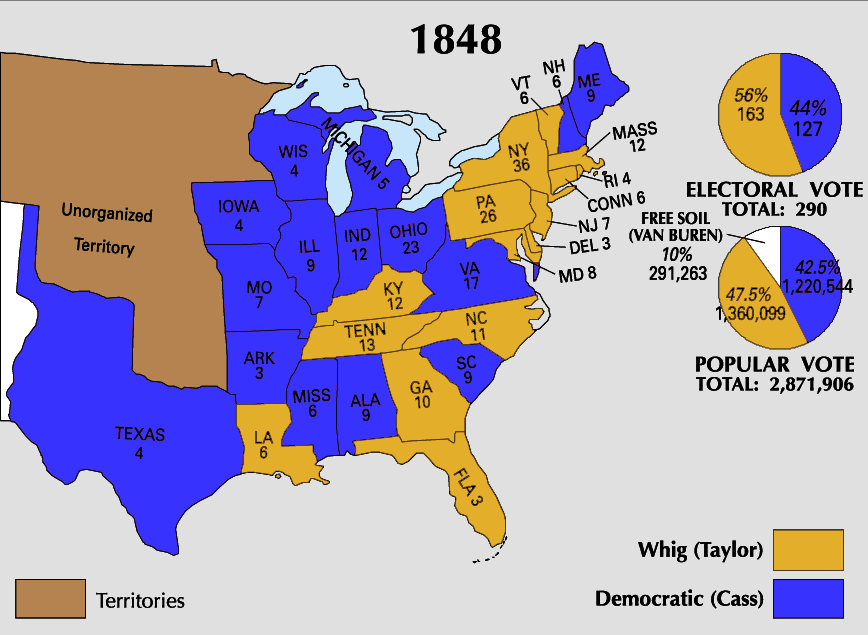
The map above shows the result of the 1848 US presidential election between Zachary Taylor and Lewis Cass. Turnout for the election was 72.80%.
Here are the key details:
| Winner: | Runner-Up: | |
|---|---|---|
| Name: | Zachary Taylor | Lewis Cass |
| Political Party: | Whig | Democratic |
| Home state: | Louisiana | Michigan |
| VP Name: | Millard Filmore | William O. Butler |
| States: Won (Out of 30): | 15 | 15 |
| Electoral College Votes (out of 290): | 163 | 127 |
| Percentage of Popular Vote | 47.28% | 42.50% |
| Total Votes | 1,360,235 | 1,223,460 |
| Margin % | 4.79% | – |
| Margin (votes) | 137,882 | – |
| 3rd Place | 4th Place: | |
|---|---|---|
| Name: | Martin Van Buren | Gerrit Smith |
| Political Party | Free Soil | Liberty |
| Electoral College Votes | 0 | 0 |
| Number of Votes: | 291,501 | 2,545 |
| Percentage of Popular Vote: | 10.10% | 0.09% |
What were the key issues in the 1848 election?
The 1848 U.S. presidential election was notable for the emergence of new political dynamics around the question of slavery, especially its expansion into newly acquired territories.
This election took place shortly after the Mexican-American War, which added vast new lands to the United States.
The key issues centered on slavery, territorial expansion, and broader sectional tensions, which led to the rise of the Free Soil Party alongside the established Whig and Democratic parties.
Here’s a breakdown of the key issues and where each of the three main candidates stood:
1. Slavery in the New Territories
- Zachary Taylor (Whig Party): Taylor was a Southern slaveholder and war hero, but he tried to avoid taking a clear stance on slavery’s expansion, as he hoped to appeal to both Northern and Southern voters. Taylor generally favored allowing new territories to decide the issue themselves through “popular sovereignty,” though he was ambiguous in his position, leading some to believe he might support Free Soil principles.
- Lewis Cass (Democratic Party): Cass was the main proponent of “popular sovereignty,” which proposed that the people in each territory should decide the legality of slavery. He believed this was a fair approach that respected states’ rights, though this stance allowed for the possibility of slavery expanding into new areas.
- Martin Van Buren (Free Soil Party): Van Buren and the Free Soil Party took a strong stance against the expansion of slavery. Their slogan, “Free Soil, Free Speech, Free Labor, and Free Men,” made clear that they opposed any extension of slavery into the new western territories, although they did not advocate for the abolition of slavery in states where it already existed.
2. Territorial Expansion and Sectional Balance
- Zachary Taylor: While Taylor did not have a clearly defined political stance on expansion, his background as a general and his victory in the Mexican-American War boosted his appeal as a national hero, making him a popular candidate for those who favored a strong Union.
- Lewis Cass: Cass was seen as favorable toward expansion and popular sovereignty as a way to maintain sectional balance between free and slave states. However, his stance was vague enough to attract both pro-slavery and anti-slavery Democrats, which somewhat undermined his position.
- Martin Van Buren: Van Buren was opposed to the expansion of slavery but not necessarily to territorial expansion itself, so long as new territories were free from slavery. This position was popular among Northerners who wanted to limit Southern influence and protect “free labor.”
3. Appeal to Different Regional Interests
- Zachary Taylor: Taylor’s attempt to stay neutral on the issue of slavery’s expansion allowed him to appeal broadly across regions. Although he was a Southern slaveholder, he received support from both Northern and Southern Whigs.
- Lewis Cass: His platform was aimed at maintaining Democratic support across the North and South through popular sovereignty, but it lacked strong appeal to the North’s growing anti-slavery sentiment.
- Martin Van Buren: The Free Soil Party, mainly drawing support from Northerners, explicitly opposed the spread of slavery and sought to restrict Southern influence. Though Van Buren had been a Democrat, he ran as a third-party candidate due to the perceived weakness of the Democratic stance on slavery.
Why did Taylor win?
Zachary Taylor’s victory in the 1848 election can be attributed to a few key factors: his personal popularity as a war hero, his ambiguous stance on the divisive issue of slavery, the fragmentation of his opposition, and his appeal across regional lines. Here’s a closer look at how and why Taylor won:
1. Military Reputation and Popularity as a War Hero
Taylor was a celebrated general who gained national fame for his victories during the Mexican-American War, particularly the battles of Palo Alto, Resaca de la Palma, and Buena Vista. His military successes made him a popular figure and a symbol of patriotism, appealing to voters who valued his service and viewed him as a strong leader.
His lack of prior political experience worked in his favor, as he was seen as a straightforward, honest figure who wasn’t tied to the corruption or partisanship often associated with Washington insiders.
2. Ambiguity on Slavery
As a Southern slaveholder, Taylor was acceptable to Southern voters who supported slavery, but he avoided taking a clear stance on the expansion of slavery into the new western territories.
This strategic ambiguity allowed him to appeal to Northern Whigs who were uncomfortable with slavery but willing to support a candidate who didn’t push aggressively for its expansion.
Unlike Democratic candidate Lewis Cass, who advocated for popular sovereignty in new territories, Taylor left his position on this issue open, allowing both Northern and Southern voters to believe he might support their views.
3. Fragmentation of the Democratic Vote
The Democrats were divided on the slavery issue, with their candidate, Lewis Cass, promoting popular sovereignty. While this position aimed to appeal to both pro-slavery and anti-slavery factions within the party, it left neither side fully satisfied.
Many Northern Democrats viewed popular sovereignty as a weak stance that could allow slavery to expand into new territories.
The formation of the Free Soil Party further split the Democratic vote. Former Democratic President Martin Van Buren ran as the Free Soil candidate, explicitly opposing the expansion of slavery.
The Free Soil Party siphoned off a significant portion of the Northern anti-slavery vote that might have otherwise gone to Cass, especially in states like New York, which was pivotal in the electoral college.
4. Regional Appeal and Whig Support in the North and South
Taylor’s Southern roots and status as a slaveholder made him acceptable to Southern Whigs, while his vague stance on slavery expansion made him palatable to Northern Whigs who prioritized unionism and preventing further sectional conflict.
The Whig Party managed to unite behind Taylor more effectively than the Democrats did behind Cass. By emphasizing Taylor’s character and military service rather than taking a firm stand on slavery, the Whigs avoided divisive issues and maintained a broad base of support.
5. Key Swing States and the Electoral College
Taylor’s success in winning key swing states, particularly in the North, was critical. The Free Soil Party’s impact was especially felt in New York, where Van Buren’s campaign took enough votes away from Cass to allow Taylor to win the state’s electoral votes.
This split of the anti-slavery vote between Cass and Van Buren helped Taylor in the electoral college.
Taylor ultimately won with 163 electoral votes to Cass’s 127. Despite not winning a majority of the popular vote (he received just over 47%), Taylor’s support was spread across enough states to secure the electoral college majority.
1848 Election Results Map By County

1848 Map From The National Atlas of the United States (now sadly permanently offline)
Other US Presidential Election Maps: