
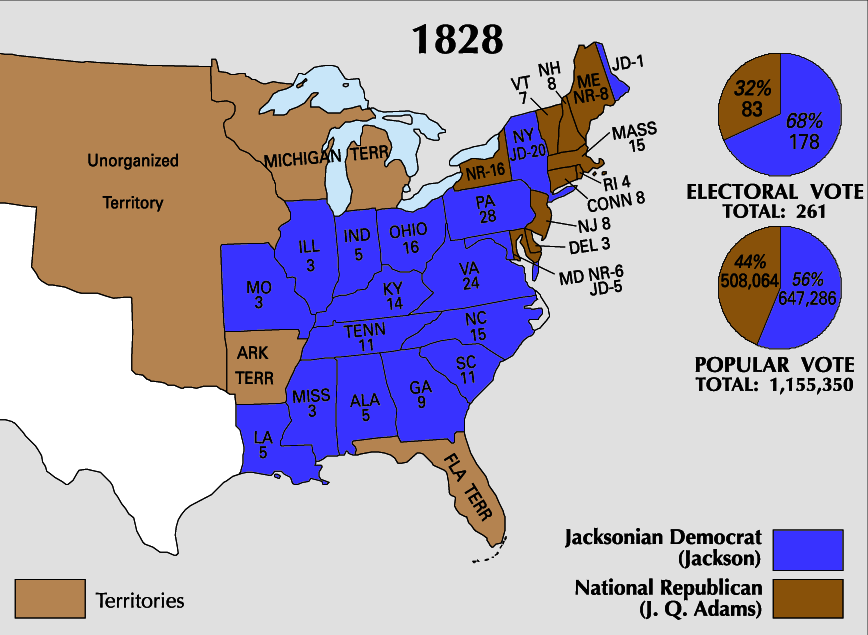
The map above shows the result of the 1828 US presidential election between Andrew Jackson and John Quincy Adams. Turnout for the election was 57.30%.
Here are the key details:
| Winner: | Runner-Up: | |
|---|---|---|
| Name: | Andrew Jackson | John Quincy Adams |
| Political Party: | Democratic | National Republican |
| Home state: | Tennessee | Massachusetts |
| VP Name: | John C. Calhoun | Richard Rush |
| States: Won (Out of 24): | 15 | 9 |
| Electoral College Votes (out of 261): | 178 | 83 |
| Percentage of Popular Vote | 55.93% | 43.60% |
| Total Votes | 642,806 | 500,897 |
| Margin % | 12.25% | – |
| Margin (votes) | 140,839 | – |
5 Facts About the 1828 Election
Here are five interesting facts about the 1828 U.S. Presidential Election:
- The Birth of Modern Political Campaigning: The 1828 election is considered the first “modern” presidential campaign. It saw the use of organized campaign strategies, rallies, slogans, and negative tactics on an unprecedented scale. Both sides employed newspapers and pamphlets to sway public opinion, with Andrew Jackson’s supporters portraying him as a war hero and man of the people, while John Quincy Adams’s campaign emphasized his intellectual and diplomatic credentials.
- Mudslinging and Personal Attacks: The 1828 election was one of the dirtiest in U.S. history, characterized by intense mudslinging. Jackson’s opponents attacked his marriage to Rachel Donelson, claiming it was bigamous because she had not been legally divorced from her first husband at the time of her marriage to Jackson. Conversely, Jackson’s campaign accused Adams of corruption and moral impropriety, including accusations that he had procured a young woman for the Russian czar while serving as a diplomat.
- Rise of Jacksonian Democracy: The 1828 election marked the rise of “Jacksonian democracy,” which emphasized greater participation by the common man in politics and a shift away from the elite political establishment. This was symbolized by Andrew Jackson himself, who was viewed as a populist hero and a champion for the average American, contrasting sharply with Adams, who was seen as an elitist intellectual.
- Record Voter Turnout: The election saw a significant increase in voter turnout compared to previous elections. This was partly due to changes in voting laws that expanded suffrage to more white male citizens by eliminating property requirements in many states. The voter participation rate nearly tripled from the 1824 election, demonstrating the growing democratization of American politics.
- Jackson’s Resounding Victory: Andrew Jackson defeated the incumbent John Quincy Adams in a landslide. Jackson won 178 electoral votes to Adams’s 83 and secured a clear majority of the popular vote, with about 56% of the total. This victory marked the beginning of the Democratic Party’s dominance in U.S. politics and the emergence of the two-party system as it is known today, with Jackson’s supporters forming the core of the new Democratic Party.
What Were the key issues of the 1828 election?
Here’s a summary of the main issues and where each candidate stood:
1. Economic Policy and the “American System”
- John Quincy Adams: As the incumbent, Adams supported Henry Clay’s “American System,” which promoted a high tariff to protect American industries, federal investment in infrastructure (like roads and canals), and a national bank. Adams and his supporters believed these policies would strengthen the nation’s economy and make it more self-sufficient.
- Andrew Jackson: Jackson, in contrast, was suspicious of centralized economic power and saw the national bank and high tariffs as benefiting the wealthy elite at the expense of ordinary Americans. He positioned himself as a populist who would protect the interests of the “common man” over the elite.
2. States’ Rights and Federal Power
- John Quincy Adams: Adams favored a strong federal government that could enact policies benefiting the nation as a whole. His support for federal investments in infrastructure and protective tariffs aligned with this view, even if these policies sometimes disadvantaged Southern states.
- Andrew Jackson: Jackson appealed to states’ rights advocates by criticizing federal overreach and advocating for a limited federal government. His campaign suggested that state sovereignty should play a significant role, though he would later have a complex relationship with this issue during his presidency.
3. Corruption and the “Corrupt Bargain” Allegation
- John Quincy Adams: In 1824, Adams had won the presidency through a controversial decision in the House of Representatives after no candidate secured a majority in the Electoral College. His appointment of Henry Clay as Secretary of State led to accusations of a “corrupt bargain.” Adams denied the allegations but struggled to shake off the label of elitism and corruption.
- Andrew Jackson: Jackson’s campaign emphasized the “corrupt bargain” narrative, presenting Jackson as the candidate who had truly won the 1824 election. His supporters portrayed him as an anti-establishment hero who would break up the corrupt “Washington elite.”
4. Personality and Character Attacks
- John Quincy Adams: Adams’ supporters portrayed Jackson as a violent, uneducated frontiersman unfit for the presidency. They highlighted his involvement in numerous duels and military actions, suggesting he was a “dangerous” choice for the nation.
- Andrew Jackson: Jackson’s campaign, however, portrayed Adams as an out-of-touch aristocrat who used taxpayer money to furnish the White House with “luxuries.” They also alleged that Adams had acted immorally during his time as a diplomat.
5. Sectional Tensions
- John Quincy Adams: Adams’ support was stronger in the Northeast, where industrialists and advocates for infrastructure projects were more receptive to his policies.
- Andrew Jackson: Jackson appealed strongly to the South and the West, where people felt alienated by federal policies favoring Northern industry. His campaign resonated with rural, agricultural communities that valued personal independence and saw Jackson as a protector of their way of life.
Why did Jackson win?
Here are the primary reasons Jackson won:
1. Widespread Populist Appeal
- Jackson was seen as a man of the people, embodying the rugged, self-made image that resonated with ordinary Americans. He appealed to voters who felt ignored by the established political elite and portrayed himself as an outsider who would represent their interests.
- His campaign highlighted his humble beginnings and military heroism, contrasting with John Quincy Adams, who was viewed as an aristocrat connected to the “Washington elite.”
2. Expansion of Voting Rights
- By 1828, voting rights had expanded significantly for white males, as many states had removed or reduced property ownership requirements. This expansion brought in a new wave of voters who were less likely to identify with the traditional, elite-led political structure.
- Jackson’s populist message appealed especially to these newly enfranchised voters in the South and the West, regions where he had strong support.
3. The “Corrupt Bargain” of 1824
- The alleged “corrupt bargain” from the 1824 election played a significant role. When no candidate won an outright majority in the Electoral College, the House of Representatives decided the outcome, ultimately selecting Adams over Jackson. Adams then appointed Henry Clay as Secretary of State, which Jackson’s supporters saw as evidence of a backroom deal.
- Jackson’s campaign emphasized this perceived injustice, arguing that the will of the people had been ignored in 1824, and they could “right the wrong” by voting for him in 1828.
4. Grassroots Campaigning and Modern Political Tactics
- Jackson’s campaign marked a new era in American politics, where direct appeals to voters became crucial. Jackson’s supporters formed one of the first well-organized campaign efforts, including rallies, parades, slogans, and newspaper endorsements.
- His supporters built a strong network of local political clubs, helping to build enthusiasm and promote voter turnout across regions, especially in the West and South. The campaign capitalized on emotions, stirring up anger toward Adams and enthusiasm for Jackson.
5. Anti-Elitism and Resentment Toward Adams’ Policies
- Jackson’s stance against policies like high tariffs and centralized economic power helped him connect with those who felt alienated by Adams’ administration, especially Southerners and Westerners. They saw Jackson as a defender of states’ rights and individual liberties, in contrast to Adams’ support for federal power.
- Many Americans felt that Adams’ “American System” favored Northern industry over the Southern and Western agrarian economies, making Jackson’s limited-government platform more appealing.
6. The Character and Smear Campaign
- The 1828 election saw an unprecedented level of personal attacks on both sides. While Adams’ supporters attacked Jackson as a violent, uneducated frontiersman, Jackson’s campaign focused on depicting Adams as morally corrupt and out of touch with the common American.
- Jackson’s supporters emphasized scandals, such as the claim that Adams had misused public funds for personal luxuries, and cast doubt on his integrity.
7. Jackson’s Image as a Military Hero
- Jackson’s military success, especially his victory at the Battle of New Orleans during the War of 1812, had made him a national hero. His military reputation reinforced his image as a strong, decisive leader who would fight for the average American.
- His popularity as a war hero resonated with Americans who valued strong, patriotic leadership and saw Jackson as a symbol of American strength and resilience.
1828 Election Results Map By County

1828 Map From The National Atlas of the United States (now sadly permanently offline)
Other US Presidential Election Maps: