
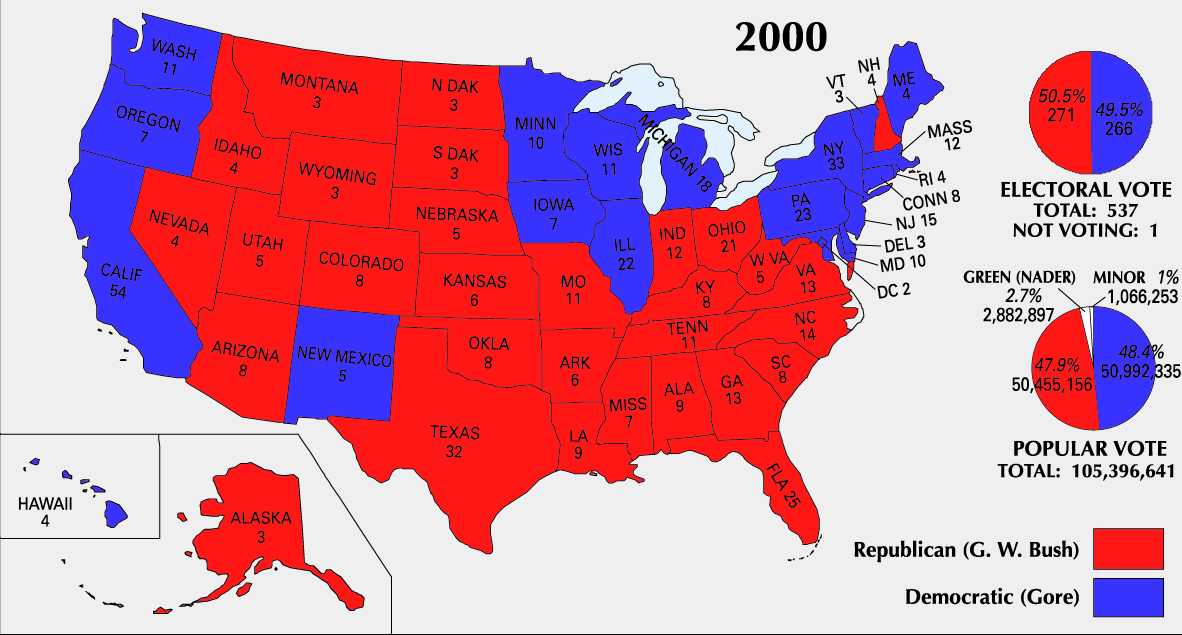
The map above shows the result of the 2000 US presidential election between George W. Bush and Al Gore. Turnout for the election was 54.20%.
Here are the key details:
| Winner: | Runner-Up: | |
|---|---|---|
| Name: | George W. Bush | Al Gore |
| Political Party: | Republican | Democratic |
| Home state: | Texas | Tennessee |
| VP Name: | Dick Cheney | Joe Lieberman |
| States: Won (Out of 51): | 30 | 21 |
| Electoral College Votes (out of 537): | 271 | 266 |
| Percentage of Popular Vote | 47.87% | 48.40% |
| Total Votes | 50,455,156 | 50,999,897 |
| Margin % | −0.51% | – |
| Margin (votes) | −537,179 | – |
Other Parties
| 3rd Place | 4th Place: | |
|---|---|---|
| Name: | Ralph Nader | Pat Buchanan |
| Political Party | Green | Reform |
| Electoral College Votes | 0 | 0 |
| Number of Votes: | 2,882,955 | 448,895 |
| Percentage of Popular Vote: | 2.74% | 0.43% |
Key Issues of The 2000 Election
Here are the key differences between the two candidates:
1. Tax Policy
- Al Gore: Advocated for targeted tax cuts aimed at the middle class, focusing on issues like college tuition and retirement savings. He proposed using the budget surplus primarily for strengthening Social Security, Medicare, and paying down the national debt.
- George W. Bush: Proposed broad-based tax cuts, including a significant reduction in income tax rates across the board. Bush argued that the surplus should be returned to the taxpayers, with a particular emphasis on reducing the top marginal tax rates.
2. Social Security
- Al Gore: Opposed privatization of Social Security and emphasized the need to protect and strengthen the existing system. He proposed creating a “lockbox” to ensure that Social Security funds would not be used for other government spending.
- George W. Bush: Supported the idea of partially privatizing Social Security, allowing younger workers to invest a portion of their Social Security taxes in private accounts. Bush argued this would provide better returns for future retirees.
3. Medicare and Health Care
- Al Gore: Proposed expanding Medicare to include a prescription drug benefit for seniors. He supported incremental health care reforms, including expanding coverage through existing programs like CHIP (Children’s Health Insurance Program).
- George W. Bush: Also supported adding a prescription drug benefit to Medicare but favored a more market-based approach. He advocated for health savings accounts and other measures to increase competition and consumer choice in health care.
4. Education
- Al Gore: Emphasized federal investment in education, advocating for universal preschool, smaller class sizes, and increased funding for school construction and teacher salaries. He supported national standards and testing to improve accountability.
- George W. Bush: Focused on education reform through increased accountability and testing, particularly through the “No Child Left Behind” framework. He promoted school choice, including charter schools and vouchers for private schools, as a way to improve education quality.
5. Environmental Policy
- Al Gore: A strong advocate for environmental protection, Gore focused on combating climate change and promoting renewable energy. He supported the Kyoto Protocol and called for stricter environmental regulations on industries.
- George W. Bush: Took a more business-friendly approach to environmental policy, favoring voluntary measures over strict regulations. Bush was skeptical of international agreements like the Kyoto Protocol, arguing that they would harm the U.S. economy.
6. Foreign Policy
- Al Gore: Advocated for a continuation of the Clinton administration’s policies, emphasizing diplomacy, international alliances, and multilateral cooperation. He supported humanitarian interventions and a strong but cautious use of American military power.
- George W. Bush: Promoted a more unilateral approach, emphasizing American sovereignty and a reduced reliance on international institutions. He advocated for a stronger military and was critical of what he saw as overreach in nation-building efforts.
7. Government Role and Philosophy
- Al Gore: Viewed government as a positive force for change and advocated for active government intervention in areas like health care, education, and environmental protection. He supported programs that aimed to reduce income inequality and provide a social safety net.
- George W. Bush: Emphasized a limited government philosophy, advocating for smaller government, lower taxes, and less regulation. Bush promoted the idea of “compassionate conservatism,” which included faith-based initiatives and welfare reform that emphasized personal responsibility.
8. Abortion
- Al Gore: Pro-choice, supported a woman’s right to choose, and opposed efforts to overturn Roe v. Wade. He advocated for maintaining and expanding access to reproductive health services.
- George W. Bush: Pro-life, supported restrictions on abortion and favored appointing Supreme Court justices who might overturn Roe v. Wade. Bush supported measures like parental notification and a ban on partial-birth abortions.
9. Campaign Finance Reform
- Al Gore: Supported stronger campaign finance reform, including limits on “soft money” contributions to political parties and greater transparency in campaign funding.
- George W. Bush: While Bush expressed support for some reforms, he was less enthusiastic about stringent regulations on campaign finance. He favored measures that would allow for more private sector involvement in campaigns.
10. Gun Control
- Al Gore: Supported stronger gun control measures, including mandatory background checks at gun shows, licensing of new handgun buyers, and mandatory child safety locks on guns.
- George W. Bush: Favored less restrictive gun control policies, emphasizing enforcement of existing laws rather than creating new regulations. He supported the Second Amendment and opposed many of the additional restrictions proposed by Gore.
Why did Bush Win?
George W. Bush won the 2000 U.S. Presidential Election through a combination of factors, most notably the outcome of the contentious Florida recount and the U.S. Supreme Court’s decision in Bush v. Gore. Here’s a breakdown of how he secured the presidency:
1. Electoral College Victory
- Bush won the Electoral College with 271 votes to Al Gore’s 266, even though Gore won the national popular vote by approximately 500,000 votes.
- The key to Bush’s victory was winning Florida’s 25 electoral votes, which were the subject of intense scrutiny and legal battles.
2. Florida’s Decisive Role
- Florida’s vote count was extremely close, initially showing Bush ahead by just a few hundred votes.
- The narrow margin triggered an automatic recount under Florida law.
- The recount process was highly contentious, involving disputes over “hanging chads” and other voting irregularities.
3. Supreme Court Decision
- The U.S. Supreme Court played a crucial role in the outcome. The Court agreed to hear the case Bush v. Gore, which addressed the methods and standards used in the Florida recount.
- On December 12, 2000, the Supreme Court ruled in a 5-4 decision to stop the recount, arguing that differing standards for recounting votes in different counties violated the Equal Protection Clause.
- This decision effectively ended the recount and allowed Florida to certify its results in favor of Bush, giving him the necessary electoral votes to win.
4. Republican Strategy and Ground Game
- The Bush campaign effectively mobilized voters in key battleground states, including Florida.
- The Republican Party’s legal and political strategy during the recount was aggressive and well-coordinated, helping Bush maintain his lead in Florida.
5. Ralph Nader’s Third-Party Run
- Ralph Nader’s candidacy as the Green Party nominee drew votes away from Al Gore, particularly in Florida and other swing states.
- Some analysts believe that if Nader had not run, Gore might have won Florida and the election, as the margin was so slim.
6. Controversial Voting Issues in Florida
- Problems with ballot design (notably the “butterfly ballot” in Palm Beach County), voter purges, and allegations of voter suppression disproportionately affecting minorities likely influenced the outcome in Florida.
- Despite these controversies, the certified results favored Bush, and the Supreme Court’s ruling solidified his victory.
In summary, Bush won the 2000 election due to a combination of winning the Electoral College, the contentious outcome in Florida, and the Supreme Court’s intervention, despite losing the national popular vote.
2000 Election Results Map By County

2000 Map From The National Atlas of the United States (now sadly permanently offline)
Other US Presidential Election Maps: