
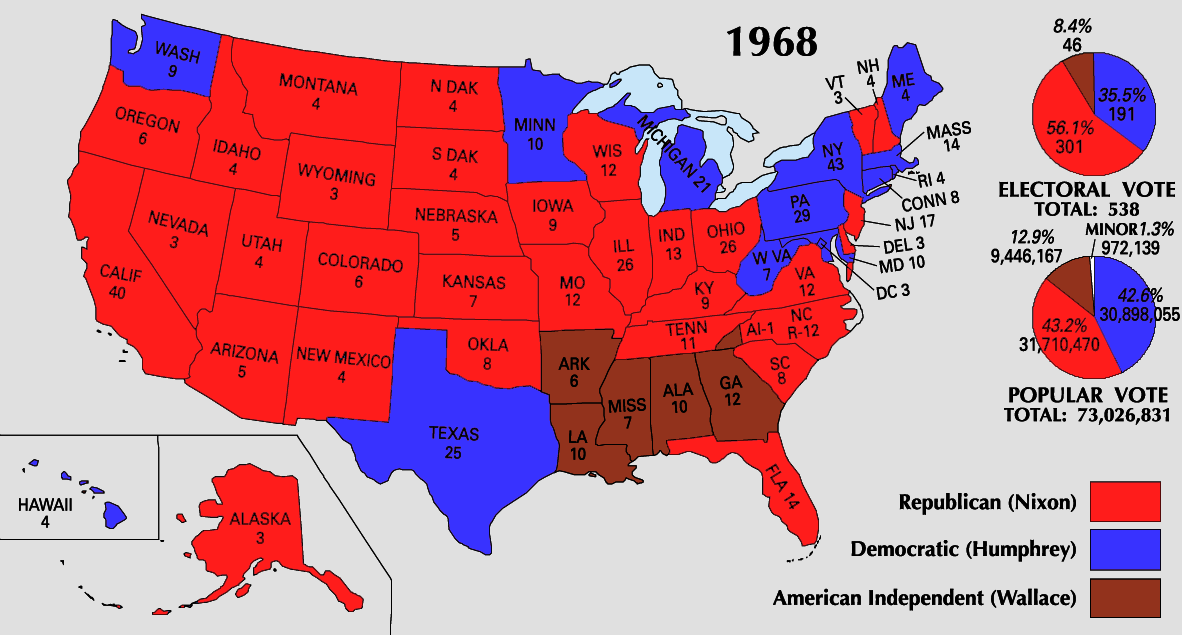
The map above shows the result of the 1968 US presidential election between Richard Nixon and Hubert Humphrey. Turnout for the election was 62.50%.
Here are the key details:
| Winner: | Runner-Up: | |
|---|---|---|
| Name: | Richard Nixon | Hubert Humphrey |
| Political Party: | Republican | Democratic |
| Home state: | New York | Minnesota |
| VP Name: | Spiro Agnew | Edmund Muskie |
| States: Won (Out of 51): | 32 | 13 |
| Electoral College Votes (out of 538): | 301 | 191 |
| Percentage of Popular Vote | 43.42% | 42.70% |
| Total Votes | 31,783,783 | 31,271,839 |
| Margin % | 0.70% | – |
| Margin (votes) | 511,944 | – |
| 3rd Place | 4th Place: | |
|---|---|---|
| Name: | George Wallace | NA |
| Political Party | American Independent | NA |
| Electoral College Votes | 46 | NA |
| Number of Votes: | 9,901,118 | NA |
| Percentage of Popular Vote: | 13.50% | NA |
Key Issues of The 1968 Election
Here are the key issues of the election and how each candidate differed:
1. Vietnam War
Richard Nixon: Nixon campaigned on a platform of achieving “peace with honor” in Vietnam. He suggested that he had a secret plan to end the war but was vague about the details. His approach was to gradually withdraw American troops while expanding the training of South Vietnamese forces, a policy that would later be known as “Vietnamization.”
Hubert Humphrey: Humphrey, as Vice President under Lyndon B. Johnson, was initially associated with Johnson’s war policies, which were unpopular. However, he later called for a halt to the bombing of North Vietnam and a negotiated settlement, trying to distance himself from Johnson’s more hawkish stance. His late pivot to a more peace-oriented position aimed to appeal to the anti-war segment of the Democratic base.
George Wallace: Wallace took a more hardline stance on Vietnam, advocating for an all-out effort to win the war. He criticized both major parties for being too lenient and for their handling of the conflict. His rhetoric appealed to voters who wanted a more aggressive approach.
2. Civil Rights and Social Unrest
Richard Nixon: Nixon appealed to what he termed the “silent majority”—Americans who were disillusioned with the civil rights protests and urban riots. He advocated for “law and order” and emphasized the need to control social unrest. Nixon’s approach was aimed at white suburban and working-class voters who were concerned about the rapid social changes of the 1960s.
Hubert Humphrey: A longtime advocate of civil rights, Humphrey supported federal enforcement of civil rights laws and promoted social welfare programs to address systemic inequalities. However, his campaign struggled to unite the liberal and more conservative factions within the Democratic Party, particularly after the chaotic Democratic National Convention in Chicago.
George Wallace: Wallace was a staunch segregationist who opposed federal civil rights legislation and appealed to white voters in the South and working-class whites in the North. His platform was explicitly against the civil rights movement, and he used inflammatory rhetoric to attract voters who felt alienated by the rapid social changes of the time.
3. Law and Order
Richard Nixon: Nixon’s “law and order” platform was central to his campaign. He positioned himself as the candidate who could restore peace and stability amid the protests, riots, and rising crime rates of the 1960s. His messaging resonated with voters worried about crime and social disorder.
Hubert Humphrey: While Humphrey also recognized the need for order, his focus was more on addressing the root causes of unrest, such as poverty and discrimination, through social programs. He aimed to balance maintaining law and order with promoting civil rights and social justice.
George Wallace: Wallace took a more extreme stance, presenting himself as the ultimate “law and order” candidate. He often used divisive language and appealed to voters who were frustrated with both the Republican and Democratic Parties’ perceived failure to maintain control.
4. Economic Issues
Richard Nixon: Nixon emphasized economic stability and advocated for policies that would reduce inflation and stimulate growth. He appealed to middle-class Americans by promising to curb government spending and reduce the national debt.
Hubert Humphrey: Humphrey promoted a continuation of the Great Society programs initiated under Johnson, focusing on social welfare, healthcare, and education. His approach aimed to address economic inequality through expanded government intervention.
George Wallace: Wallace’s economic rhetoric was populist and focused on criticizing the elite and “big government.” He capitalized on resentment against federal programs perceived to benefit minority groups at the expense of white working-class Americans.
Why did Nixon win?
Richard Nixon won the 1968 U.S. presidential election due to a combination of several factors, including his effective campaign strategy, the divisions within the Democratic Party, the appeal of his message to key voter groups, and the broader political and social climate of the time. Here are the key reasons why Nixon won:
1. Appeal to the “Silent Majority”
Nixon effectively appealed to what he called the “silent majority”—a substantial segment of Americans who were disillusioned with the social upheaval of the 1960s, including anti-war protests, civil rights demonstrations, and urban riots. These voters, mostly white, middle-class Americans, were concerned about the perceived decline in law and order, rising crime rates, and rapid social changes. Nixon’s promise of “law and order” and a return to traditional values resonated strongly with this group.
2. Divisions Within the Democratic Party
The Democratic Party was deeply divided in 1968, particularly over the Vietnam War. The chaos of the Democratic National Convention in Chicago, marked by violent clashes between anti-war protesters and police, highlighted the party’s internal conflicts. Hubert Humphrey, the Democratic nominee, was associated with President Lyndon B. Johnson’s unpopular Vietnam policies, and his late shift toward advocating for peace failed to fully unite the party or energize anti-war voters. Many liberal and anti-war Democrats were alienated, reducing Humphrey’s ability to consolidate a broad base of support.
3. Third-Party Candidacy of George Wallace
George Wallace, the candidate of the American Independent Party, ran on a platform of segregation, states’ rights, and a hardline stance on law and order. His campaign siphoned off a significant number of votes from Southern states and from white working-class voters in the North who might otherwise have supported Humphrey. Wallace’s presence in the race split the Democratic vote, particularly among more conservative voters, which indirectly benefited Nixon.
4. Nixon’s Ambiguity and Moderation on Key Issues
Nixon managed to position himself as a moderate candidate who could bridge the growing divide in American society. On the Vietnam War, he promised “peace with honor,” a vague formulation that allowed him to appeal to both those who wanted an end to the war and those who opposed a hasty withdrawal. His lack of specific policy details allowed a wide range of voters to project their desires onto his campaign.
5. Effective Use of Media and Campaign Strategy
Nixon’s campaign was highly organized and made effective use of television and media to convey his message. He presented himself as a calm, experienced leader who could restore stability to a nation in turmoil. His campaign ads and appearances emphasized themes of peace, stability, and order, contrasting sharply with the chaos and divisions associated with the Democratic Party.
6. Backlash Against the Johnson Administration
The 1968 election was, in many ways, a referendum on the Johnson administration, which was deeply unpopular due to the Vietnam War and domestic unrest. Nixon successfully distanced himself from Johnson’s policies, while Humphrey struggled to separate himself from the administration’s failures. Many voters saw Nixon as the best alternative to continue American leadership without the same level of turmoil.
7. The Promise of Change Without Radicalism
Nixon’s campaign presented him as the candidate of change, but without the radicalism associated with both the New Left (as seen in the anti-war protests) and the right-wing extremism of George Wallace. This balanced approach appealed to a broad cross-section of voters who desired a change in leadership but were wary of more extreme alternatives.
8. Late-Stage Surge by Hubert Humphrey
While Humphrey did experience a surge in support late in the campaign after distancing himself from Johnson’s war policies, it wasn’t enough to overcome the lead that Nixon had built. The shift came too late to fully capitalize on the growing discontent with the war and bring back the alienated segments of the Democratic base.
1968 Election Results Map By County

1968 Map From The National Atlas of the United States (now sadly permanently offline)
Other US Presidential Election Maps: