
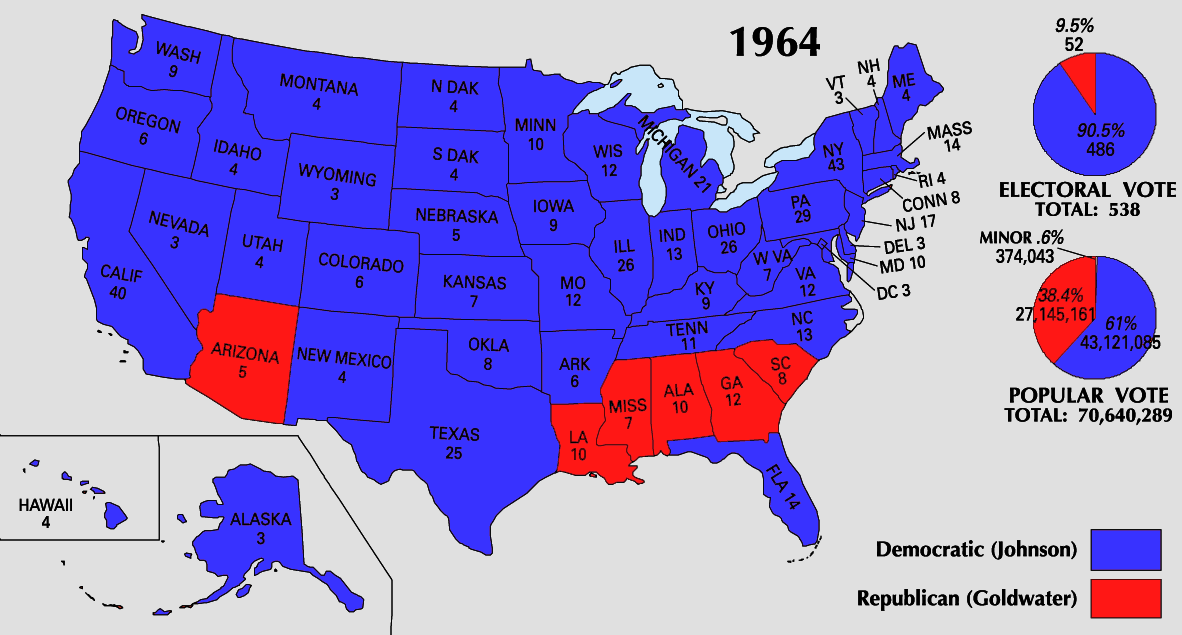
The map above shows the result of the 1964 US presidential election between Lyndon B. Johnson and Barry Goldwater. Turnout for the election was 62.80%.
Here are the key details:
| Winner: | Runner-Up: | |
|---|---|---|
| Name: | Lyndon B. Johnson | Barry Goldwater |
| Political Party: | Democratic | Republican |
| Home state: | Texas | Arizona |
| VP Name: | Hubert Humphrey | William E. Miller |
| States: Won (Out of 51): | 44 | 6 |
| Electoral College Votes (out of 538): | 486 | 52 |
| Percentage of Popular Vote | 61.05% | 38.50% |
| Total Votes | 43,127,041 | 27,175,754 |
| Margin % | 22.58% | – |
| Margin (votes) | 15,951,287 | – |
| 3rd Place | 4th Place: | |
|---|---|---|
| Name: | Eric Hass | Clifton DeBerry |
| Political Party | Socialist Labor | Socialist Workers |
| Electoral College Votes | 0 | 0 |
| Number of Votes: | 45,189 | 32,706 |
| Percentage of Popular Vote: | 0.06% | 0.05% |
Key Issues of The 1964 Election
Several key issues defined the campaign, and the candidates differed sharply on their positions:
1. Civil Rights
Lyndon B. Johnson: Johnson strongly supported civil rights legislation, including the Civil Rights Act of 1964, which he signed into law. This landmark act aimed to end segregation in public places and banned employment discrimination on the basis of race, color, religion, sex, or national origin. Johnson’s campaign was seen as advocating for racial equality and federal enforcement of civil rights.
Barry Goldwater: Goldwater voted against the Civil Rights Act of 1964, arguing that while he supported civil rights in principle, he believed that parts of the Act infringed upon states’ rights and individual liberties. His stance appealed to many conservative voters, especially in the South, but alienated moderate Republicans and African American voters.
2. Role of Government and Economic Policy
Lyndon B. Johnson: Johnson promoted his vision of the “Great Society,” a set of domestic programs aimed at eliminating poverty and racial injustice. His policies included Medicare and Medicaid, federal aid to education, and the War on Poverty programs. He believed in a more active federal government role in economic and social affairs.
Barry Goldwater: Goldwater advocated for a reduction in the size of the federal government, lower taxes, and decreased government spending. He was a staunch proponent of free-market economics and a critic of New Deal and Great Society programs, which he viewed as steps toward socialism. His campaign emphasized individual freedom and limited government intervention in the economy.
3. Cold War and Foreign Policy
Lyndon B. Johnson: Johnson pursued a policy of containment against communism but was more measured in his approach compared to Goldwater. He was committed to the ongoing strategy in Vietnam and sought to avoid escalation while maintaining U.S. commitments. Johnson’s campaign portrayed him as a steady leader who would keep the country safe.
Barry Goldwater: Goldwater was known for his hawkish stance on the Cold War. He advocated for a more aggressive military posture against the Soviet Union and communism. His rhetoric suggested a willingness to use nuclear weapons if necessary, which caused concern among many Americans about the potential for war.
The Johnson campaign capitalized on this fear with the famous “Daisy” ad, which implied that Goldwater’s election might lead to nuclear war.
4. Social Issues and Conservatism vs. Liberalism
Lyndon B. Johnson: Johnson represented the liberal wing of the Democratic Party, emphasizing social welfare, civil rights, and a more progressive agenda. His campaign sought to appeal to a broad coalition, including African Americans, labor unions, and liberal intellectuals.
Barry Goldwater: Goldwater’s candidacy marked a shift to the right for the Republican Party, emphasizing conservative principles. He opposed federal welfare programs, supported states’ rights, and called for a more traditional interpretation of the Constitution. His campaign was the beginning of the modern conservative movement within the Republican Party.
Why did Johnson win such a big landslide?
Lyndon B. Johnson’s landslide victory in the 1964 United States presidential election can be attributed to several key factors, including his ability to build a broad coalition, effective campaign strategy, the unpopularity of his opponent’s positions, and the overall political climate of the time.
Here are the primary reasons for Johnson’s overwhelming win:
1. Public Sympathy and Continuity After Kennedy’s Assassination
Johnson became president after the assassination of President John F. Kennedy in November 1963. He was able to capitalize on the national mood of grief and desire for continuity.
Many voters viewed Johnson as the rightful successor to Kennedy’s vision and policies. His “Let Us Continue” campaign slogan emphasized stability, progress, and the continuation of Kennedy’s legacy, which resonated with a nation still mourning.
2. Civil Rights and the Great Society Agenda
Johnson had strong support from African American voters and progressive whites due to his strong advocacy for civil rights. His signing of the Civil Rights Act of 1964 was a bold move that aligned him with the fight against racial segregation and discrimination.
Moreover, his “Great Society” vision aimed to reduce poverty and racial injustice, improve education, and expand social programs. These policies appealed to a wide range of voters, including liberals, urban dwellers, minorities, and labor unions.
3. Goldwater’s Extremist Image
Barry Goldwater was perceived by many voters as an extremist, particularly because of his hawkish foreign policy positions and his opposition to popular New Deal and civil rights programs.
His rhetoric, which sometimes suggested a willingness to use nuclear weapons, created fear among the electorate.
The Johnson campaign famously exploited this fear with the “Daisy” television ad, which portrayed Goldwater as a dangerous choice who could lead the country into nuclear war. This advertisement became one of the most iconic and controversial in American political history, contributing significantly to Goldwater’s negative image.
4. Democratic Coalition and Regional Shifts
Johnson’s Democratic Party was able to maintain a strong coalition of voters that included labor unions, African Americans, urban voters, intellectuals, and the traditional New Deal coalition. At the same time, Goldwater’s conservatism alienated many moderate Republicans and independents.
While Goldwater’s candidacy marked the beginning of a political realignment in the South toward the Republican Party, it was too early for this shift to yield significant electoral gains. Johnson still managed to hold onto several southern states, though Goldwater carried a few deep southern states due to his opposition to civil rights legislation.
5. Economic Prosperity and a Stable Domestic Environment
The U.S. economy was in relatively good shape in 1964, with low unemployment and stable economic growth. Johnson was able to capitalize on this economic stability by promising continued prosperity.
His emphasis on government programs that could help those who had not yet benefited from economic growth further broadened his appeal.
6. Goldwater’s Ideological Purity and Limited Appeal
Goldwater’s campaign focused heavily on conservative ideology, including a strong emphasis on states’ rights, a reduction in the size of government, and a robust anti-communist foreign policy stance.
While this appealed to conservative voters, it did not resonate with the broader electorate, especially in a country that was still in the midst of a post-war liberal consensus. His proposals to drastically cut government programs and his critique of the Civil Rights Act alienated moderate Republicans, independents, and many centrists.
7. Effective Campaign Strategy by Johnson
Johnson’s campaign effectively painted him as the safe, stable, and experienced choice, contrasting Goldwater’s perceived recklessness. The “Daisy” ad, although aired only once, became a symbol of Johnson’s portrayal of Goldwater as a dangerous extremist. Johnson’s campaign also highlighted his experience and ability to lead, emphasizing his role in passing major legislation like the Civil Rights Act.
1964 Election Results Map By County

1964 Map From The National Atlas of the United States (now sadly permanently offline)
Other US Presidential Election Maps: