
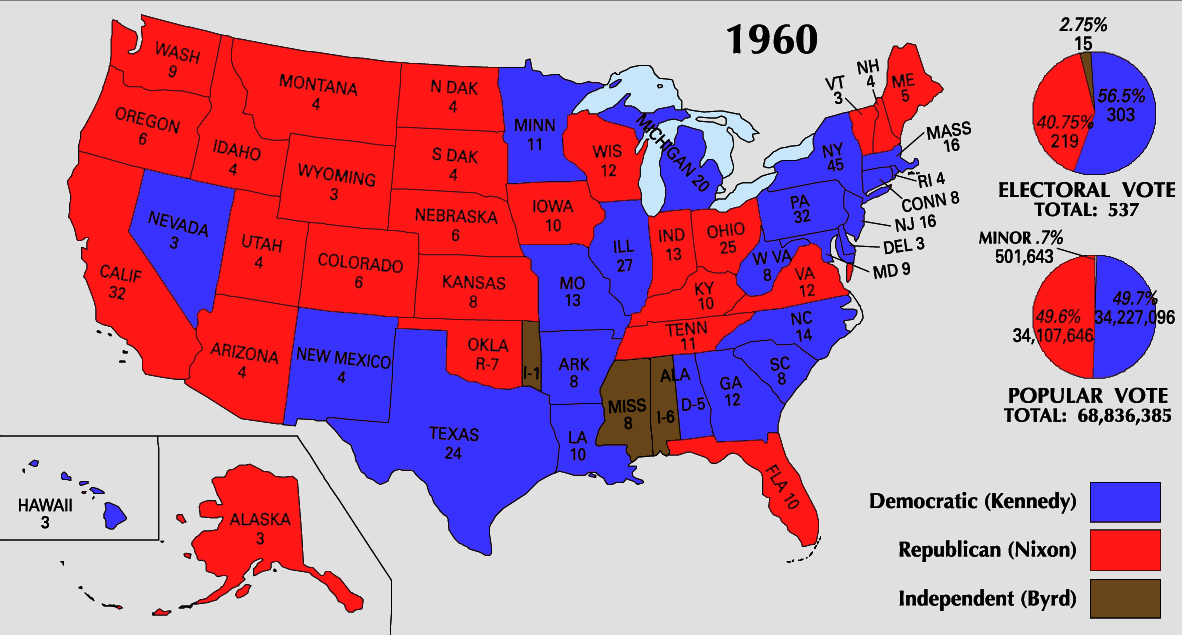
The map above shows the result of the 1960 US presidential election between John F. Kennedy and Richard Nixon. Turnout for the election was 63.80%.
Here are the key details:
| Winner: | Runner-Up: | |
|---|---|---|
| Name: | John F. Kennedy | Richard Nixon |
| Political Party: | Democratic | Republican |
| Home state: | Massachusetts | California |
| VP Name: | Lyndon B. Johnson | Henry Cabot Lodge Jr. |
| States: Won (Out of 50): | 22 | 26 |
| Electoral College Votes (out of 537): | 303 | 219 |
| Percentage of Popular Vote | 49.72% | 49.60% |
| Total Votes | 34,220,984 | 34,108,157 |
| Margin % | 0.17% | – |
| Margin (votes) | 112,827 | – |
| 3rd Place | 4th Place: | |
|---|---|---|
| Name: | Harry F. Byrd | unpledged electors |
| Political Party | Democratic | Democratic |
| Electoral College Votes | 15 | 0 |
| Number of Votes: | NA | 286,359 |
| Percentage of Popular Vote: | NA | 0.42% |
Key Issues of The 1960 Election
Below is an overview of the main issues and where each candidate stood on them:
1. Cold War and National Security
The Cold War and the threat posed by the Soviet Union were central to the election.
- Kennedy: He accused the Eisenhower-Nixon administration of allowing a “missile gap,” suggesting the U.S. had fallen behind the Soviets in nuclear capabilities. Kennedy argued for stronger defense programs and a more assertive foreign policy to counter the spread of communism.
- Nixon: As Vice President under Eisenhower, Nixon defended the administration’s record, claiming that the U.S. was still ahead of the Soviet Union in military power. He emphasized experience in foreign affairs and argued for continuity in the fight against communism.
2. The Economy
The late 1950s saw a recession, and the state of the economy was a major issue.
- Kennedy: He proposed stimulating the economy with government spending and tax cuts to spur growth and reduce unemployment. His campaign promised a “New Frontier” of opportunity and innovation, aiming to increase economic investment and raise the standard of living for all Americans.
- Nixon: Nixon promoted a balanced budget and fiscal conservatism, arguing that the Eisenhower administration had put the country on the right economic path. He opposed large-scale spending programs, favoring more limited government intervention in the economy.
3. Civil Rights
Civil rights had become an increasingly important issue due to the rise of the Civil Rights Movement and key events like sit-ins and protests.
- Kennedy: While cautious at first, Kennedy took a stronger stance as the campaign progressed. His phone call to Coretta Scott King after Martin Luther King Jr. was arrested helped him gain African American support. He expressed support for civil rights, though specifics of his plans were somewhat vague.
- Nixon: Nixon had supported civil rights legislation during his time as Vice President, but during the campaign, he was less vocal about it, perhaps to avoid alienating Southern voters. Nixon’s civil rights platform was more about gradual progress within the existing system.
4. Religion
Kennedy’s Catholic faith was a significant issue, as no Catholic had ever been elected president, and some voters feared he would be influenced by the Vatican.
- Kennedy: He confronted the issue directly, famously stating in a speech to Protestant ministers in Houston that he believed in the separation of church and state and that his decisions would be based on national interests, not religious dictates.
- Nixon: Nixon downplayed the religious issue and avoided making it a focal point of his campaign, trusting that public suspicion of Kennedy’s Catholicism would work in his favor without him having to explicitly bring it up.
5. Televised Debates
The 1960 election was the first to feature nationally televised debates, and these played a crucial role in shaping public perceptions of the candidates.
- Kennedy: In the first debate, Kennedy appeared youthful, calm, and confident, which helped him make a strong impression, particularly with television viewers.
- Nixon: Nixon, recovering from an illness and refusing makeup for the debate, appeared tired and less vibrant. This visual disadvantage hurt him among television viewers, though radio listeners felt Nixon had performed better on substance.
6. Cuba and Latin America
The recent Cuban Revolution, which brought Fidel Castro to power, was a significant issue, as it raised concerns about the spread of communism close to U.S. shores.
- Kennedy: Kennedy criticized the Eisenhower-Nixon administration for not doing enough to prevent the communist takeover in Cuba. He argued for a more aggressive policy to stop the spread of communism in Latin America.
- Nixon: Nixon defended the administration’s handling of Cuba but avoided detailing any major new policies. He stressed the importance of patience and careful diplomacy rather than drastic action.
7. Space Race
The U.S. and the Soviet Union were locked in a competition for space dominance, with the Soviets’ launch of Sputnik raising fears that the U.S. was falling behind.
- Kennedy: Kennedy used the space race as part of his broader argument about American decline and called for greater investment in science and technology. He argued that the U.S. needed to take the lead in space exploration.
- Nixon: Nixon touted the administration’s achievements in space and defended the pace of the space program. He advocated for continued progress but did not present any dramatic new proposals.
8. Youth vs. Experience
A central theme in the election was the contrast between Kennedy’s youth and Nixon’s experience.
- Kennedy: At 43 years old, Kennedy represented a younger generation and presented himself as a dynamic, forward-looking candidate. His “New Frontier” theme promised innovation, progress, and bold new ideas to tackle the challenges of the 1960s.
- Nixon: Nixon, although only a few years older, emphasized his experience, particularly his eight years as Vice President. He portrayed himself as more seasoned and capable of handling the complex global challenges facing the U.S., especially in the Cold War.
Summary of Candidate Stances
| Issue | John F. Kennedy | Richard Nixon |
|---|---|---|
| Cold War | Accused Eisenhower-Nixon administration of allowing a “missile gap”; called for stronger defense and a more assertive stance against communism. | Defended administration’s record; emphasized continuity in Cold War strategy. |
| Economy | Advocated government spending, tax cuts, and investment in social programs to stimulate growth. | Supported fiscal responsibility and balanced budgets. |
| Civil Rights | Took a pro-civil rights stance; gained significant support from African Americans. | Supported civil rights but was more cautious to avoid alienating Southern voters. |
| Religion | Defended separation of church and state, addressed concerns about his Catholicism directly. | Avoided making religion a focal point, letting public concern about Kennedy’s faith play out. |
| Cuba/Latin America | Criticized administration for allowing communist influences so close to the U.S.; called for more aggressive policies. | Defended administration’s handling of Cuba and advocated for patience in foreign affairs. |
| Space Race | Promised greater investment in the space program to regain U.S. leadership. | Defended the progress made but did not propose dramatic new initiatives. |
| Leadership Style | Presented as youthful, energetic, and ready to lead a new generation. | Emphasized experience, particularly his foreign policy credentials. |
Kennedy’s emphasis on change, combined with his strong debate performances, helped him edge out Nixon in one of the closest elections in U.S. history.
Why did Kennedy win?
- Televised Debates: The first-ever televised presidential debates were a critical factor in Kennedy’s victory. Kennedy, young and charismatic, came across as confident and composed on television, while Nixon appeared tired and less vibrant. This visual contrast worked in Kennedy’s favor, especially since TV was a rapidly growing medium and many voters based their impressions on what they saw. The debates helped Kennedy gain the edge he needed in what was otherwise a very close race.
- Campaign Organization and Strategy: Kennedy’s campaign was exceptionally well-organized, with strong grassroots efforts, particularly in key states. His team focused on swing states and organized a massive get-out-the-vote effort. Kennedy’s ability to energize voters, especially young people and African Americans, was crucial to securing his narrow victory.
- African American Vote: Kennedy’s phone call to Coretta Scott King after Martin Luther King Jr. was arrested for participating in a protest was a turning point. It won him significant support from African American voters, particularly in key Northern states. The civil rights movement was gaining momentum, and Kennedy’s stance, although moderate, was seen as more favorable to the movement than Nixon’s.
- Youth and Charisma: Kennedy represented a new generation of leadership. At 43, he was the youngest person ever elected president. His “New Frontier” vision appealed to voters looking for change after eight years of Eisenhower’s presidency. Kennedy projected optimism, energy, and a sense of forward momentum, which resonated with many Americans, especially younger voters.
- Economic Concerns: The country had recently experienced a recession, and Kennedy’s message about the need for government intervention and economic stimulus resonated with voters worried about job security and economic growth. While Nixon stressed continuity, Kennedy’s promise of a new approach to invigorate the economy was attractive to many voters.
- Catholic Vote: Although Kennedy’s Catholicism was initially seen as a potential obstacle, he effectively neutralized it with his speech to the Greater Houston Ministerial Association, where he firmly stated his commitment to the separation of church and state. His Catholic faith ultimately helped him with the growing Catholic population in key states, including New York and Illinois.
- Key States and Electoral College: Kennedy’s success in large, populous states like Illinois and Texas played a decisive role in his victory. His running mate, Lyndon B. Johnson, a Texan with strong ties to Southern Democrats, helped secure Texas, while Kennedy’s own efforts, combined with effective political machines (like that of Chicago’s Mayor Richard Daley), helped win Illinois by a razor-thin margin. Winning these key states was crucial in the close electoral college outcome.
What Was Going On With Harry F. Byrd?
Harry F. Byrd, a segregationist Senator from Virginia, did not run an active campaign in 1960, but he became a recipient of electoral votes as a third-party candidate. His candidacy reflected the deep divisions within the Democratic Party, particularly over the issue of civil rights, which alienated many Southern Democrats.
- Southern Resistance to Civil Rights: Byrd’s presence on the electoral ballot was largely symbolic of Southern dissatisfaction with the Democratic Party’s increasingly liberal stance on civil rights. Although Kennedy’s civil rights proposals were moderate compared to later Democratic policies, they were too progressive for many Southern Democrats. The Dixiecrats (Southern segregationists) saw Byrd as a way to express their opposition to Kennedy and the Democratic Party’s civil rights platform without supporting Nixon.
- Electoral Vote Strategy: Byrd ended up receiving 15 electoral votes, even though he was not on the ballot in most states. This happened because several Southern electors, called “unpledged electors,” refused to vote for Kennedy, whom they saw as too liberal on civil rights. These electors instead cast their ballots for Byrd as a protest against Kennedy’s nomination and his growing support for civil rights reforms.
- Impact of Byrd’s Candidacy: Byrd’s role did not change the outcome of the election, but it underscored the growing fracture within the Democratic Party over civil rights, a divide that would continue to grow throughout the 1960s. Byrd’s presence showed that the traditional Southern Democratic base was increasingly alienated from the national party, setting the stage for the future realignment of Southern voters toward the Republican Party.
1960 Election Results Map By County

Map From The National Atlas of the United States (now sadly permanently offline)
Other US Presidential Election Maps: