
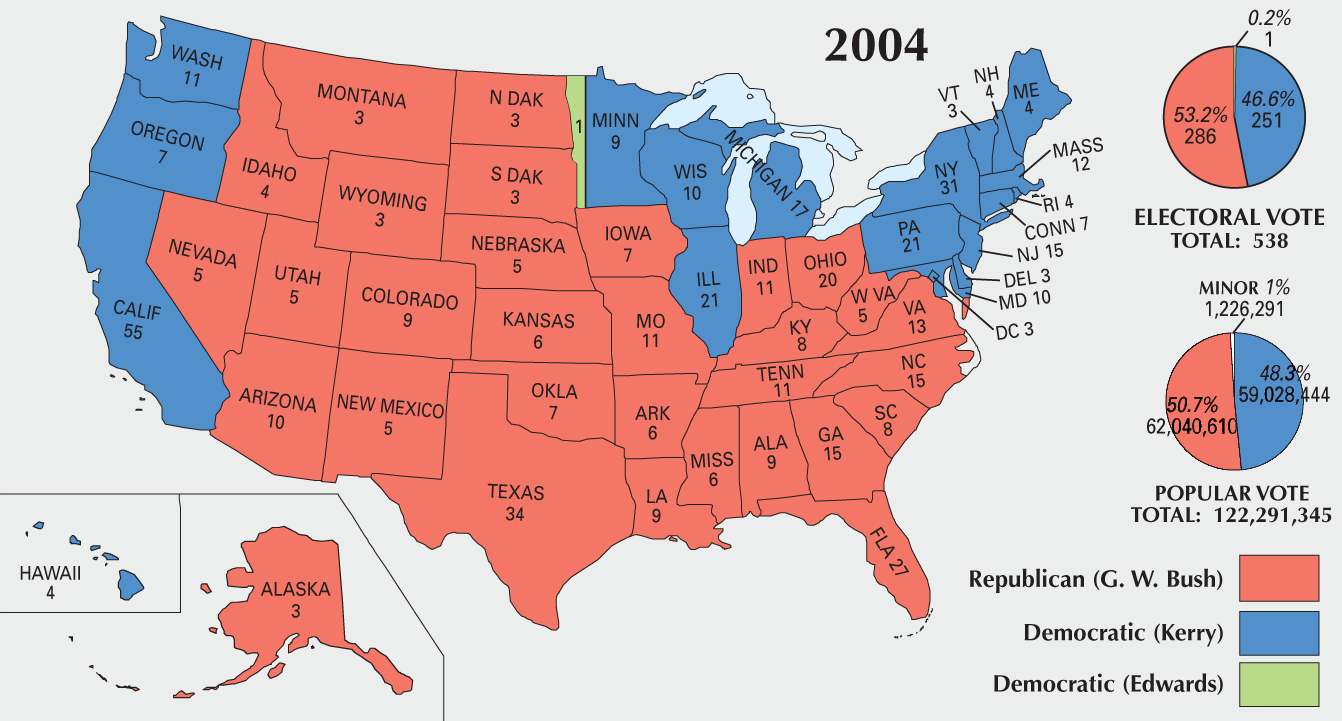
The map above shows the result of the 2004 US presidential election between George W. Bush and John Kerry. Turnout for the election was 60.10%.
Here are the key details:
| Winner: | Runner-Up: | |
|---|---|---|
| Name: | George W. Bush | John Kerry |
| Political Party: | Republican | Democratic |
| Home state: | Texas | Massachusetts |
| VP Name: | Dick Cheney | John Edwards |
| States: Won (Out of 51): | 31 | 20 |
| Electoral College Votes (out of 538): | 286 | 251 |
| Percentage of Popular Vote | 50.73% | 48.30% |
| Total Votes | 62,040,610 | 59,028,444 |
| Margin % | 2.46% | – |
| Margin (votes) | 3,012,171 | – |
Other Parties:
| 3rd Place | 4th Place: | |
|---|---|---|
| Name: | Ralph Nader | Michael Badnarik |
| Political Party | Independent | Libertarian |
| Electoral College Votes | 0 | 0 |
| Number of Votes: | 465,650 | 397,265 |
| Percentage of Popular Vote: | 0.38% | 0.32% |
Key Issues of The 2004 Election
The main issues included:
1. Terrorism and National Security
- The election occurred in the aftermath of the September 11, 2001, terrorist attacks and during the ongoing War on Terror. National security was a dominant theme, with President George W. Bush emphasizing his leadership in the fight against terrorism and the invasion of Iraq. The Bush campaign argued that his administration’s policies were essential for protecting the U.S. from future attacks.
2. The Iraq War
- The decision to invade Iraq in 2003 was highly controversial and became a central issue in the election. The war’s justification, particularly the claims about weapons of mass destruction (WMDs) that were never found, and the ongoing violence and instability in Iraq, were significant points of debate. Bush defended the invasion as necessary for U.S. security, while his opponent, Senator John Kerry, criticized the administration’s handling of the war, though he initially voted to authorize the invasion.
3. The Economy
- Economic issues, including job creation, outsourcing, the federal budget deficit, and tax cuts, were important to voters. Bush’s administration had implemented tax cuts that were a point of contention. Supporters argued they stimulated the economy, while critics claimed they disproportionately benefited the wealthy and increased the deficit.
4. Health Care
- Health care was a significant issue, with debates over rising costs, access to care, and the future of Medicare. Kerry proposed expanding access to health care and criticized Bush for not doing enough to address the issue. The affordability and availability of prescription drugs, especially for seniors, were also hot topics.
5. Social Issues
- Social issues, including same-sex marriage, abortion, and stem cell research, played a role in the campaign. The Bush administration and many Republicans supported a federal constitutional amendment to ban same-sex marriage, which energized conservative voters. Kerry opposed such an amendment but maintained that he believed marriage should be between a man and a woman.
6. Leadership and Character
- Leadership and personal character were also central to the election. Bush’s campaign portrayed him as a decisive leader in times of crisis, while Kerry was depicted by critics as inconsistent, particularly regarding his voting record on the Iraq War. The term “flip-flopper” became associated with Kerry due to his perceived changes in position on key issues.
7. The Role of the Media and Swift Boat Veterans
- The media played a crucial role in shaping public perceptions. The “Swift Boat Veterans for Truth,” a group that questioned Kerry’s military service in Vietnam, ran ads that became highly controversial and were seen as damaging to Kerry’s campaign.
Why Did Bush Win?
George W. Bush’s victory in the 2004 U.S. presidential election can be attributed to several factors that played a significant role in swaying voters and securing his re-election:
1. Perceived Strong Leadership on National Security
- Post-9/11 Context: The election took place in the shadow of the September 11, 2001, terrorist attacks. Bush’s campaign successfully positioned him as a strong leader who had taken decisive actions to protect the country, including the invasions of Afghanistan and Iraq.
- War on Terror: Many voters believed that Bush was the better candidate to handle national security and the ongoing War on Terror. His campaign emphasized that his leadership was crucial to keeping America safe, and this message resonated with a significant portion of the electorate.
2. Support for the Iraq War
- Justification for the War: Despite controversies surrounding the Iraq War, particularly the failure to find weapons of mass destruction, many Americans still supported the war or felt that it was necessary for national security. Bush’s firm stance on continuing the war effort and not showing weakness appealed to voters who prioritized security.
- Criticism of Kerry’s Position: The Bush campaign effectively portrayed John Kerry as inconsistent on the Iraq War, branding him as a “flip-flopper” for his changing positions. This undermined Kerry’s credibility on national security, a key issue in the election.
3. Cultural and Social Issues
- Mobilization of Conservative Voters: Bush’s stance on social issues, particularly his support for a federal constitutional amendment to ban same-sex marriage, galvanized conservative voters, especially in key swing states. His positions on abortion, stem cell research, and other social issues also helped solidify his base.
- Turnout among Evangelical Christians: The Bush campaign successfully mobilized evangelical Christians and other socially conservative groups, who turned out in large numbers to support him, especially in states where these voters were a critical bloc.
4. Economic Messaging
- Tax Cuts and Economic Recovery: Bush’s tax cuts were a central part of his economic message. His administration argued that the tax cuts had helped the economy recover from the 2001 recession and created jobs. While the economy was not the dominant issue, the message that Bush’s policies were leading to a recovery helped him with voters concerned about economic stability.
- Deficit Concerns: Although the growing federal deficit was a concern, many voters were more focused on the immediate economic recovery and were willing to overlook the long-term fiscal implications.
5. Campaign Strategy and Tactics
- Effective Campaigning: The Bush campaign was well-organized and focused on turning out the vote in key battleground states. They used sophisticated microtargeting techniques to identify and mobilize potential supporters, particularly in states like Ohio, which proved crucial to the election’s outcome.
- Swift Boat Ads and Attack Campaigns: The “Swift Boat Veterans for Truth” ads, which attacked Kerry’s military service record, were controversial but effective in raising doubts about Kerry’s character and leadership. Although these ads were not directly affiliated with the Bush campaign, they contributed to the overall negative perception of Kerry.
6. Voter Turnout and Polarization
- High Voter Turnout: The 2004 election saw a very high voter turnout, particularly among groups that traditionally supported Bush, such as evangelical Christians and rural voters. This was partly due to the intense polarization of the electorate, which motivated both sides to turn out in large numbers.
- Narrow Margin in Key States: Bush won crucial swing states, including Ohio, by narrow margins. His victory in Ohio, in particular, secured his re-election, as it provided the necessary electoral votes to surpass the 270 needed to win.
7. Incumbency Advantage
- Presidential Incumbency: As the sitting president, Bush had the advantage of incumbency, which included greater media exposure and the ability to use the presidential platform to influence public opinion. His administration’s handling of national events, such as the war on terrorism, allowed him to frame the election around his strengths.
2004 Election Results Map By County

2004 Map From The National Atlas of the United States (now sadly permanently offline)
Other US Presidential Election Maps: